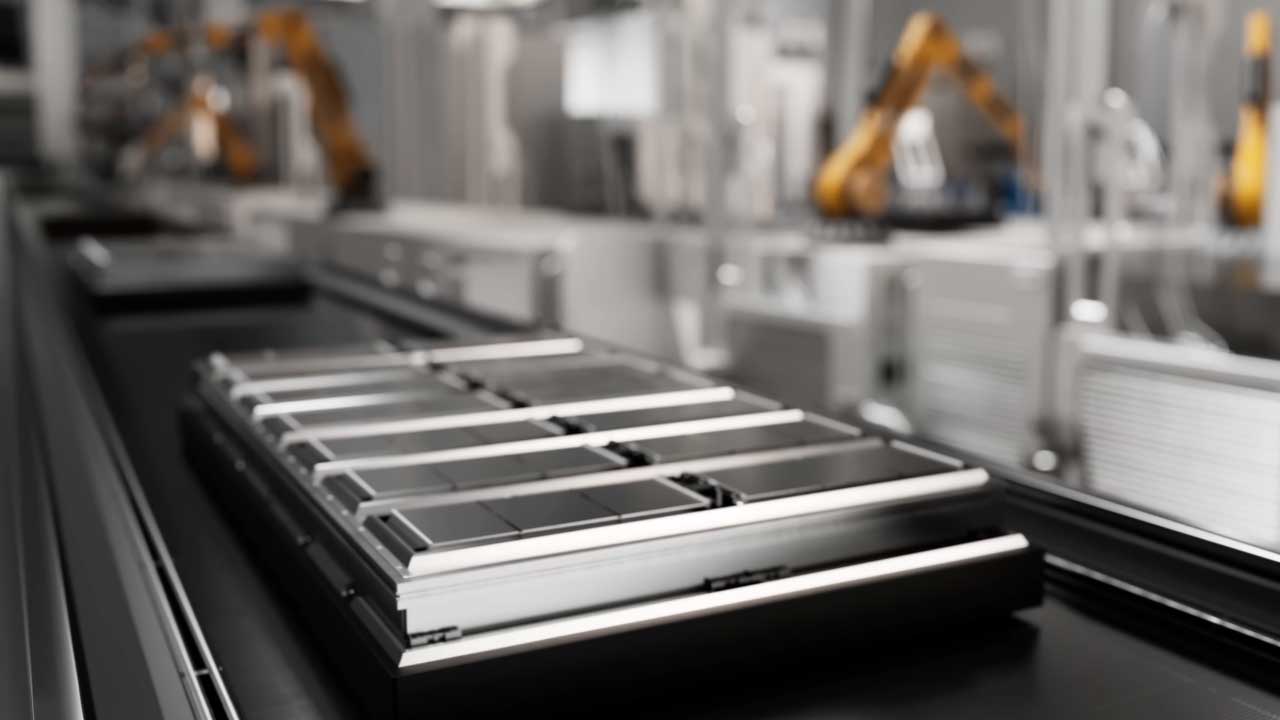

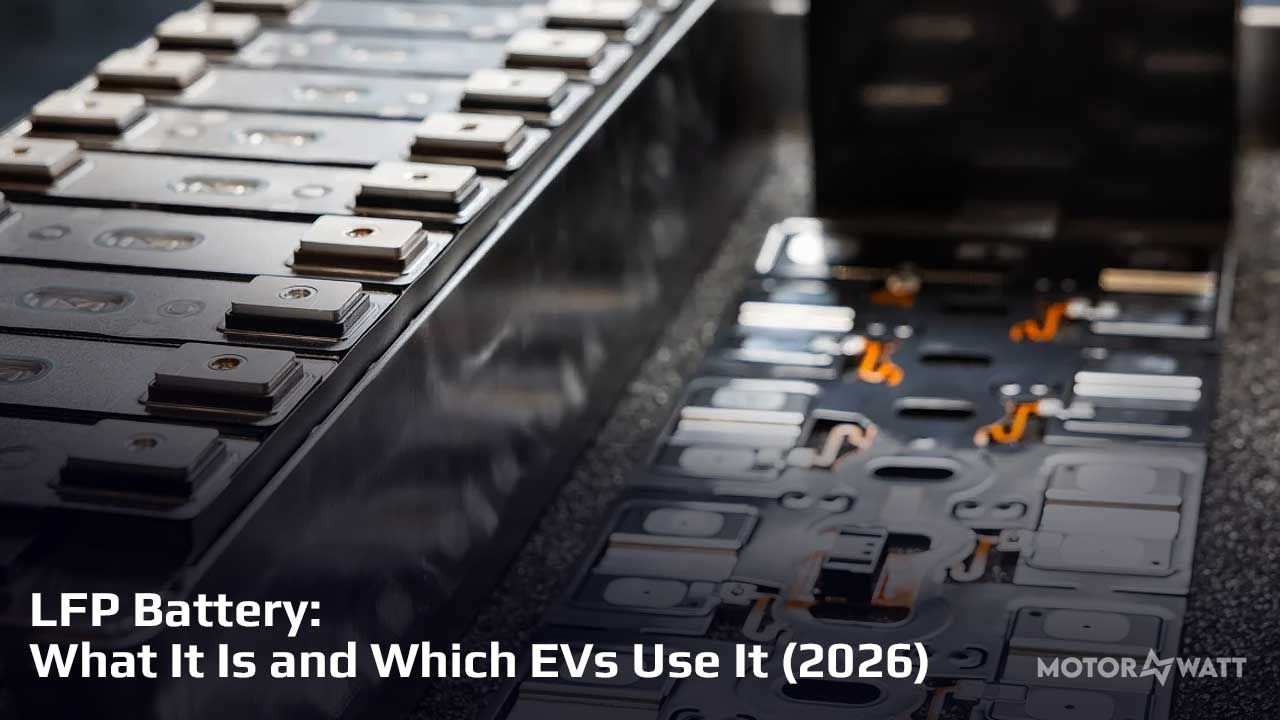
An LFP battery swaps the nickel and cobalt in a typical EV battery for iron and phosphate. You get a cheaper, longer-lived pack, and you give up some range per pound. Over half the EV batteries built worldwide in 2025 were LFP, according to the IEA. In the US you can count the models on one hand.
What is an LFP battery?
An LFP battery is a lithium-ion battery whose cathode, the positive electrode, is made of lithium iron phosphate instead of nickel-based materials. The graphite anode and electrolyte work like any other lithium-ion cell. The result costs less, survives more charge cycles and runs cooler, but stores less energy per kilogram.
The cathode is where the money goes. NMC batteries rely on nickel, manganese and cobalt. LFP uses iron and phosphate, which cost far less and avoid cobalt mining entirely.
LFP vs LiFePO4: one chemistry, two names
You'll see "LiFePO4" on home, RV and solar batteries and "LFP" on car spec sheets. They're the same thing. LiFePO4 is the chemical formula; LFP is the shorthand. If you're shopping for a 12V camper battery, this article isn't for you. If you're shopping for an EV, keep reading.
Is an LFP battery a lithium-ion battery?
Yes. People often ask whether LFP is "better than lithium," but LFP is one kind of lithium-ion battery. The useful comparison is LFP against the nickel-based chemistries (NMC and NCA) that power most long-range EVs.
Which EVs use LFP batteries in the US?
|
Model
|
Trim
|
Battery
|
EPA range
|
Status (October 2026)
|
|---|---|---|---|---|
|
2027 Chevrolet Bolt
|
||||
|
2026 Ford Mustang Mach-E
|
||||
|
Rivian Commercial Van
|
||||
|
Rivian R1S / R1T
|
||||
|
Tesla Model 3 RWD
|
||||
|
Ford midsize electric pickup
|
That's the whole list, and it's short. LFP was close to three-quarters of China's EV battery demand in 2024, but the IEA reports that its share in the US almost halved in 2025, from an already low base. Tariffs and tax-credit rules on Chinese-made cells explain most of that, because almost all LFP cells are still made in China.
EPA range of the LFP models you can buy new or used:
EPA-rated range in miles. Data: Ford, InsideEVs, Electrek (2025–2026).
Every one of these is an entry trim or a work vehicle. Automakers use LFP where cost matters more than maximum range. Full specs for each model are in the Motorwatt EV database.
Which Teslas have LFP batteries?
None of the new Teslas built for the US market. Electrek's August 2026 review of the US Model Y Standard found a 69.5 kWh pack of NCA cells, not LFP. Tesla does make LFP cells in Nevada, but that output goes to its Megapack grid-storage product.
The LFP Teslas on US roads are mostly Model 3 RWD cars from the 2022 to 2024 model years, which used CATL cells from China and were rated at 272 miles. They're worth a look on the used market for the reasons below. For what Tesla sells new, see our rundown of Tesla's 2026 lineup.
Rivian, Ford and Chevrolet models with LFP packs
Ford has gone furthest. The 2026 Mach-E Standard Range uses a 73 kWh pack rated by Ford at 260 miles (RWD) and 240 miles (AWD), and InsideEVs and dealer listings identify it as LFP. In 2026 Ford also started making its own LFP cells in Marshall, Michigan, under a technology license from CATL, for a midsize electric pickup due in 2027 at around $30,000.
GM's 2027 Bolt matters more to most buyers. It starts at $28,995 and uses a 65 kWh LFP pack with cells imported from China at launch. InsideEVs reports it charges at up to 150 kW, and Electrek says Edmunds got 290 miles out of it in real-world testing, beating its EPA rating. LFP is a big reason the cheapest electric cars keep getting cheaper.
Rivian went the other way. It offered a 92.5 kWh LFP Standard pack on the 2025 R1S and R1T, then dropped that pack for 2026 to make room for the R2.
Upcoming EVs with LFP batteries
Ford's 2027 pickup is the only one with a confirmed date. Beyond it, the US story depends on domestic cell production. Tesla's Nevada plant and Ford's Michigan plant are a start. Whether they lead to more affordable LFP cars is the thing to watch over the next two model years.
LFP battery pros and cons for EV owners
Advantages: cycle life, safety and cost
LFP cells are typically rated for 2,000 to 6,000+ full charge cycles. NMC cells sit around 1,000 to 2,500, according to EV Infrastructure News. Even the low end of the LFP range is more than most drivers will use, so EV battery degradation is less of a worry with this chemistry.
Safety is the second advantage. LFP doesn't reach thermal runaway until around 270°C, compared with roughly 150 to 210°C for NMC. A fire is still possible. It's much harder to start.
Then there's price. The IEA found LFP packs were more than 40% cheaper per kWh than NMC on average in 2025. That saving is how GM can sell a Bolt for under $29,000.
Downsides: energy density and cold weather
What is the downside of an LFP battery? Mainly these:
- Lower energy density: about 90–205 Wh/kg at the cell level, vs 150–300 Wh/kg for NMC
- More range loss in deep cold: 30% or more below freezing, vs roughly 15–25% for NMC
- Harder for the car to estimate state of charge, because the voltage barely changes across most of the charge range
- Slower DC fast charging on a cold pack unless the car preconditions it first
Density and cold-weather figures are from EV Infrastructure News' August 2026 comparison. The density gap shrinks at the pack level (about 125–145 Wh/kg vs 140–180 Wh/kg), partly because LFP packs often use simpler cell-to-pack designs, as the new Bolt does. Cold is the real catch. If you live with long, hard winters, test-drive the car in winter before you buy, and read up on how EV range is tested so the window-sticker number doesn't mislead you.
How to charge an LFP battery (yes, to 100%)
This is the part that surprises people coming from NMC cars. With LFP, charging to 100% is fine, and often recommended.
Tesla's owner's manual for LFP cars says to keep the charge limit at 100% even for daily use and to fully charge at least once a week. The reason is calibration. LFP's flat voltage curve makes it hard for the car to estimate how much charge is left, and a full charge gives the battery management system a fixed reference point. Rivian's own documents described its LFP pack as able to charge from 0 to 100% without degradation worries.
A simple LFP charging routine
- Set your home charge limit to 100%, or follow your manufacturer's guidance if it differs.
- Do at least one full charge a week so the range estimate stays accurate.
- In winter, precondition the battery before DC fast charging.
- Don't leave the car sitting at 0% for long periods.
Want to know what that full charge costs? Our EV charging cost calculator works it out for your electricity rate.
How to tell if your Tesla has an LFP battery
Open Controls > Software > Additional Vehicle Information. The "High Voltage Battery type" line says Lithium Iron Phosphate if you have one. There's a quicker tell too: on LFP cars the charge-limit slider is a plain 0–100% bar, without the separate "Daily" and "Trip" markers that nickel-based Teslas show.
LFP vs NMC: quick comparison
|
LFP
|
NMC
|
|
|---|---|---|
|
Cathode materials
|
||
|
Cell energy density
|
||
|
Rated cycle life
|
||
|
Thermal runaway onset
|
||
|
Cold-weather range loss (below 0°C)
|
||
|
Recommended daily charge
|
||
|
Relative pack cost (2025)
|
Most long-range US EVs still use a nickel chemistry, including every new US-built Tesla (NCA) and the long-range trims of the cars above, because nickel packs fit more range into the same weight. For the full breakdown, including cost trends and home storage, read our LFP vs NMC battery comparison.
LFP battery FAQ
- Why did Tesla stop selling LFP Teslas in the US?
The LFP Model 3 RWD used Chinese-made cells. When stricter battery-sourcing rules for the $7,500 federal tax credit took effect in 2024, it lost eligibility, and Tesla dropped it in October 2024. Tesla's Nevada LFP plant currently supplies Megapack, not cars.
- Does BYD use LFP or NMC batteries?
LFP. BYD's Blade battery is a lithium iron phosphate design, and in 2021 BYD said all of its battery-electric models would use it as standard. BYD passenger cars aren't sold in the US.
- Are LFP batteries safer than other lithium-ion batteries?
They're more thermally stable, with thermal runaway starting around 270°C versus roughly 150–210°C for NMC. Fires are less likely, but no lithium-ion battery is fireproof.
- How long do LFP batteries last?
LFP cells are typically rated for 2,000 to 6,000+ full cycles, against about 1,000 to 2,500 for NMC. Most cars will be scrapped for other reasons long before the pack wears out. If you're budgeting for the worst case anyway, see our guide to EV battery replacement cost.
- Who makes LFP batteries?
Chinese firms dominate. CATL and BYD are the two biggest battery makers, with about 43% and 22% of China's 2025 EV battery installations across all chemistries. In the US, Ford makes LFP cells in Michigan under a CATL license, and Tesla makes them in Nevada for grid storage.
Should you look for an LFP battery in your next EV?
If most of your driving is commuting and you charge at home, yes. You can charge to full every night without worrying about the battery, and the car costs less up front. If you regularly drive long highway stretches in a cold climate, a bigger nickel-based pack will serve you better. Right now the new-car LFP shortlist in the US is the Bolt and the Mach-E Standard Range, with used Model 3 RWD and R1 Standard cars as alternatives. We expect that list to grow once Michigan-made cells reach showrooms in 2027.
Related Video