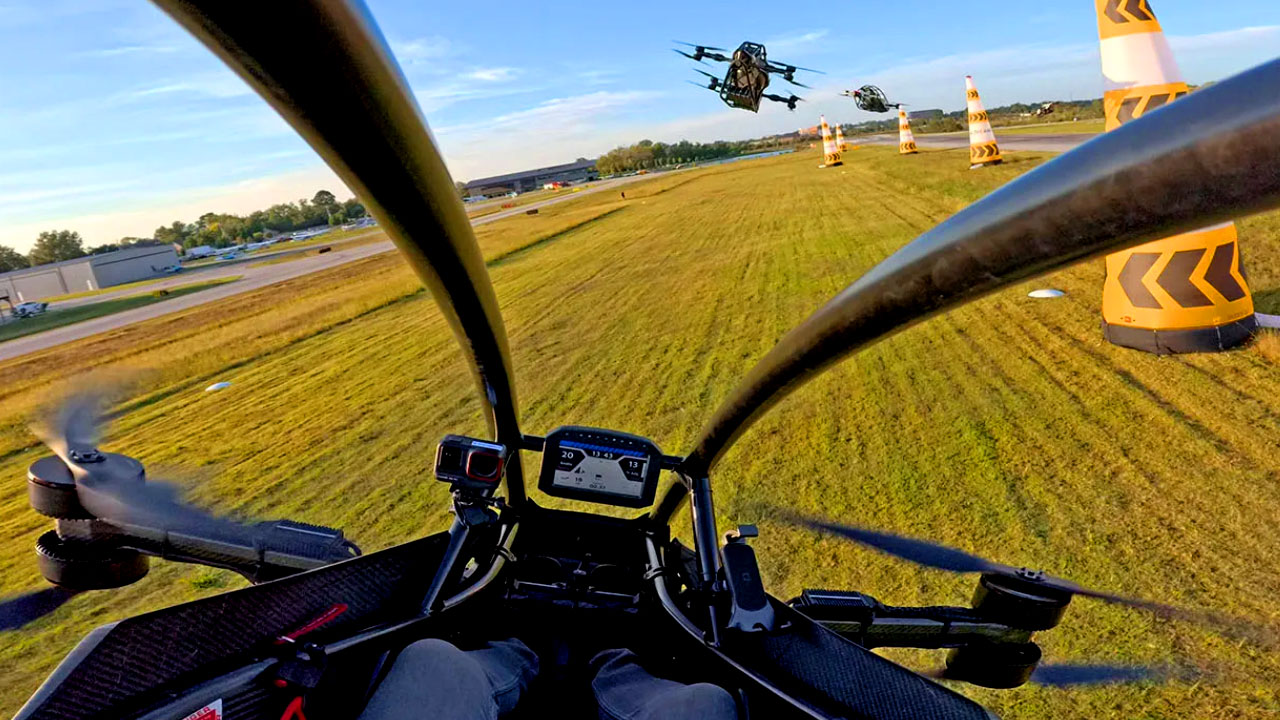

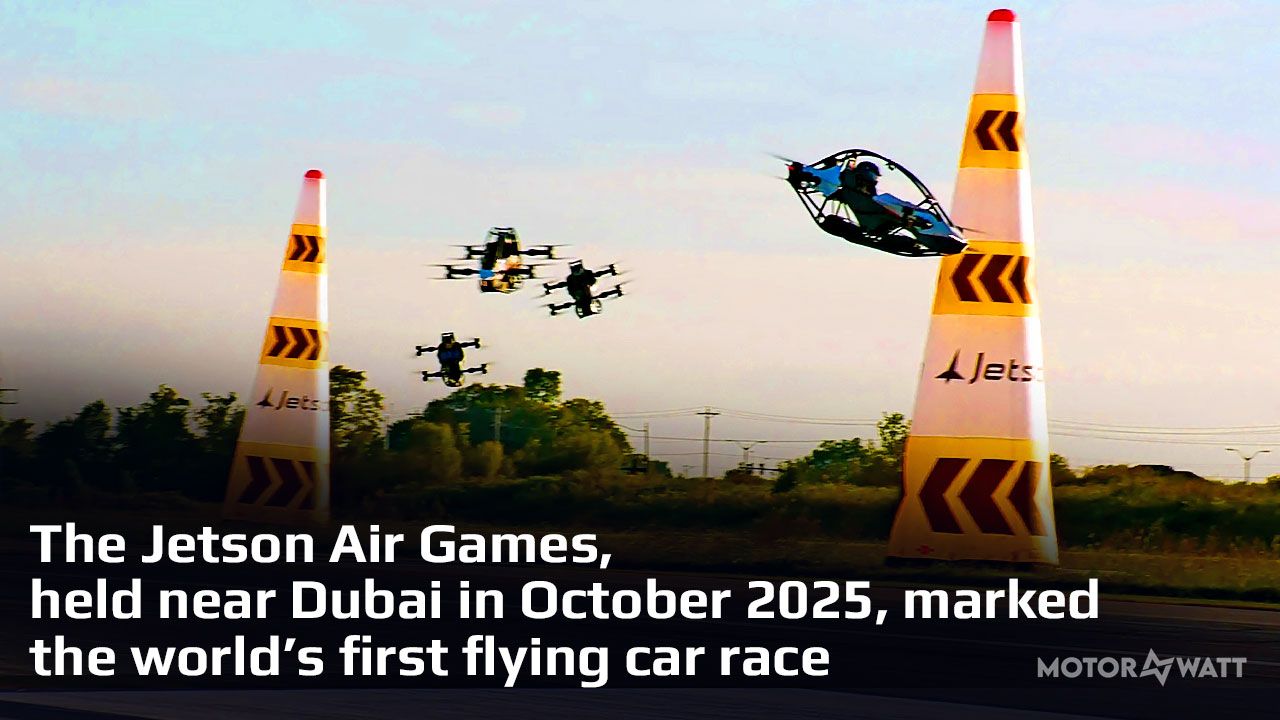
The Jetson Air Games weren’t just another motorsport debut—they signaled the dawn of a new era in electric aviation. Hosted outside Dubai on October 13, 2025, this event turned the concept of flying cars from Hollywood fantasy into screaming reality. Twelve Jetson eVTOL racers took to the air, piloted by daredevils threading through a 3.2-kilometer (2-mile) neon circuit at over 220 km/h (136 mph). Unlike drones, these single-seat machines demand human finesse. Their eight tilting ducted fans give them agility, while onboard AI co-pilots manage wind correction and stability. Jetson’s creation stands at the intersection of adrenaline and innovation, merging Formula 1 precision with zero-emission propulsion.
Electric Vertical Takeoff and Landing eVTOL Technology
At the core of the Jetson Air Games lies eVTOL technology—electric vertical takeoff and landing aircraft that defy conventional racing limits. Each Jetson Racer runs on battery power, featuring regenerative braking that recoups energy during descents, ensuring a carbon-neutral flight profile. With a combined thrust of over 88 kW (118 hp), the Jetson crafts can climb vertically before transitioning into forward flight seamlessly. Pilots handle control sticks similar to those in light aircraft, but the experience is closer to a jet ski soaring through the sky. The eight ducted fans are arranged symmetrically to provide stability, redundancy, and the kind of torque responsiveness one would expect from a racing supercar—only airborne.
Dubai: Birthplace of Aerial Motorsports
Dubai has long been synonymous with ambition, but the Jetson Air Games pushed that image to stratospheric heights. The city’s Department of Economy and Tourism teamed up with Jetson AB of Sweden to host the inaugural flying car race. Against the backdrop of shimmering dunes, 15,000 spectators watched as pilots darted through thirty-meter-high “sky gates,” pulled barrel rolls, and twisted into a 180-degree loop called The Helix. With the roar of electric propulsion echoing above the desert, this event cemented Dubai as the spiritual home of aerial motorsport—a futuristic counterpart to Monaco’s street circuits. Plans are already in motion for a permanent Sky Grand Prix facility projected to attract half a million fans annually by 2027.
Racing Highlights and Human Drama
No race is complete without drama, and the Jetson Air Games delivered in abundance. U.S. pilot Lila Chen of Team SkyBlade clinched victory in a blistering 4 minutes 37 seconds, just 0.8 seconds ahead of local contender Khalid Al-Mansoori. On Lap 3, Marco Rossi’s craft grazed a gate pylon, prompting its automatic parachute system—an engineering triumph that saved both pilot and machine with minimal damage. Chen described the experience as “threading a needle at Mach 0.3 while the world spins below.” With cockpit temperatures peaking at over 40 °C (104 °F), pilots relied on active cooling suits and sharp instincts. The combination of human endurance and AI precision made the race less about pure speed and more about aerial control under extreme conditions.
AI Co-Pilots and Sustainable Innovation
Jetson’s genius lies not only in speed but also in sustainability. Each Racer uses smart AI systems to assist pilots in maintaining flight balance and adjusting thrust during gusts. However, Jetson insists on human override for all aggressive maneuvers—a decision that keeps the thrill authentic. Energy consumption was remarkably low: the full fleet burned less energy than a Formula 1 car uses in a single warm-up lap. This efficiency underscores Jetson’s commitment to eco-conscious racing and its consumer ambitions. The company’s upcoming Jetson ONE, priced around $92,000 (≈ €86,000), will offer similar technology to private buyers starting in 2026, turning anyone with a pilot’s license and nerve into a personal air mobility pioneer.
Global Impact and Future of Jetson Air Games
The implications of Jetson’s race ripple far beyond Dubai. Both the FAA and EASA dispatched observers to the event, hinting at expedited certification for Jetson’s consumer models. Next year’s season expands to Singapore, Los Angeles, and Tokyo, with qualification leagues open to eVTOL-certified pilots holding 50 hours of simulator time. CEO Peter Ternström summarized it best: “This isn’t a stunt—it’s the starting grid for personal air mobility.” Governments are already eyeing aerial corridors and safety frameworks, signaling that flying cars are no longer a sci-fi daydream but a viable extension of electric transport. Jetson is positioning itself as the Tesla of the skies, accelerating the path toward mainstream adoption of electric flight.
Conclusion
Pros and Cons of the Jetson
- High-speed, zero-emission propulsion with up to 220 km/h (136 mph) top speed
- Carbon-neutral operation through regenerative braking technology
- AI co-pilot assistance with manual override for full control
- Expanding global race circuit boosting pilot training and innovation
- FAA and EASA engagement signaling consumer model readiness
- High pilot skill requirement and limited flight duration due to current battery capacity
- Restricted to controlled circuits pending regulatory approval for urban airspace
Final thoughts
The Jetson Air Games showcased more than speed—it unveiled the electric aviation future, merging human instinct with digital precision. For early adopters, the Jetson ONE offers a thrilling gateway into personal flight, where eco-friendly technology meets the adrenaline of motorsport. As Jetson’s wings spread across continents, one thing is certain: the sky is no longer the limit—it’s the racetrack.
Related Video