

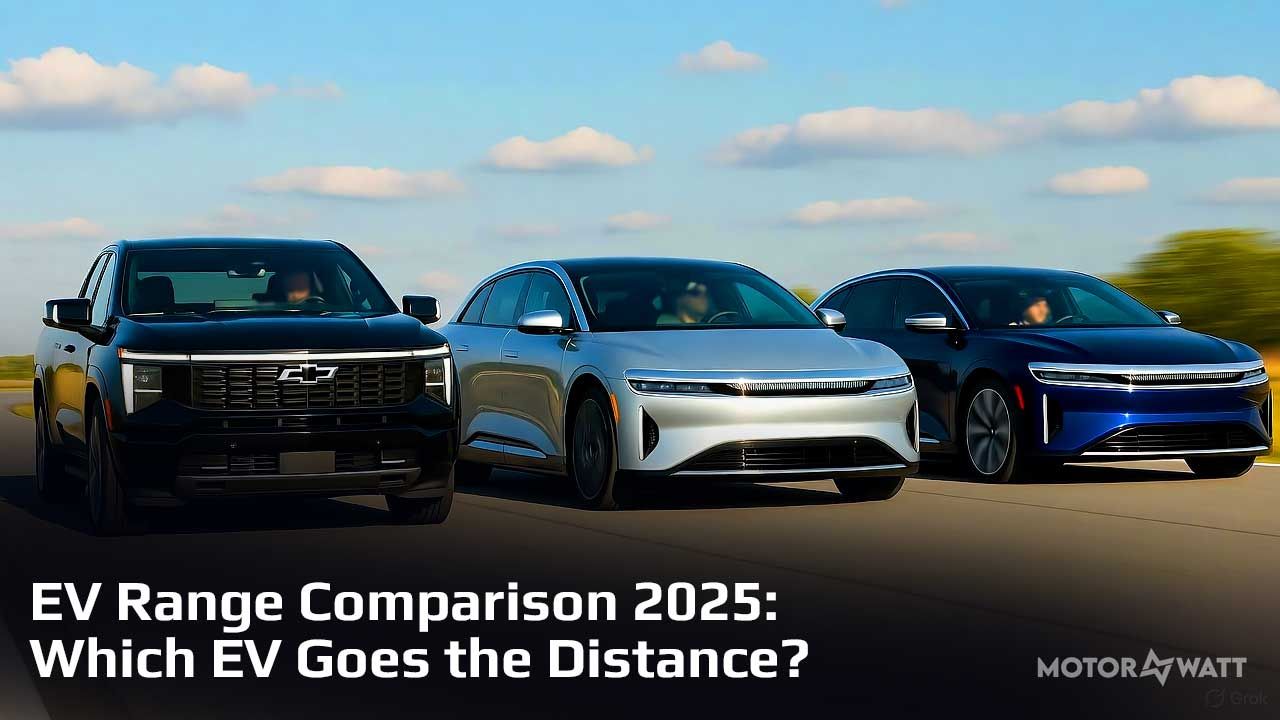
EV range Comparison Chart
The 2025 EV range comparison chart shows the Lucid Air Grand Touring leading with 512 miles (824 km) from a 118 kWh battery. Budget buyers get 319 miles in the $33,600 Chevy Equinox EV. Average range now exceeds 300 miles, up from 250 miles in 2023.
Discover the longest-range electric vehicles of 2025 with our comprehensive EPA-verified comparison chart. From luxury sedans hitting 512 miles to affordable SUVs exceeding 300 miles, find the perfect EV for your driving needs.
Lucid Air Grand Touring
Chevy Equinox EV - 319 miles
Up from 250 miles in 2023
Hyundai Ioniq 6
Why Electric Vehicle Range Matters in 2025
Let's be honest-range isn't just some spec sheet number you glance at before moving on. It's about freedom. Freedom from hunting down charging stations every hundred miles, freedom to take that spontaneous weekend road trip, and freedom from the nagging voice in your head asking, "Will I make it?" In 2025, electric vehicles have finally crossed the threshold where range anxiety is becoming more myth than reality.
Here's what's changed: the average EV range has climbed past 300 miles (483 km), up significantly from around 250 miles (402 km) just two years ago. We're talking about battery packs that are denser, aerodynamic designs that slice through air like a hot knife through butter, and charging infrastructure that's finally catching up to our expectations. According to Car and Driver's 2025 testing, over 15 production EVs now offer more than 400 miles of range-a milestone that seemed like science fiction back in 2020.
Here's the thing about EPA estimates: they're optimistic. Real-world tests from Consumer Reports and Edmunds typically show 10-15% less range on highways, especially when you're cruising at 70+ mph (113+ km/h). And if you're driving in cold weather? Expect efficiency to drop 20-30% as the battery works overtime to stay warm. That 350-mile EPA rating might translate to 280 miles (450 km) on a freezing January morning in Minnesota.
What Actually Affects Your EV Range?
Battery Size & Chemistry
Bigger isn't always better, but it helps. Modern EVs pack batteries ranging from 60 kWh to mammoth 205 kWh packs. The Chevrolet Silverado EV with its 205 kWh battery achieves 460 miles (740 km), while the Lucid Air squeezes 512 miles (824 km) from just 118 kWh thanks to superior efficiency.
Efficiency (mi/kWh)
Think of this as your EV's "MPG." Sleek sedans like the Hyundai Ioniq 6 hit an impressive 5+ mi/kWh (8+ km/kWh), while boxier SUVs and trucks typically manage 2.5-3.5 mi/kWh (4-5.6 km/kWh). Aerodynamics matter-a lot.
Your Driving Style
City drivers rejoice! EVs love stop-and-go traffic thanks to regenerative braking. You might actually exceed EPA estimates in urban settings. Highway drivers? Not so lucky. Sustained speeds above 60 mph (97 km/h) tank your range faster than you can say "supercharger."
Weather & Climate
Battery chemistry doesn't play nice with extreme temperatures. Cold weather saps energy for heating, while hot climates demand AC that drains the pack. Optimal range occurs in the 65-75°F (18-24°C) sweet spot.
But here's the encouraging part: with fast-charging networks like Tesla's Superchargers and Electrify America blanketing 99% of major highways, that "range anxiety" everyone's talking about is fading fast. Most EV owners charge overnight at home-just like plugging in your smartphone-and rarely think about range during their daily 40-mile (64 km) average commute.
The 2025 EV Range Comparison Chart: Complete Rankings
We've compiled the latest EPA ratings as of October 2025, focusing on long-range trims to give you an apples-to-apples comparison. All data comes from official EPA filings and verified by sources like Coltura, Consumer Reports, and Cars.com. Remember: these are optimal-condition numbers. Real-world range typically runs 10-20% lower depending on conditions.
Prices include destination fees but exclude incentives like the $7,500 federal tax credit (where applicable). Currency conversions use October 2025 rates: 1 USD = 0.772 GBP = 0.904 EUR. Battery sizes are usable capacity where available; some manufacturers list gross capacity.
| Vehicle Model | EPA Range | Battery Size | Vehicle Type | Starting Price (USD) |
|---|---|---|---|---|
| Lucid Air Grand Touring | ||||
| Chevrolet Silverado EV RST | ||||
| Lucid Air Sapphire | ||||
| Tesla Model S Long Range | ||||
| Rivian R1S Dual Max | ||||
| Tesla Model 3 Long Range | ||||
| Hyundai Ioniq 6 SE Long Range | ||||
| Tesla Model Y Long Range RWD | ||||
| Ford Mustang Mach-E Premium | ||||
| Chevrolet Equinox EV LT FWD |
Longest-range trims from the comparison table, ranked by EPA miles.
Lower price and higher range indicate stronger value. This is a simplified visual of the scatter data.
Higher bars indicate greater distance traveled per unit of energy.
Key Insights from the 2025 EV Range Data
Standout Performers: The Range Champions
The Lucid Air Grand Touring absolutely dominates the range game, hitting a remarkable 512 miles (824 km) on a single charge. That's more range than most gas cars! What makes it even more impressive? It achieves this with a relatively modest 118 kWh battery, translating to an efficiency of 4.3 mi/kWh (6.9 km/kWh)-outpacing even Tesla's flagship sedans. If you're a luxury buyer who does serious highway miles (think San Francisco to Los Angeles on a single charge), the Lucid is your golden ticket. Real-world tests from Edmunds have verified 485+ miles (780+ km) in optimal conditions.
On the truck front, the Chevrolet Silverado EV RST is rewriting the rules with its massive 205 kWh battery delivering 460 miles (740 km). This isn't your weekend warrior truck-it's built for commercial fleets and contractors who need all-day range without charging breaks. Compare that to the Ford F-150 Lightning's 300 miles (483 km), and you see why fleet managers are taking notice. The Silverado's battery is so large it can even power your house during an outage-talk about versatility.
The Rivian R1S Dual Max deserves special mention for hitting 410 miles (660 km) while still being an adventure-ready, three-row SUV that can tow 7,700 lbs (3,493 kg). Edmunds' 70-mph highway range test returned 390 miles (628 km)-impressive for a vehicle weighing over 7,000 lbs (3,175 kg). It's the ideal road-trip machine for families who refuse to compromise.
Value Picks: Maximum Range Without Breaking the Bank
Budget-conscious buyers, meet your new best friend: the Chevrolet Equinox EV LT. At just $33,600 (£25,939 / €30,374) before the $7,500 federal tax credit, it delivers a solid 319 miles (513 km) of EPA range. That brings the effective price down to $26,100 (£20,159 / €23,610)-making it the most affordable 300+ mile EV on the market. Perfect for urban families who need space (57.2 cu ft / 1,620 L of cargo) without the luxury price tag.
The Tesla Model 3 Long Range at $43,880 (£33,875 / €39,667) offers an outstanding 405 miles (652 km) with premium features like Tesla's Autopilot, Supercharger access, and over-the-air updates. Real-world highway tests often exceed 350 miles (563 km) in mild weather, and the efficiency is class-leading at 4.9 mi/kWh (7.9 km/kWh). For tech-savvy buyers who want range, performance (0-60 in 4.2 seconds!), and value, it's tough to beat.
2025 Market Trends: What's Changing?
- Sedans Still Rule Efficiency: Aerodynamic sedans like the Hyundai Ioniq 6 and Lucid Air achieve 15-25% better efficiency than SUVs thanks to lower drag coefficients (Cd 0.21-0.24 vs. 0.30+ for SUVs).
- SUVs & Trucks Closing the Gap: Just three years ago, 400-mile SUVs didn't exist. Now the Rivian R1S, Tesla Model X Plaid (396 miles / 637 km), and upcoming models are proving you can have size and range.
- 800V Architecture Arrives: The Hyundai Ioniq 6 and Lucid Air use 800-900V systems that enable ultra-fast charging-adding 200+ miles (322+ km) in 12-15 minutes. That's effectively extending your "range" by slashing charging time.
- Real-World Sales Tell the Story: According to 2025 sales data, the Tesla Model Y (337 miles / 542 km) leads all EV deliveries, proving that 300+ miles meets most buyers' needs. The average American drives just 40 miles (64 km) daily-meaning a 300-mile EV offers a full week between charges for typical use.
Toyota and QuantumScape are targeting 2026-2027 for solid-state batteries that promise 500+ miles (805+ km) with 10-minute full charges. While not here yet, this technology will redefine the EV landscape within the next two years.
Factors Beyond Range: The Complete Buying Picture
Range grabs the headlines and dominates dinner table debates, but it's just one piece of the EV puzzle. Here's what else you need to consider before pulling the trigger on that Lucid or Tesla:
Charging Speed: Time is the New Range
Forget range for a moment-charging speed might actually matter more for road trips. Lucid's 900V system can add 200+ miles (322+ km) in just 12 minutes at 350 kW DC fast chargers. Tesla's V4 Superchargers deliver similar speeds with their 250 kW network covering 99% of major highways in North America. Meanwhile, the Chevrolet Equinox EV maxes out at 150 kW, requiring 30+ minutes for an equivalent charge.
Here's the real-world math: On a 1,000-mile (1,609 km) road trip, a Lucid Air might need two 15-minute charging stops, while a lower-spec EV could require four 30-minute stops. That's the difference between 30 minutes and 2 hours of charging time. Suddenly, raw range matters less when you can recharge in the time it takes to grab coffee and stretch your legs.
Price & Incentives: The Total Cost Equation
Sticker prices tell only half the story. Many EVs qualify for the $7,500 federal tax credit (Model 3, Model Y, Equinox EV, F-150 Lightning), potentially slashing costs below $30,000. Add in state incentives-California offers up to $7,500 more, Colorado $5,000-and you're looking at serious savings. The Equinox EV's effective price could drop to under $20,000 (£15,440 / €18,080) in some states.
Fuel Savings
Electricity costs ~$0.13/kWh nationally vs. $3.50/gallon gas. Driving 15,000 miles annually costs about $600/year in an EV vs. $2,100/year in a 30-MPG gas car. That's $1,500 annual savings (£1,158 / €1,356).
Maintenance Savings
No oil changes, no transmission flushes, no spark plugs. EVs save $800-1,200 annually (£618-926 / €723-1,085) on maintenance. Brake pads last 100,000+ miles (160,934+ km) thanks to regenerative braking.
Performance & Features: More Than Just Range
High-range models often pack serious performance. The Tesla Model S Long Range hits 60 mph (97 km/h) in 3.1 seconds despite its 410-mile range. The Lucid Air Sapphire boasts 1,234 HP (920 kW) and does 0-60 in 1.89 seconds-supercar territory-while maintaining 427 miles of range. Even "budget" options like the Model 3 Long Range deliver 0-60 in 4.2 seconds.
Features vary wildly too. Tesla's over-the-air updates keep your car improving for years. The Rivian R1S includes a Camp Mode that powers accessories overnight (fridge, lights, heating) without draining the battery. The Model Y offers an optional third row for seven passengers. Think about your actual needs: Do you tow a boat? Need off-road capability? Require 7+ seats? Let those factors guide your choice.
Total Ownership: The 10-Year View
EVs cost more upfront but save long-term. Consumer Reports estimates EVs save owners $6,000-10,000 (£4,632-7,720 / €5,424-9,040) over the vehicle's lifetime through reduced fuel and maintenance costs. Modern batteries are warrantied for 8 years / 100,000+ miles (160,934+ km) and typically retain 80-90% capacity after a decade-meaning that 400-mile EV still offers 320-360 miles (515-579 km) after 10 years.
About 80% of EV charging happens at home overnight on a Level 2 (240V) charger. Installation costs $500-2,000 (£386-1,544 / €452-1,808) but enables "full tank" mornings for pennies. If you can't install home charging, factor in 20-30 weekly minutes at public chargers-still less time than gas station visits!
Test drive based on your routine. If highways dominate your commute, prioritize aerodynamic sedans like the Model 3 or Ioniq 6. Need off-road adventure? Go rugged with Rivian. Hauling gear or towing? The Silverado EV's 460 miles and 10,000-lb (4,536 kg) towing capacity can't be beat. There's an EV for every lifestyle now-you just need to match your needs to the right model.
Frequently Asked Questions About EV Range
- Which electric vehicle has the longest range in 2025?
The Lucid Air Grand Touring holds the crown with an EPA-estimated 512 miles (824 km) of range on a single charge. This luxury sedan achieves this through a combination of a 118 kWh battery and exceptional efficiency of 4.3 mi/kWh (6.9 km/kWh). Real-world testing by automotive publications has verified 485+ miles (780+ km) in optimal highway conditions. For comparison, the runner-up Chevrolet Silverado EV RST offers 460 miles (740 km) but requires a much larger 205 kWh battery pack to achieve it.
- What's the most affordable EV with 300+ miles of range?
The Chevrolet Equinox EV LT FWD takes this honor with a starting price of $33,600 (£25,939 / €30,374) and EPA range of 319 miles (513 km). After applying the $7,500 federal tax credit (for which it qualifies), the effective price drops to approximately $26,100 (£20,159 / €23,610). This makes it an incredible value for families seeking practical range in an SUV package with 57.2 cubic feet (1,620 liters) of cargo space. The Tesla Model 3 Long Range at $43,880 (£33,875 / €39,667) offers even more range (405 miles / 652 km) but at a higher price point.
- How does cold weather affect electric vehicle range?
Cold weather significantly impacts EV range, typically reducing it by 20-30% in temperatures below 32°F (0°C). This happens because lithium-ion batteries operate less efficiently in cold conditions, and the cabin heating system draws substantial power directly from the battery pack. For example, a vehicle rated for 300 miles (483 km) might deliver only 210-240 miles (338-386 km) in winter conditions. Modern EVs mitigate this with battery preheating systems (which warm the battery while plugged in) and heat pumps (which use 25-50% less energy than traditional resistive heaters). Pro tip: precondition your EV while still plugged in to use grid power for heating rather than battery power.
- How long does it take to charge an electric vehicle?
Charging time varies dramatically based on the charger type and your vehicle's capabilities. Level 1 (120V household outlet): 3-5 miles (5-8 km) per hour-mainly for emergency use. Level 2 (240V home/public charger): 20-40 miles (32-64 km) per hour, fully charging most EVs overnight in 8-12 hours. DC Fast Charging (50-350 kW): 150-300 miles (241-483 km) in 20-30 minutes for vehicles with advanced charging systems. For example, the Lucid Air can add 200+ miles (322+ km) in just 12 minutes on a 350 kW charger thanks to its 900V architecture, while the Hyundai Ioniq 6 charges 10-80% in under 18 minutes. Most EV owners charge at home overnight and rarely need fast charging unless road-tripping.
- What happens if my EV runs out of charge on the road?
First, modern EVs provide multiple low-battery warnings starting at 20-30% charge (60-90 miles / 97-145 km remaining), making it extremely difficult to strand yourself unintentionally. If you do run out, you have a few options: (1) Roadside assistance from your manufacturer or AAA can tow you to the nearest charger (most EVs include this free for 3-5 years), (2) Mobile charging services exist in major cities (essentially a charging truck that comes to you), or (3) A flatbed tow to a charging station. Unlike gasoline cars, you can't just walk to get a gallon of electricity, so plan your trips using your vehicle's built-in route planner that accounts for charging stops. Apps like PlugShare and ChargePoint show real-time charger availability and locations.
- Is 300 miles of range enough for most drivers?
Absolutely. According to U.S. Department of Transportation data, the average American drives just 40 miles (64 km) per day, meaning a 300-mile (483 km) EV provides 7+ days of driving between charges for typical use. Even with a 20% winter range reduction (down to 240 miles / 386 km), that's still 6 days of commuting. The real question isn't daily range but road trip viability-and with DC fast chargers now covering 99% of major highways, adding 150-200 miles (241-322 km) in 20-30 minutes during rest stops makes long-distance travel practical. Sales data supports this: the Tesla Model Y (337 miles / 542 km) outsells longer-range models, suggesting 300+ miles hits the sweet spot for most buyers' needs and budgets.
- Do electric vehicles lose range as they age?
Yes, but less than you might fear. Modern lithium-ion batteries typically retain 80-90% capacity after 8-10 years or 100,000-150,000 miles (160,934-241,402 km) depending on usage patterns and climate. This means a vehicle originally rated for 400 miles (644 km) would still offer 320-360 miles (515-579 km) after a decade-more than sufficient for most drivers. Battery degradation is covered by comprehensive warranties: most manufacturers guarantee 70-80% capacity retention for 8 years / 100,000+ miles. Factors that accelerate degradation include frequent DC fast charging to 100%, extreme heat exposure, and consistently deep discharges. Best practices: charge to 80% daily, avoid depleting below 20%, and use Level 2 charging for regular use (save fast charging for road trips).
Ready to Make the EV Switch?
With ranges now exceeding 500 miles, prices dropping below $30,000 after incentives, and charging networks blanketing highways, 2025 is the perfect time to join the electric revolution. Whether you're eyeing the luxurious Lucid Air or the value-packed Chevy Equinox EV, there's never been a better selection of long-range electric vehicles.
Dreaming of Tesla's Supercharger convenience? Considering Rivian's adventure capabilities? Or maybe you're team Lucid for that unbeatable efficiency? Drop your thoughts in the comments-we'd love to hear your road-test stories and help you find your perfect electric match!
The Bottom Line: Finding Your Perfect EV Range
In 2025, electric vehicle ranges are no longer a compromise-they're a competitive advantage. With options spanning from the Lucid Air's astounding 512 miles (824 km) to everyday heroes like the Equinox EV's practical 319 miles (513 km), there's an electric vehicle for every budget, lifestyle, and driving pattern. The days of "range anxiety" are fading into history, replaced by the reality of widespread fast charging, improving battery tech, and increasing vehicle efficiency.
Here's what you need to remember: Match the range to your actual needs, not your fears. If you drive 40 miles (64 km) daily, a 300-mile (483 km) EV gives you week-long peace of mind. For road warriors covering 50,000+ annual miles, the Lucid or Silverado EV's ultra-long range eliminates charging hassles. And for budget-conscious families, the sub-$27,000 (after incentives) Equinox EV proves you don't need luxury prices for worry-free driving.
Use this comparison chart as your launchpad-cross-reference these EPA figures with your annual mileage, local charging infrastructure, and climate conditions. Test drive your top choices in real-world conditions: highway speeds, with climate control running, ideally in weather representing your worst-case scenario. You'll quickly discover which EV fits your life.
2026 promises even more exciting developments-solid-state batteries, 600+ mile ranges, and sub-$25,000 EVs with 250+ mile capabilities. But don't wait: today's EVs already deliver exceptional range, proven reliability, and ownership costs that undercut gasoline vehicles by thousands annually. The future is electric, and it's already here.
Your turn: Which EV from our comparison chart caught your eye? Are you prioritizing maximum range, best value, or a balance of both? Share your thoughts, questions, and experiences in the comments below. And if you're already driving an EV, we'd love to hear how your real-world range compares to EPA estimates-help future buyers with your insights! Stay tuned for our next deep dive on 2025 charging innovations, battery technology breakthroughs, and the best EV road trip routes in North America.
Related Video