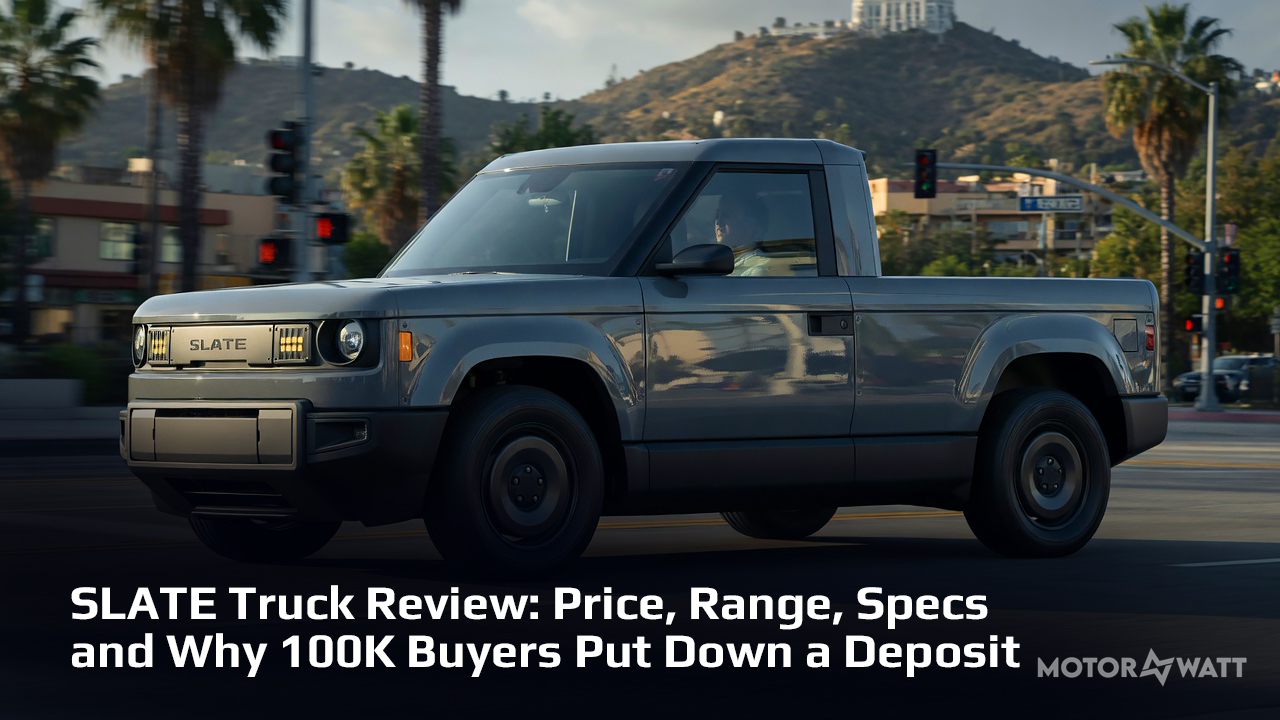

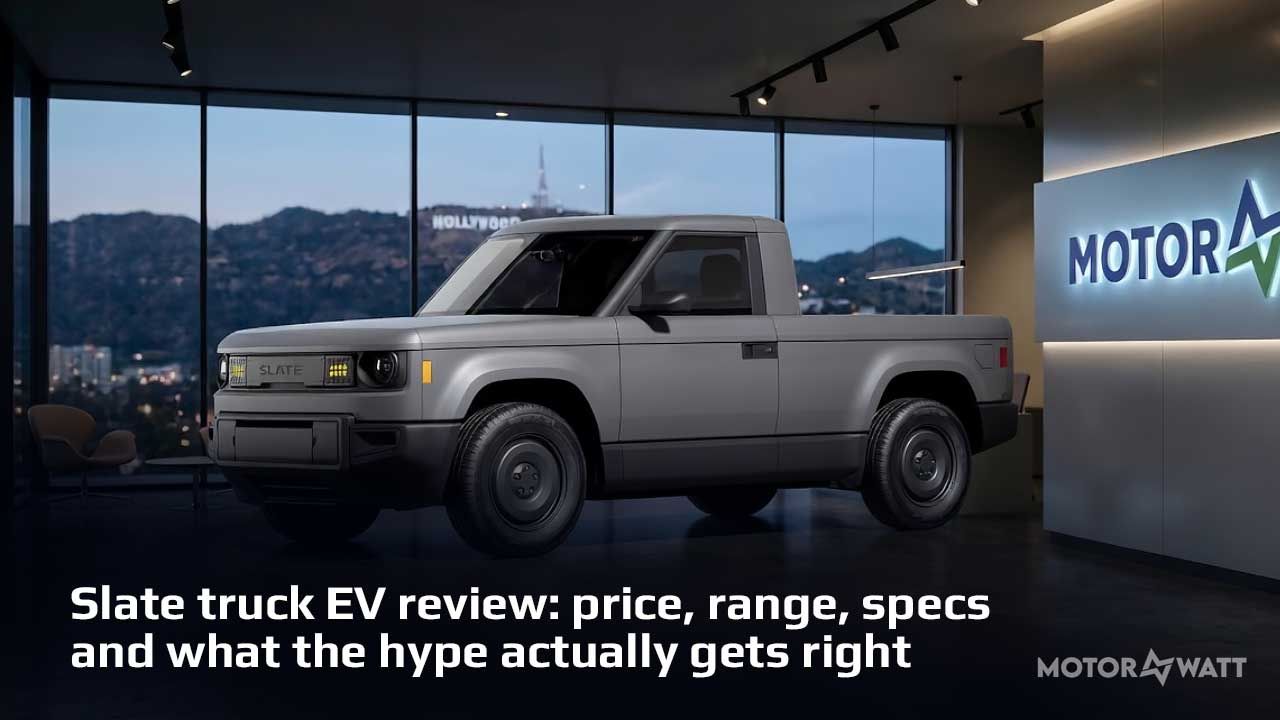
By May 2025 — three weeks after its public reveal — Slate Auto had collected 100,000 refundable reservations for a truck most people had never heard of. No TV ads. No celebrity endorsements. No Super Bowl spot. Just word of mouth, a $50 deposit, and a price tag that made people do a double-take.
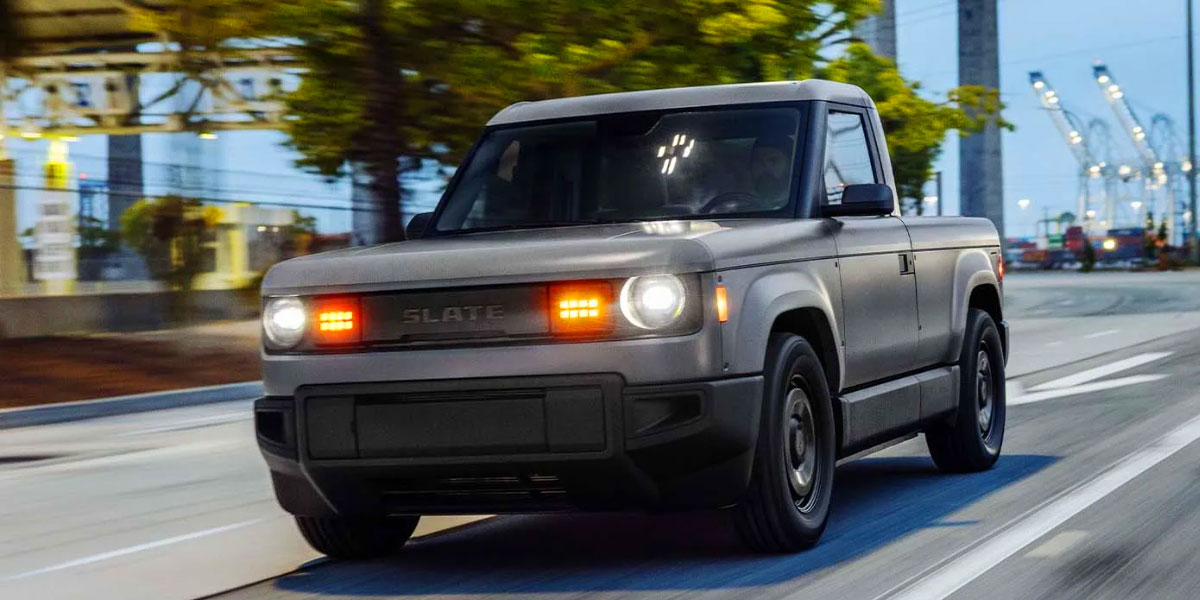
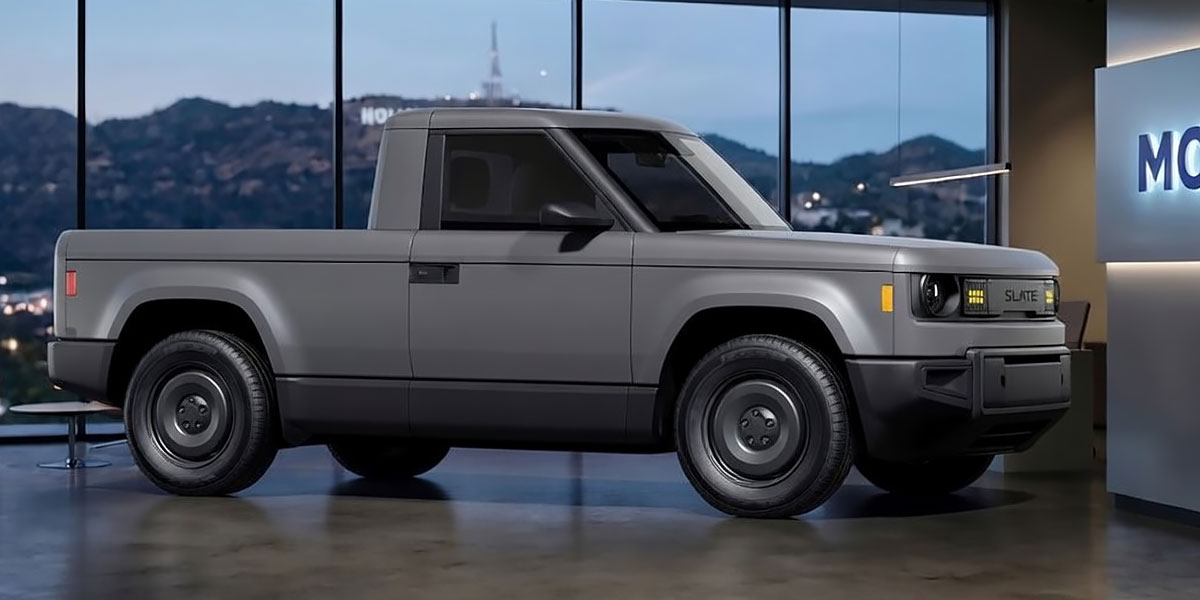
The Slate Truck is a sub-$28,000 electric pickup built on what its founders call the "blank slate" philosophy: ship a capable bare-bones EV, then let buyers customize it into whatever they need. The exterior is unpainted grey polypropylene, ready to be wrapped in any color you choose. A bolt-on SUV conversion kit is also available if the truck bed isn't what you need.
It's a genuinely interesting concept. Whether it's the right truck for you is a different question — and one this review is going to answer directly.
Production starts in Q4 2026. Nobody has driven a production Slate Truck yet. What we have are confirmed factory specs from Slate Auto, a detailed Wikipedia spec entry sourced from official materials, and a clear picture of where this truck fits in the market. Here's everything you need to know before deciding whether that $50 deposit is worth it.
What is the Slate Truck? Key specs at a glance
The Slate Truck is a compact, two-door electric pickup produced by Slate Auto, an Indianapolis-based startup. It's rear-wheel drive only, built on a dedicated EV platform, and assembled at a facility in Warsaw, Indiana. First deliveries are expected in late 2026.
Full specs table: battery, range, power, charging, dimensions, price
Here are the confirmed specifications as of April 2026:
| Spec | Value |
|---|---|
|
Starting price
|
Under $28,000 MSRP
|
|
Battery options
|
52.7 kWh or 84.3 kWh (NMC chemistry, SK On)
|
|
EPA-rated range
|
~150 mi (242 km) / ~240 mi (386 km)
|
|
Motor
|
Single rear-mounted permanent magnet synchronous
|
|
Power
|
201 hp (150 kW)
|
|
Torque
|
195 lb-ft (264 N·m)
|
|
Drivetrain
|
Rear-wheel drive
|
|
Curb weight
|
3,602 lbs (1,634 kg)
|
|
Payload
|
~1,433 lbs (~650 kg)
|
|
AC charging
|
11 kW (NACS)
|
|
DC fast charging
|
120 kW (NACS)
|
|
Frunk storage
|
7 cu ft
|
|
Length
|
174.6 in (4,435 mm)
|
|
Width
|
70.6 in (1,793 mm)
|
|
Height
|
69.3 in (1,760 mm)
|
|
Wheelbase
|
108.9 in (2,766 mm)
|
|
Assembly
|
Warsaw, Indiana, USA
|
The battery supplier is SK On, using NMC (nickel-manganese-cobalt) chemistry — the same battery chemistry found in most US-market EVs, including several Ford and Kia models. NMC delivers strong energy density (good for range) but requires more thermal management than LFP chemistry. In practical terms: expect range to drop more noticeably in very cold weather compared to an LFP-based EV like the base Tesla Model 3.
Slate Truck price: how much does it actually cost?
The Slate Truck starts under $28,000 MSRP — a figure that genuinely stands out in the US electric vehicle market, where most new EVs begin at $35,000 or higher.
Base price, options & accessory packages
Reserving your Slate Truck requires only a $50 fully refundable deposit — one of the lowest reservation fees in the automotive industry. There's no obligation to complete the purchase when your turn in the queue arrives.
Final trim-level and options pricing hasn't been published yet. The under-$28,000 figure refers to the base configuration, which ships without several features buyers of traditional trucks might expect as standard. Slate Auto's "Slate Maker" configurator tool lets you add accessories before and after purchase — roof racks, lift kits, tire carriers, wrap kits, and the SUV conversion body kit — each priced separately. Think of the base truck as the platform; the final price you pay depends on what you add.
EV tax credit eligibility and net cost
When Slate first revealed the truck in April 2025, it advertised a sub-$20,000 effective price. That figure assumed buyers would claim the $7,500 federal EV tax credit under the Inflation Reduction Act. Within weeks of the reveal, the federal credit was eliminated in early 2025, which pushed the floor price back up to the raw MSRP.
State-level incentives remain available in many markets: Colorado offers $5,000, Connecticut $4,500, and California up to $7,500 for eligible EV purchases. If you're in one of those states, the effective out-of-pocket cost could fall to roughly $20,500–$23,000 on the base configuration.
Because the Slate Truck is assembled in Indiana and the battery is manufactured by SK On (a South Korean supplier), its domestic content eligibility under any future federal incentive programmes is something to watch. For an electric vehicle in the US, even at the unsubsidised MSRP, the Slate Truck is meaningfully cheaper than the Chevy Equinox EV (~$35,000) — and it's a truck.
Battery and range: 150 miles or 240 miles?
Two battery packs. Choose based on how you actually drive.
52.7 kWh vs. 84.3 kWh battery pack comparison
The 52.7 kWh pack targets approximately 150 miles (242 km) of EPA-rated range. The 84.3 kWh pack pushes that to approximately 240 miles (386 km). Both use NMC chemistry built by SK On. Both support 11 kW AC charging and 120 kW DC fast charging via NACS.
The 52.7 kWh option costs less upfront and is sufficient if your daily round-trip commute is under 80 miles (130 km) and you have access to overnight home charging. That covers most US drivers — the US Department of Transportation puts the average American's daily driving at roughly 37 miles. At that usage level, you'd be charging from a typical 20–40% state of charge, not stressing the battery at the extremes.
The 84.3 kWh pack makes sense if you regularly drive 100 to 200 miles in a single day, commute in very cold weather, or if your charging situation is less predictable. At 240 miles of rated range, you have meaningful buffer for real-world conditions. NMC range drops roughly 20–30% below freezing — if you're in Minnesota, Michigan, or a similarly harsh winter climate, the larger pack is the right call.
Real-world range expectations vs. EPA rating
EPA-rated range is measured under moderate, controlled conditions — moderate speeds, climate control off, flat terrain. Real-world highway driving tells a different story.
At a steady 75 mph (120 km/h) with a payload in the bed, expect the 52.7 kWh pack to deliver 115–130 miles of actual range and the 84.3 kWh pack to deliver 185–210 miles. Winter temperatures below 20°F (–7°C) will cut those numbers further by roughly 20–25%.
One thing to note on the charging side: at 120 kW DC peak charging, the Slate Truck is adding roughly 200 miles of range per hour at maximum rate — about 20 miles of range for every 6 minutes plugged in. That's a competitive charge-to-range ratio for a sub-$28,000 vehicle.
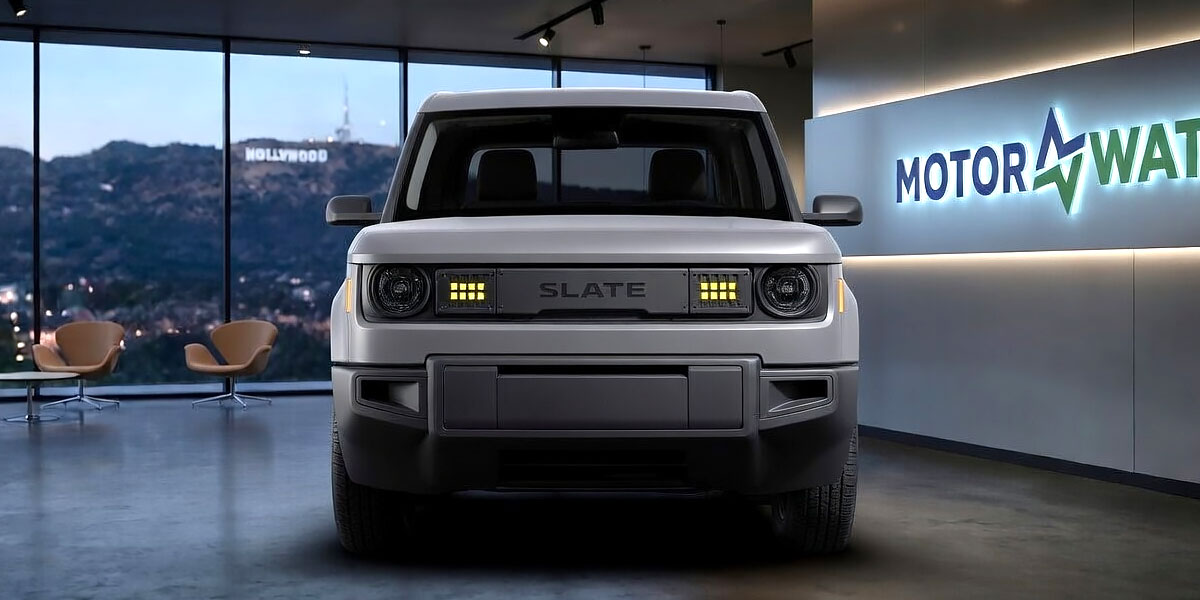
Charging: Tesla Supercharger access via NACS
The Slate Truck's NACS connector is one of its strongest advantages. Here's what it means in practice.
Public charging: NACS connector and DC fast charging (120 kW)
The Slate Truck uses a NACS (North American Charging Standard) connector — the same plug used on all Tesla vehicles, now adopted across the industry since 2023. That gives Slate Truck buyers access to the Tesla Supercharger network from day one: over 20,000 fast-charge stalls in the United States, covering all major highways and most mid-size cities. It's the most reliable DC fast-charging network in the country by a significant margin.
Beyond Superchargers, NACS has been adopted by Ford, GM, Rivian, Honda, and others — meaning public chargers at EVgo, ChargePoint, and Electrify America are increasingly NACS-compatible. The Slate Truck's peak 120 kW DC charge rate means you're not leaving capability on the table at any of those networks.
Home charging setup and recommended Level 2 chargers
For home charging, the Slate Truck supports 11 kW AC, which means a Level 2 (240V) home charger will add approximately 35–40 miles of range per hour. A full charge on the 84.3 kWh pack from empty takes roughly 8–9 hours overnight — entirely practical. If you're only topping up daily from a partial state of charge, expect 2–4 hours on most nights.
The 11 kW AC capacity means the Slate Truck can take full advantage of a 48-amp EVSE. For guidance on selecting the right home charger for your setup, our fastest EV home charger guide covers the options at that amperage. And if you plan to rely on the public charging network for longer trips, our EV road trip planning guide covers how to map stops on the Supercharger network efficiently.
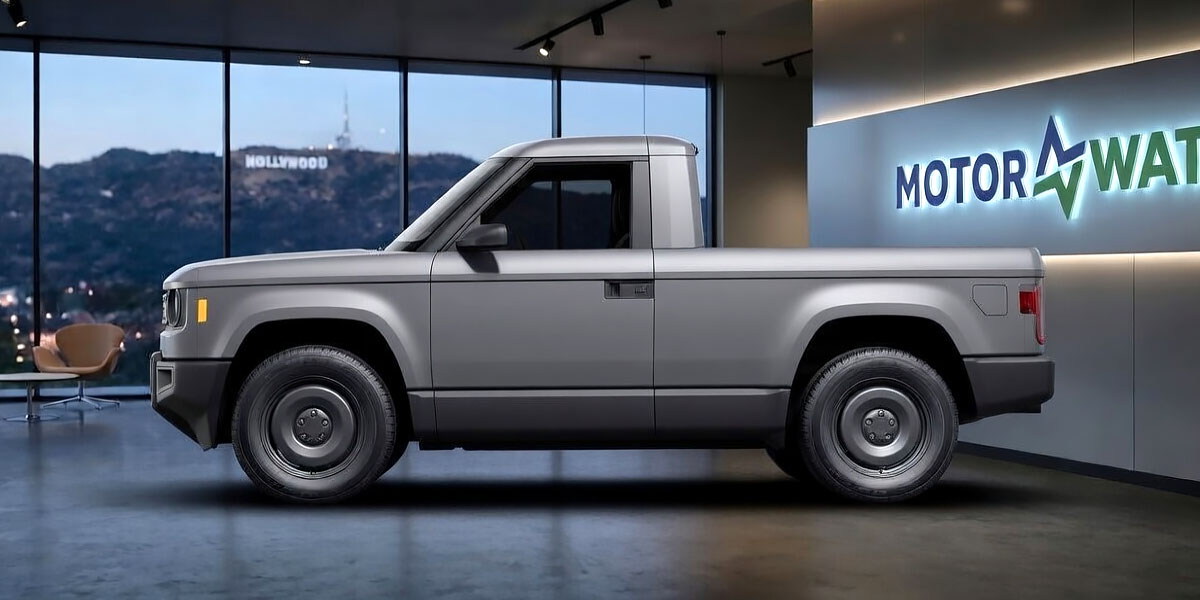
Performance: 201 HP, RWD, 0–60 & towing capacity
The Slate Truck's performance specs are modest in raw numbers but worth understanding in context.
Acceleration and top speed
The Slate Truck makes 201 hp (150 kW) and 195 lb-ft (264 N·m) of torque from its single rear-mounted permanent magnet motor. Slate hasn't published official 0–60 mph figures yet. For context: 201 hp is similar to the Ford Maverick Hybrid (191 hp combined). But electric torque delivery is immediate, which means the Slate Truck should feel more responsive off the line than those numbers suggest in everyday driving — think of it like the difference between a diesel and a petrol at low revs. The pull is there before you've consciously registered the accelerator movement.
Top speed has not been officially stated. Based on comparable single-motor EVs at this power level, a governed top speed in the 90–100 mph range is likely, but this is not confirmed by Slate Auto.
Payload, towing, and 4WD: What the Slate Truck can (and can't) do
Payload comes in at approximately 1,433 lbs (650 kg) per manufacturer materials. That's competitive in the compact truck class — the Ford Maverick Hybrid is rated at 1,500 lbs — and sufficient for most lifestyle use: plywood sheets, bags of mulch, e-bikes, camping gear.
Towing capacity has not been officially published as of April 2026. Given the 195 lb-ft torque output and RWD configuration, an estimated tow rating of 1,500 to 2,500 lbs is plausible, but treat that as speculation until Slate confirms it. If towing is a critical factor in your decision, wait for the official figure before reserving.
On four-wheel drive: there isn't any. The Slate Truck is rear-wheel drive only. No AWD or 4WD option has been announced. If you need AWD for regular off-road driving, serious winter conditions, or consistent all-weather traction, the Slate Truck in its current configuration isn't the right truck — the Hyundai Santa Cruz (AWD trim) or a Ford Maverick EcoBoost with AWD would be stronger alternatives.
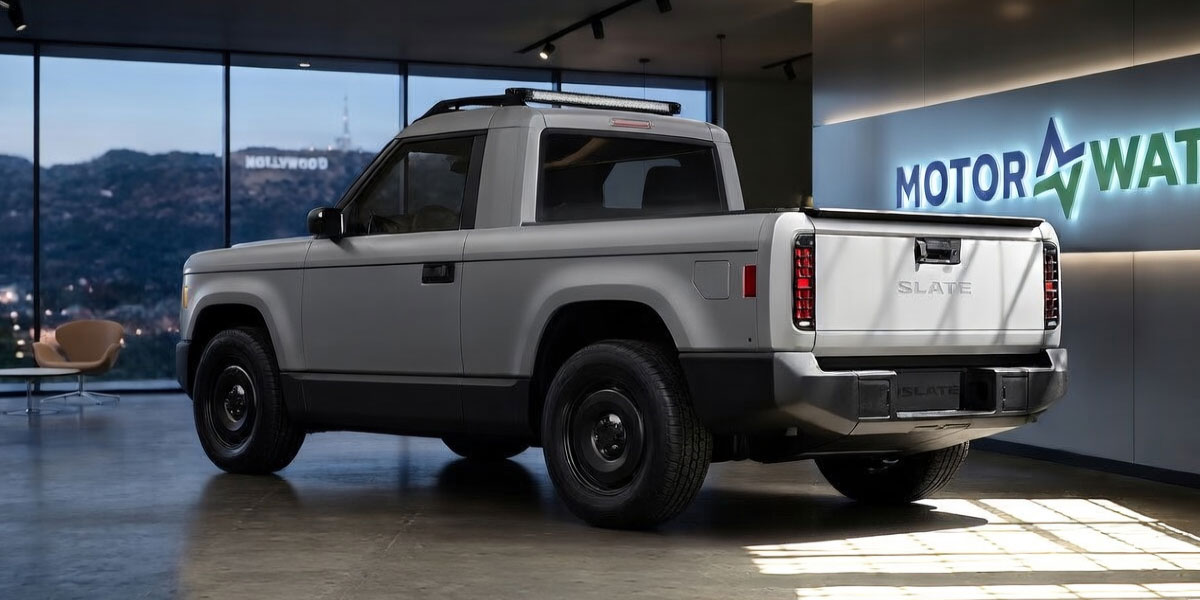
The "Blank Slate" Customization System
This is the Slate Truck's defining differentiator. Understanding how the system works is essential to evaluating whether it's a genuine advantage for your situation or just a compelling press narrative.
Wraps, body kits, and the SUV conversion
The truck ships in a single exterior finish: unpainted grey polypropylene. No paint. That's deliberate. The body panels are engineered to accept wraps — Slate Auto sells its own wrap kits starting around $500, and the polypropylene surface is formulated to hold aftermarket vinyl well. You can change the truck's color yourself, cheaply, without voiding anything. If you change your mind in three years, you peel and re-wrap.
Beyond color, modular body accessories include roof racks, lift kits, tire carriers, bed accessories, and — the headline option — the SUV conversion kit. This bolt-on body modification transforms the truck from an open pickup to an enclosed SUV-style silhouette. Pricing for the SUV kit has not been finalized, but Slate has shown the conversion as a complete accessory. For fleet buyers or commercial operators who need to repurpose vehicles across different tasks, the ability to physically reconfigure the body is a meaningful advantage.
The Slate Maker configurator tool
Slate Maker is Slate Auto's web-based configurator — a tool that lets you spec your truck before purchase and continue adding accessories after delivery. The catalogue is expected to grow over time as the aftermarket ecosystem develops around the platform.
The philosophy driving all of this is simple: most vehicles arrive with features you didn't ask for, at a price inflated to match. Slate's pitch is the inverse — start with a capable, reliable EV at the lowest possible price, then add exactly what you need. If you don't need a built-in speaker, you don't pay for one. If you want to change your truck's color in two years without a $4,000 respray, you can.
Whether that appeals to you depends entirely on your priorities. For buyers who want a fully sorted vehicle straight out of the box, the Slate Truck will feel sparse in base trim. For buyers who want to own a platform they control — and pay only for what they use — it's genuinely compelling.
Interior: Bare-Bones by Design
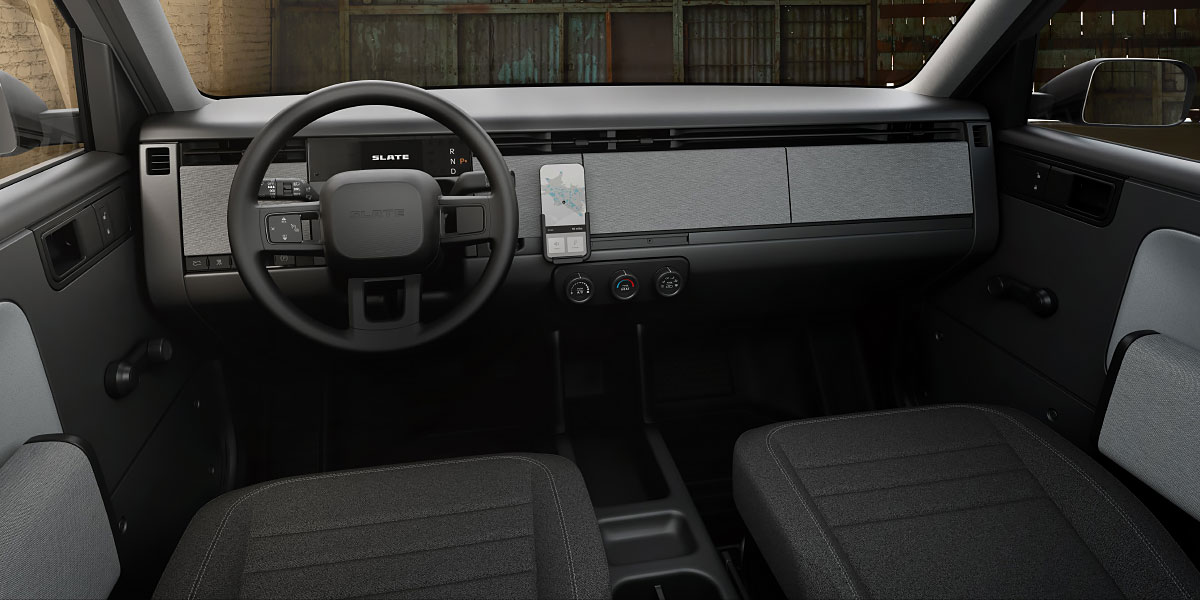
The base Slate Truck interior is minimal by any conventional standard. That's not an oversight — it's the product strategy.
What's included — and what isn't
The base configuration does not include a factory infotainment screen, powered speakers, or power windows. Those are the confirmed omissions. Manual window cranks are a deliberate design choice, not a cost-cutting shortcut. Slate's founders have been explicit that they're building for buyers who are tired of software complexity — and the associated failure points — in modern vehicles.
What is confirmed: 7 cubic feet of frunk storage, a home charging installation service, and a partnership with RepairPal providing access to 4,000 service points across the US from day one. That last point matters more than it might initially seem. One of the legitimate risks with new EV startups is service network depth — Rivian had gaps in its early years, and Tesla had to build its own service centres from scratch. Slate is using RepairPal's existing independent mechanic network, which means your local shop may already be in the programme.
Cabin air conditioning has not been officially confirmed for the base trim. Some form of HVAC is expected because EVs require battery thermal management regardless, but whether the base model includes cabin AC is not yet on the spec sheet. Check slate.auto for the current configuration before committing.
Technology and connectivity options
Navigation is handled through your phone via a mount (sold separately). Audio is Bluetooth-only — you bring your own portable speaker. The approach strips out everything that contributes to infotainment system complexity and replaces it with a model that makes your existing devices do the work.
The Slate Auto app — announced but not yet released in final form — will handle over-the-air software updates, charging scheduling, and accessories management through the Slate Maker tool. This mirrors the connected vehicle model used by Tesla and Rivian, but applied to a far simpler base vehicle. For more on how connected EV ownership works in practice, our EV ownership guide covers what to expect from OTA updates and remote management across different brands.
Slate Truck vs. Ford Maverick vs. Hyundai Santa Cruz
The Slate Truck, Ford Maverick, and Hyundai Santa Cruz all target the compact pickup segment. Here's a direct comparison:
| Spec | Slate Truck EV | Ford Maverick Hybrid | Hyundai Santa Cruz |
|---|---|---|---|
| Starting price | |||
| Powertrain | |||
| EPA fuel/range | |||
| Payload | |||
| Towing | |||
| Drivetrain | |||
| Fast charging | |||
| Home charging | |||
| 4WD available | |||
| Delivery |
The Maverick Hybrid is the closest price competitor at $24,165 to start. It has better payload, better towing (on the EcoBoost trim), and — critically — it's available today. The downside is that it burns petrol. At 42 mpg city, it's one of the most fuel-efficient trucks sold anywhere, but fuel and maintenance costs over five years still run meaningfully higher than an EV. At US average fuel prices (~$3.30/gallon) and average electricity rates (~$0.16/kWh), a Maverick Hybrid costs roughly $1,200 more per year to fuel than a Slate Truck driven the same miles. Over five years: $6,000 — not far off the price gap between the two.
The Santa Cruz is larger, more powerful, better at towing — and offers AWD, which is a genuine advantage in snowy markets. It doesn't come close to the Slate Truck on running costs.
The Slate Truck wins on: total cost of ownership, NACS charging access, and customizability. It loses on: towing, drivetrain options, and the fact that you can't buy one yet. Both the Maverick and the Santa Cruz are proven, available products. If you need a truck before late 2026, neither requires you to wait.
Reservation & Delivery: when can you buy the Slate Truck?
By May 2025 — roughly three weeks after the truck's public reveal — Slate Auto had collected over 100,000 reservations. That number came before the federal tax credit was eliminated and before Slate had published full specifications. The queue is long.
How to reserve a Slate Truck ($50 refundable deposit)
The reservation process is straightforward:
- Go to slate.auto and click "Reserve."
- Enter your details and submit a $50 fully refundable deposit via credit card.
- Receive a confirmation email with your place in queue.
- When your turn comes up, Slate will invite you to complete your configuration via the Slate Maker tool.
- Final payment and delivery scheduling happen at that stage.
The $50 deposit is fully refundable at any time before you complete the purchase — no questions asked, no cancellation fee. There is no obligation to go through with the order when you're invited to configure.
Production and delivery dates
Production is scheduled to begin Q4 2026 at the Warsaw, Indiana facility. First deliveries are expected by late 2026. If you placed a reservation in spring 2025, you may receive delivery in late 2026 or early 2027. If you're reserving today (April 2026), realistically plan for a 2027 delivery window.
Slate Auto has partnered with RepairPal to support service from day one at 4,000+ locations nationwide — a smarter go-to-market than trying to build a proprietary service network from scratch, and a lesson apparently learned from watching other EV startups struggle post-delivery.
For a look at what's currently available in the electric truck market while you wait, the MOTORWATT EV marketplace lists all current electric trucks by range, price, and availability.
Who is behind Slate Auto? Jeff Bezos, Leadership, and Backing
Slate Auto is backed by Jeff Bezos — the same investor who previously backed Rivian. Bezos is not the founder or CEO; he's a capital backer. The company is run by an experienced automotive leadership team, though Slate has kept individual executives relatively low-profile compared to Lucid or Rivian's very public leadership culture.
The Bezos connection explains a few things. Slate is well-capitalised for an early-stage startup, which reduces — but doesn't eliminate — the risk of the company folding before it delivers trucks. It also explains the Amazon ecosystem DNA visible in the product design: the Slate app integration and home charger installation service both have the "seamless digital onboarding" sensibility you'd associate with Amazon-adjacent product thinking.
One legitimate concern: Bezos also invested in Rivian, which went through years of production difficulty and a painful financial journey before stabilising. Slate's vehicle is deliberately simpler — no complex frunk/gear tunnel, no quad-motor AWD option. The more stripped-down the vehicle, the lower the production complexity risk. That's partly why the Slate Truck's bare-bones approach isn't just a marketing angle — it's also a manufacturing strategy.
Is Slate Auto a real company? The evidence is encouraging: a confirmed production facility in Warsaw, Indiana; a confirmed battery supplier in SK On; a confirmed service network partner in RepairPal; and over 100,000 paid reservations collected in three weeks. Those are real indicators. But until trucks are rolling off the line and into customers' driveways, some uncertainty is inherent. That's true of any reservation-stage vehicle.
Is the Slate Truck right for you? Our verdict
The Slate Truck is the most genuinely interesting affordable EV launched in years. The price, the Tesla Supercharger access, and the customization system are all real advantages — not marketing spin.
But "interesting" and "right for you" are different questions.
Choose the Slate Truck if you:
- Drive under 150 miles daily and have access to home charging (Level 2 preferred)
- Want the lowest total cost of ownership in the compact pickup segment
- Value NACS / Tesla Supercharger access from day one
- Don't need 4WD or serious towing over 3,000 lbs
- Are comfortable waiting until late 2026 or 2027 for delivery
- Like the idea of a customizable platform rather than a pre-configured vehicle
Choose the Ford Maverick Hybrid instead if you:
- Need a truck now, not in 18+ months
- Regularly tow over 2,000 lbs
- Aren't sure you have a reliable home charging setup
- Want a thoroughly tested, proven vehicle with established service
Choose the Hyundai Santa Cruz instead if you:
- Need AWD or better all-weather capability
- Regularly carry heavy payloads (Santa Cruz is the class leader at 1,748 lbs)
- Want a more refined interior from day one
The Slate Truck won't be for everyone. A bare-bones EV with no built-in stereo, rear-wheel drive only, and a 2026 delivery window has real limitations. If you regularly tow heavy loads and need a proven electric truck now, our roundup of the best heavy-duty electric trucks covers stronger alternatives. But for a buyer whose daily driving fits within 150–240 miles, who has a garage to charge in, and who's genuinely excited by a vehicle they can personalise — the Slate Truck makes a compelling case for that $50 reservation.
FAQ
- How much does the Slate Truck cost?
The Slate Truck starts under $28,000 MSRP. A $50 fully refundable deposit holds your reservation. Before the federal EV tax credit was eliminated in early 2025, Slate advertised a sub-$20,000 effective price after incentives. State-level EV rebates may still apply depending on where you live — states like Colorado ($5,000) and California (up to $7,500) have active programmes.
- What is the range of the Slate EV truck?
Two options: the 52.7 kWh battery delivers approximately 150 miles (242 km) of EPA-rated range; the 84.3 kWh battery delivers approximately 240 miles (386 km). Real-world range will be lower at highway speeds, with heavy payload, or in cold weather. Expect 20–25% range reduction below freezing.
- Does the Slate Truck use Tesla chargers?
Yes. The Slate Truck uses a NACS connector — the same plug used on Tesla vehicles — which means access to the entire Tesla Supercharger network: over 20,000 fast-charge stalls across the US. The truck supports up to 120 kW DC fast charging, adding roughly 200 miles of range per hour at peak rates.
- Does Jeff Bezos own Slate Auto?
Jeff Bezos is a key financial backer of Slate Auto but does not own or operate the company. Slate Auto is an independent startup led by a professional automotive leadership team. Bezos previously backed Rivian in a similar capacity.
- Does the Slate Truck have air conditioning?
Slate Auto has not confirmed whether cabin air conditioning is standard on the base trim. The base configuration deliberately omits features like a factory stereo, power windows, and infotainment screen. Some form of HVAC is expected (EVs require battery thermal management systems), but the cabin AC specification for the base model has not been officially confirmed. Check slate.auto for the current spec sheet before reserving.
- When will the Slate Truck be delivered?
Production begins Q4 2026 at the Warsaw, Indiana facility. First customer deliveries are expected by late 2026. If you're reserving today, a realistic delivery estimate is 2027, depending on your position in the queue.
- Can you get 4WD on the Slate Truck?
No. The Slate Truck uses a rear-wheel drive layout with a single rear-mounted permanent magnet motor. No all-wheel drive or four-wheel drive option has been announced as of April 2026. If AWD is a requirement, the Hyundai Santa Cruz (AWD trim) or a Ford Maverick EcoBoost with AWD option may be better alternatives.
Related Video