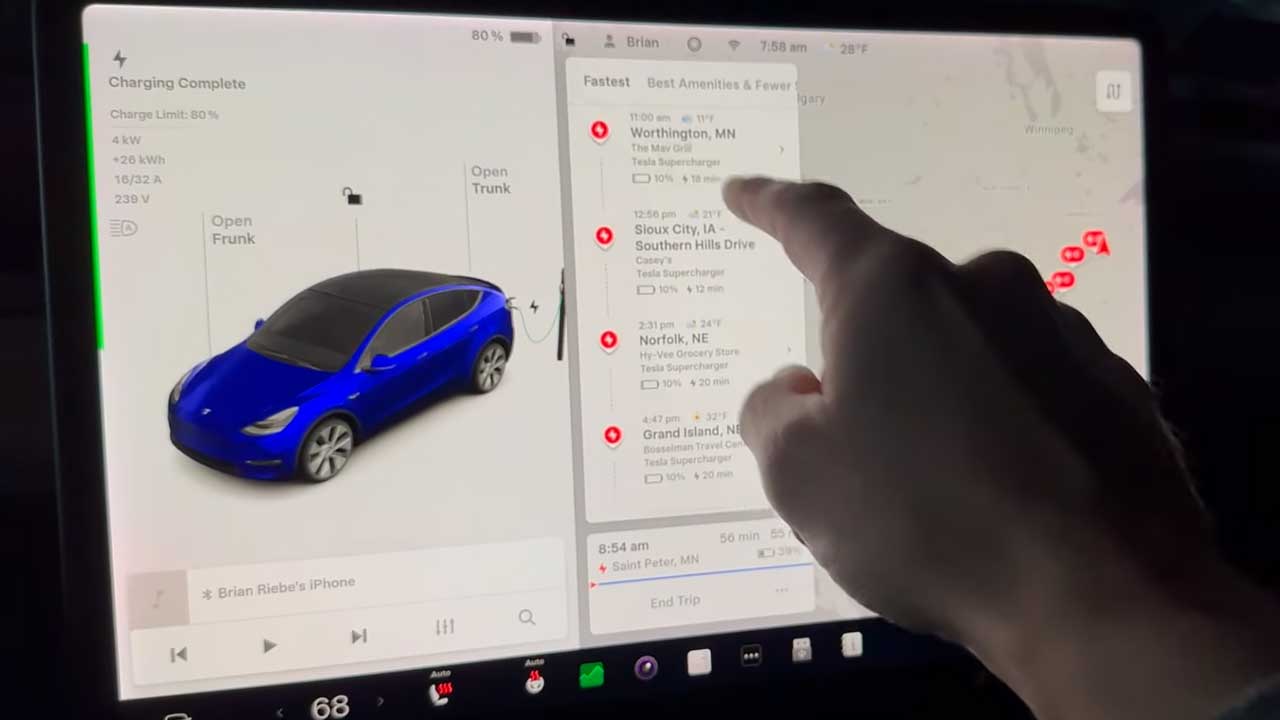

Everything real EV owners actually need — from pre-trip battery prep to picking the fastest chargers — so your electric road trip goes smoother than a gas run ever did.
The best EV road trip planning in 2026 comes down to four things: knowing your real-world range, mapping charge stops before you leave, keeping state-of-charge between 20% and 80% while fast-charging, and choosing overnight lodging with Level 2 outlets. Do those four things right and you will beat any gas-car trip on comfort, cost, and stress level.
Key Findings at a Glance
- 326,000+ public charging ports are live across the U.S. as of early 2026 — up 30% year-over-year (Paren/EV Connect, Feb 2026).
- Average new EV range hit 283 miles (455 km) for model-year 2024 — four times higher than in 2011 (Recharged, 2025).
- 45% of EV owners report zero road-trip challenges, and 78% say range anxiety fades with real-world experience (CDK Global / Recurrent, 2025).
- Modern DC fast chargers add 150–200 miles (240–320 km) in 15–20 minutes — about the same time it takes to grab a coffee and use the restroom.
What's Inside This Guide
- 01 Is EV Road-Tripping Really Harder?
- 02 Know Your Real-World Range
- 03 Best EV Road Trip Planning Apps
- 04 Understanding Charging Levels
- 05 How to Plan Your Route
- 06 Pre-Trip Vehicle Prep Checklist
- 07 On-Road Driving Habits That Save Range
- 08 Choosing EV-Friendly Lodging
- 09 The 5-Phase EV Road Trip Strategy
- 10 Full App Comparison Table
- 11 EV Road Trip FAQ (7 Questions)
- 12 Action Plan & Next Steps
Is Planning an EV Road Trip Really That Much Harder Than Gas?
Here is the counterintuitive truth: for most American drivers, an EV road trip is now easier to plan than a gas trip — because the apps do all the heavy lifting for you. A Better Route Planner or your vehicle's built-in navigation already accounts for your battery level, speed, elevation, and weather. No gas-car navigation does that.
People have been successfully road-tripping in EVs for more than a decade, according to Plug In America. The early stories of stranded drivers were real — but they belong to a different era. As of February 2026, the U.S. hosts 77,148 public charging stations with over 236,000 ports, according to EV Connect and the U.S. Department of Energy's Alternative Fuels Data Center.
"While it can be scary to try something new, there's some comfort in knowing you're not the first person to take a road trip across the U.S. in an EV. In fact, people have been doing it for more than ten years."
EV Road Trips: Old Approach vs. Smart 2026 Approach
| Dimension | Old Approach (Pre-2022) | Smart 2026 Approach | Outcome |
|---|---|---|---|
| Route planning | Manual Google Maps + hope for the best | A Better Route Planner with live SOC, weather & speed inputs | Zero guesswork |
| Charging network | One proprietary network (Tesla-only or J1772) | NACS adapters + Tesla Supercharger access for non-Tesla EVs | Vastly more stops |
| Charger reliability | Non-Tesla uptime ~70% (J.D. Power 2022) | Non-Tesla uptime 85.5%; Tesla Supercharger 99%+ (Paren Q2 2025) | Dramatically better |
| Average range | ~150–200 mi (240–320 km) per charge | 283 mi (455 km) median EPA; 300–512 mi (483–824 km) top models | 2× longer hops |
| Charging speed | 50 kW DCFC peak; 60–90 min stops | 250–400 kW stations; 150–200 mi added in 15–20 min | Gas-comparable stops |
| Overnight charging | Rare hotel charger support; mostly 120V outlets | Filter hotels by EV charging on Booking.com, Hotels.com, Airbnb | Wake up fully charged |
| Cost per mile | $0.03–0.06/mi (home charging) but public was expensive | $0.02–0.04/mi home; $0.28–0.48/kWh ($0.25–0.43/kWh) at DCFC 2026 | 60–70% cheaper than gas |
What Is Your Real-World EV Range — and Why It Matters for Road Trips?
EPA range estimates are lab numbers. Real-world highway range at 75 mph (121 km/h) typically runs 70–85% of the EPA figure. According to Consumer Reports' 2025 real-world range tests, half of the 26 EVs tested fell short of EPA estimates at highway speeds — some by as much as 50 miles (80 km).
The practical rule of thumb, according to Recharged's 2025 analysis: plan on 70–80% of EPA range for highway cruising. That means a 360-mile (580 km) EPA car gives you about 260–290 comfortable miles (420–467 km) between fast-charge stops. A 300-mile (483 km) EPA car nets roughly 220–250 real-world highway miles (354–402 km).
Pro tip: Use your car's energy consumption display over a full tank (or charge) in conditions similar to your trip. That number beats any EPA sticker for planning purposes.
Estimated real-world highway range at 70–75 mph (113–121 km/h), based on 80% of EPA ratings. Data: Car and Driver, Consumer Reports, Recharged 2025.
What Kills Your Range on a Road Trip?
Five factors crush EV range faster than anything else. Understanding them lets you plan honest, stress-free charging intervals:
- Speed: Every 10 mph (16 km/h) above 65 mph (105 km/h) can cut range by 10–15%. Driving 80 mph (129 km/h) versus 65 mph (105 km/h) costs roughly 20–30% of your range.
- Cold weather: Sub-freezing temperatures can temporarily reduce range by 20–40%. Heat pumps (found in most 2023+ EVs) reduce that penalty by 15–20% versus resistive heating.
- Elevation gain: Climbing 1,000 feet (305 m) consumes significant energy. Descending recovers some via regenerative braking — but not all.
- Headwinds: A 20 mph (32 km/h) headwind can reduce range by 10–15%.
- Payload and towing: Adding 500 lbs (227 kg) of cargo or a trailer hitch cuts range noticeably — sometimes by 25–30% for trailers.
Approximate range penalty by condition at highway speeds. Sources: Consumer Reports, Recurrent, AAA 2025.
What Are the Best EV Road Trip Planning Apps in 2026?
According to experienced EV drivers surveyed by Plug In America, the combination of A Better Route Planner for routing and PlugShare for real-time charger status beats any other stack hands down. Here are the ten tools every road-tripper should know.
ABRP is the gold standard for EV road trip planning. It calculates your exact route based on vehicle model, current state of charge (SOC), weather, elevation, and speed — then maps the optimal charge stops so you never arrive at a charger with less than 10–15% battery. Every serious EV road-tripper uses it.
- Vehicle-specific range modeling
- Live weather & wind integration
- Elevation-aware routing
- Custom SOC buffer settings
- Charger real-time status
- Works for 700+ EV models
- Browser + iOS + Android app
- Tesla, NACS & CCS networks
Pros
- Most accurate route modeling available
- Free tier covers 95% of use cases
- Constantly updated charger database
Cons
- Interface takes time to learn
- Premium needed for live traffic
- Offline use requires a plan
Google Maps (EV Mode)
Google Maps added dedicated EV routing for compatible vehicles (including many Android Auto cars) that shows charge stops based on your battery level. It is not as deep as ABRP, but most people already have it installed and it serves as a solid starting point for planning before switching to a dedicated EV app.
- EV charging stop integration
- Battery level-aware routing (select vehicles)
- Real-time traffic
- Charger speed filter
- Familiar interface — zero learning curve
- Available in 220+ countries
- Works offline (downloaded maps)
- Voice navigation
Pros
- Everyone already has it
- Excellent traffic and routing engine
- EV features improving rapidly in 2025–2026
Cons
- Vehicle-specific accuracy still lags ABRP
- No custom SOC buffer controls
- EV mode requires compatible vehicle/phone
Electrify America operates over 900 stations across the U.S. with 150–350 kW charging speeds. At 350 kW, a compatible EV like the Hyundai IONIQ 5 or Porsche Taycan can add 200 miles (322 km) in about 18 minutes. Their Pass+ plan cuts per-kWh pricing from roughly $0.48 to $0.36 (€0.42 to €0.31).
- 900+ U.S. stations
- Up to 350 kW charging
- Real-time charger availability
- In-app payment
- Pricing: ~$0.36–0.48/kWh (€0.31–0.42/kWh)
- CCS & CHAdeMO connectors
- Station amenities listed
- Plug&Charge on select vehicles
Pros
- Highest-power public chargers in the U.S.
- Strong highway corridor coverage
- Pass+ pricing is competitive
Cons
- Reliability improving but still spotty in some regions
- Pay-per-minute pricing in some states
- App can be sluggish
EVgo
EVgo focuses on placing fast chargers at grocery stores, Walmart locations, and retail centers — so you charge while you shop, not while you wait. Over 1,000 fast-charging locations across 35+ states, with a growing portfolio of 350 kW Autocharge+ stations that eliminate the tap-to-pay step.
- 1,000+ fast-charge locations
- 35+ U.S. states coverage
- Autocharge+ (plug & go)
- Retail/grocery co-location
- Up to 350 kW at newer stations
- Tesla NACS port support (2024+)
- Real-time availability in app
- Roaming via multiple networks
Pros
- Convenient co-location with shops
- Autocharge+ removes friction
- Improving reliability scores
Cons
- Per-minute pricing can be expensive for slow-charging cars
- Less rural highway coverage than EA
- Membership required for best rates
ChargePoint operates the largest Level 2 network in North America with over 80,000 ports. While not the fastest for road-trip DC charging, ChargePoint shines at hotels, workplaces, parking garages, and destination locations where you are parked for multiple hours anyway.
- 80,000+ ports in North America
- Strong hotel & workplace coverage
- Level 2 (up to 80A / 19.2 kW)
- DC fast charging at select sites
- RFID card + app access
- Roaming across partner networks
- App shows live availability
- Available in Canada & Europe
Pros
- Massive Level 2 footprint
- Excellent hotel & destination coverage
- Reliable payment and access
Cons
- Mostly L2 — slow for emergency top-ups
- Pricing varies widely by host
- DCFC locations fewer than EA or EVgo
Chargeway uses a color-coded, number-based system (Green 1, Blue 3, etc.) to tell drivers exactly which chargers work with their specific vehicle — no need to understand J1772, CCS, CHAdeMO, or NACS acronyms. It is exceptionally beginner-friendly and pairs well with PlugShare for verification.
- Color + number charger ID system
- Vehicle-specific compatibility filter
- No acronyms — plain English
- Works with PlugShare data
- Covers all major U.S. networks
- Free — no subscription
- iOS & Android
- Ideal for first road trip
Pros
- Eliminates connector confusion instantly
- Perfect for new EV drivers
- Simple, clean interface
Cons
- Less depth than ABRP for routing
- Smaller community vs PlugShare
- No turn-by-turn navigation
GM Energy / Pilot Flying J EV Hub Network
The GM–Pilot Flying J joint venture now spans over 25 states with high-power 350 kW chargers co-located at truck stops with full amenities — showers, restaurants, fuel. This network is specifically designed for long-haul road-trip charging with every convenience gas stations have always offered, and then some.
- 25+ U.S. states (expanding fast)
- 350 kW capable chargers
- Full truck-stop amenities on site
- 24/7 staffed locations
- NACS + CCS connectors
- Integrated into OnStar navigation
- App-free payment available
- Targeting 500 sites by 2026
Pros
- Best amenities of any charging network
- 350 kW speeds rival best-in-class
- Rapidly expanding in 2025–2026
Cons
- Still limited geography as of 2026
- No dedicated trip-planning app yet
- Pricing transparency varies
Launched in 2024 by a coalition of eight automakers, Ionna targets 30,000 charging ports by 2030. Stations are designed around a 10-charger minimum at 350 kW+ each — far exceeding the federal NEVI minimum of four 150 kW chargers. This is the "Supercharger rival" that non-Tesla EV owners have been waiting for.
- 8-automaker consortium backing
- 30,000 ports target by 2030
- 10+ chargers per station (standard)
- 350 kW+ charging capability
- NACS + CCS connectors
- Premium station design standard
- Focus on highway corridors
- Integrated in-vehicle navigation
Pros
- Backed by most major automakers
- Ambitious scale — 30,000 ports by 2030
- Premium design will set new standards
Cons
- Still early in rollout as of 2026
- Limited current footprint
- Pricing model not yet fully established
What Are EV Charging Levels and Which Should You Use on a Road Trip?
Understanding the three charging levels is fundamental to stress-free EV road-trip planning. Each has a distinct role, and knowing when to use each one will save you time and money.
| Level | Power Output | Miles Added Per Hour | Cost | Best Use Case |
|---|---|---|---|---|
| Level 1 (120V) | 1.4–1.9 kW | 3–5 mi (5–8 km) | ~$0.15/kWh (€0.13/kWh) home | Overnight at home or friend's house |
| Level 2 (240V) | 7.2–19.2 kW | 14–35 mi (23–56 km) | $0.15–0.35/kWh (€0.13–0.30/kWh) | Hotels, campgrounds, restaurants with 2–8 hr stay |
| DC Fast Charge (CCS / NACS) | 50–350 kW | 150–800 mi (240–1,290 km) | $0.28–0.48/kWh (€0.24–0.42/kWh) public | En-route top-ups during active driving day |
"Don't try to charge to 100% if you're fast charging. The last 20% takes a long time and isn't worth the wait — just like with cellphone batteries."
How Do You Plan an EV Road Trip Route Step by Step?
Route planning for an EV road trip follows a clear, repeatable process. Get this right once and every future trip becomes second nature.
- Enter your trip in ABRP with your exact vehicle model, current battery level, and preferred minimum arrival SOC (set 15–20% as your buffer). ABRP will calculate optimal charge stops automatically.
- Cross-check each planned stop on PlugShare. Look for recent check-ins (within 7 days). If the last check-in shows "broken" or "occupied," mark an alternate charger nearby.
- Identify backup chargers. For every planned stop, note the nearest alternative charger within 15 miles (24 km). This is your Plan B — and you will rarely need it, but you will always be glad it exists.
- Account for weather. If the forecast calls for temperatures below 32°F (0°C) or a significant headwind, add one extra charge stop per 250 miles (400 km) of planned driving.
- Download the apps and set up payment before you leave. A weak cell signal at a remote charger is the worst time to create an account. Set up Electrify America, EVgo, and ChargePoint at home with payment methods saved.
- Set your departure charge. Leave home at 90–95% if you have access to a home charger. Do not charge to 100% regularly — it stresses the battery — but for a long trip, that extra 5–10% buffer is worth it.
U.S. public DC fast charging port count by year. Sources: Climate Central, EV Connect, Paren, DOE AFDC — 2025–2026 data.
What Should You Check on Your EV Before a Road Trip?
A pre-trip inspection takes 15 minutes and can save hours of roadside headaches. Run through this checklist before every long-distance EV trip:
| Item | What to Check | Why It Matters |
|---|---|---|
| Battery State of Charge | Charge to 90–95% before departure | Maximizes first-leg distance while protecting battery health |
| Tire Pressure | Inflate to manufacturer spec (check door jamb sticker) | Under-inflated tires reduce range 2–3% per 10 PSI low |
| Software Update | Install any pending OTA updates at home overnight | Updates often improve charging speed and range estimates |
| Charging Adapters | Pack J1772, NACS, and any manufacturer adapters | Adapter compatibility gives you access to 3× more chargers |
| Charging Cable (L2) | Pack your mobile connector / EVSE cable | Essential for campgrounds, RV parks, 14-50 outlets at accommodations |
| Battery Pre-Conditioning | Enable "departure time" pre-conditioning if your EV supports it | Warm battery = faster DC charging at your first stop |
Which Driving Habits Save the Most Range on an EV Road Trip?
Range management on the road is simpler than most people think. According to Plug In America's EV road-trip community, the single most effective thing you can do is also the most obvious one: slow down. Turning off the A/C or heat barely makes a dent — but dropping from 80 mph to 65 mph (129 to 105 km/h) can recover 20–30% of your range.
- Stay at or below 70 mph (113 km/h). Aerodynamic drag rises sharply above this speed. On a cross-country run, you will arrive at chargers with noticeably more range — often enough to skip an entire stop.
- Use regenerative braking aggressively. Set your regen level to maximum (one-pedal driving if available). Every deceleration from 60 mph (97 km/h) recovers meaningful energy versus burning it as heat in traditional brake pads.
- Pre-condition the cabin while plugged in. If you are leaving from a hotel charger, cool or heat the car while it is still connected. Starting with a comfortable cabin temperature costs you zero range.
- If you run critically low, slow down immediately. Slowing from 70 to 55 mph (113 to 89 km/h) can extend remaining range by 15–20%. This is the one tip Plug In America puts above all others: "The number one thing you can do is slow down."
- Use seat heaters in cold weather instead of cabin heat. Seat heaters warm you directly and use a fraction of the energy required to heat the entire cabin volume.
- Avoid rapid acceleration between charge stops. EVs love a smooth right foot. Jackrabbit starts on a road trip are the equivalent of aggressive gear-shifting in a manual gas car — entertaining but wasteful.
How Do You Find EV-Friendly Hotels and Lodging on a Road Trip?
Charging where you sleep is the single biggest time-saver in EV road-tripping. Wake up with a full battery every morning and you can often skip every midday charging stop on shorter driving days.
Where to look for EV-friendly lodging:
- Hotels.com, Expedia, Booking.com: All three now offer EV charging as a filter under amenities.
- Airbnb: Search for listings that include "EV charger." Many hosts have Level 2 chargers in garages.
- PlugShare Destination Chargers: Many hotels, wineries, resorts, and B&Bs list their chargers on PlugShare. Filter by "Hotels" in the charger type menu.
- Tesla Destination Chargers: Tesla's website lists hundreds of hotel partners with dedicated Level 2 NACS outlets. Non-Tesla drivers can often access these with an adapter.
- KOA Campgrounds and EV-Friendly RV Parks: Many KOA locations now offer 50-amp hookups (NEMA 14-50) compatible with most EV charging cables — typically for $10–$20 per night ($8.70–$17.40 / €8.70–€17.40) extra.
The 5-Phase EV Road Trip Planning Strategy for 2026
Follow these five phases in order. Each phase takes about the same time as planning a gas-car trip used to — except you will end up with a smarter, stress-free result.
Know Your Numbers (1–2 days before)
Calculate your real-world highway range using ABRP's vehicle model, set your minimum arrival SOC at 15–20%, and note any elevation changes or weather forecasts. This gives you your "planning range" — the figure you actually use, not the EPA sticker.
Plot & Verify Charge Stops (1 day before)
Run your route in ABRP, then cross-check every planned charger on PlugShare for recent check-ins. Set up your network apps (Electrify America, EVgo, ChargePoint) with payment saved. Identify one backup charger for each stop.
Vehicle Prep & Departure Charge (Morning of trip)
Run through the pre-trip checklist: tire pressure, adapters, mobile EVSE, software updates. Leave at 90–95% SOC. Enable departure pre-conditioning if your car supports it so battery is at optimal temperature for fast charging.
Drive Smart, Charge to 80% (During the trip)
Stay at or below 70 mph (113 km/h) for best range. At every fast charger, stop at 80% — never 100%. Align charge stops with meal breaks, coffee runs, or sightseeing. Use seat heaters over cabin heat in cold weather.
Overnight Lodging Charge & Next-Day Reset
Plug into your hotel Level 2 charger before dinner. Set the charge limit to 90% for the next day's departure. Review tomorrow's route in ABRP each evening — weather and charger status can change overnight.
Full EV Road Trip App & Network Comparison 2026
| # | App / Network | Best For | Max Charge Speed | Ease of Use | Road-Trip Ready | Price |
|---|---|---|---|---|---|---|
| 1 | ABRP | Route planning | N/A (planning app) | ★★★★☆ | ✓ Essential | Free / $3.99/mo |
| 2 | PlugShare | Charger verification | N/A (info app) | ★★★★★ | ✓ Essential | Free |
| 3 | Tesla Nav | Tesla owners | 250 kW V3 Supercharger | ★★★★★ | ✓ Best-in-class | Included |
| 4 | Google Maps | Beginners | N/A (info app) | ★★★★★ | △ Good starting point | Free |
| 5 | Electrify America | Non-Tesla fast charging | 350 kW | ★★★☆☆ | ✓ Highway corridors | Free / $4/mo Pass+ |
| 6 | EVgo | Urban + retail stops | 350 kW (select) | ★★★★☆ | ✓ Metro areas | Free / $7.99/mo |
| 7 | ChargePoint | Hotels & L2 charging | 19.2 kW L2 / 62 kW DC | ★★★★☆ | ✓ Overnight stays | Free / $4.99/mo |
| 8 | Chargeway | EV newbies | N/A (info app) | ★★★★★ | △ Supplement with ABRP | Free |
| 9 | GM/Pilot EV Hub | Highway long-haul | 350 kW | ★★★☆☆ | ✓ 25+ states | Pay-per-use |
| 10 | Ionna | Future highway corridors | 350 kW+ | ★★★☆☆ | △ Expanding in 2026 | Pay-per-use |
What Do EV Experts Say About Road-Trip Planning in 2026?
"The 500-mile barrier represents a psychological tipping point for EV adoption. Once consumers see EVs consistently exceeding the range of gasoline vehicles, range anxiety becomes obsolete."
"In Q2 2025, 250-plus-kW chargers rose to 38% of all new deployments — up from 24%. The industry is building for the road trip, not just the commute."
"78% of electric car owners report that feelings of range anxiety decrease with familiarity, experience, and understanding their driving habits."
EV Road Trip Planning: Frequently Asked Questions
- How long does it actually take to charge an EV on a road trip?
At a 150–350 kW DC fast charger, most modern EVs add 150–200 miles (240–322 km) in 15–25 minutes when charging from 20% to 80%. That is roughly the same time as a gas-car pit stop when you include getting off the highway, fueling, using the restroom, and grabbing a drink. Older or lower-power vehicles on slower 50 kW chargers may take 45–60 minutes for the same fill. The CDK Global 2025 road trip study found that 37% of EV road-trippers added 30–60 extra minutes total versus a gas car — often spent on planned meal breaks anyway.
- What should I do if I arrive at a charger and it's broken?
First, do not panic — this is why you identified backup chargers during planning. Use PlugShare to find the nearest operational fast charger (usually within 5–15 miles / 8–24 km on most major routes). In the meantime, call the network's customer support number (posted on the charger or in the app) — many networks can remotely reset a charger and get it working within minutes. The Recharged 2026 guide notes that non-Tesla uptime has improved to 85.5%, meaning roughly 1 in 7 chargers may have an issue — always plan with a backup.
- Is it cheaper to charge on the road or fill up with gas?
It depends on which charger you use. Home Level 2 charging runs about $0.02–0.04 per mile ($0.012–0.025 per km), versus roughly $0.12–0.16/mile ($0.075–0.10/km) for a 30 mpg gas car at $3.80/gallon ($1.00/liter). That is 60–70% cheaper. Public DC fast charging at $0.36–0.48/kWh (€0.31–0.42/kWh) costs roughly $0.09–0.14/mile ($0.056–0.087/km) — still cheaper than gas in most cases, and often free at hotel chargers. The Electrify America Pass+ plan at $4/mo (€3.48/mo) cuts per-kWh pricing meaningfully for frequent road-trippers.
- How do non-Tesla EVs access Tesla Superchargers in 2026?
Most non-Tesla EVs can now access Tesla Superchargers in two ways. Vehicles with the NACS (North American Charging Standard) port — including many 2024+ Fords, GMs, Rivians, and others — plug in directly. Older CCS-only vehicles need a NACS adapter, which Tesla sells for $230 (€200) and several third parties offer for less. Once connected, simply pay through the Tesla app or at the charger. Per Plug In America, getting a NACS adapter before your trip is one of the most valuable things a non-Tesla driver can do to expand their charging options.
- Does cold weather really kill EV range, and how do I handle it on a road trip?
Yes — sub-freezing temperatures can temporarily reduce range by 20–40% per Recurrent and AAA data. The main culprit is battery heating (not cabin heating, as many assume). To manage it: (1) Enable battery pre-conditioning before each charging stop — the car heats its own battery to optimal temperature, dramatically speeding up charging. (2) Add one extra planned charge stop per 300 miles (483 km) in severe cold. (3) Use seat heaters instead of max cabin heat to reduce energy draw. EVs with heat pumps (most 2023+ models) suffer 15–20% less range loss than those with resistive-only heating systems.
- Can I take an EV on a road trip through remote rural areas?
Yes, with careful planning. The key is identifying charging gaps in advance. Climate Central's 2025 analysis found that along major U.S. road-trip routes, the longest gap between DC fast chargers ranges from 42 miles (68 km) along parts of I-5 in Oregon to 259 miles (417 km) along I-70 in Illinois and Ohio. For remote routes with gaps over 150 miles (241 km), plan to use campground 50-amp outlets (NEMA 14-50) overnight, or bring a Level 1 adapter as an emergency backup. PlugShare is essential for finding private outlets and RV park chargers in rural stretches.
- How much should I worry about range anxiety on an EV road trip?
Less than you think — and a lot less than you used to. A 2025 Recurrent survey found that 78% of EV owners report range anxiety decreasing significantly with real-world use. CDK Global's 2025 data shows 45% of EV road-trippers encountered zero challenges. The average American drives just 30–40 miles (48–64 km) per day — well within the range of any modern EV — and only takes two road trips exceeding 200 miles (322 km) one-way per year. With ABRP planning your stops and PlugShare verifying charger status, genuine range anxiety is rare. It becomes excitement to explore new stops along the way.
Your EV Road Trip Action Plan: Start Here
The infrastructure is ready. The range is there. The apps do the heavy thinking. All you need is a plan — and here is yours, broken down by timeline:
Install ABRP and PlugShare. Set up accounts and payment on Electrify America, EVgo, and ChargePoint. Order a NACS adapter if you drive a non-Tesla CCS vehicle.
Enter your full route into ABRP with your exact vehicle model, current SOC, and 15–20% arrival buffer. Cross-check each charge stop on PlugShare. Identify one backup charger per stop.
Start charging to 90–95%. Install any pending software updates. Pack your Level 2 mobile EVSE cable and all adapters. Book hotel with confirmed EV charging.
Check tire pressure (adds 2–3% range per correct PSI). Enable departure pre-conditioning. Leave at 90–95% SOC. Set cruise control at 65–70 mph (105–113 km/h).
Charge to 80% at fast chargers — never 100%. Align stops with meals. Slow down in headwinds or cold. Use seat heaters over cabin heat. Check tomorrow's chargers each evening.
Leave a PlugShare check-in at every charger you used. Your real-time report helps the next EV driver on your route — that is how the community stays accurate.
The electric road trip is not just a compromise version of the gas-car experience. Planned well, it is genuinely better: quieter, cheaper per mile, and filled with the kind of unexpected stops — a charger next to a waterfall, a Pilot Flying J with great BBQ — that make road trips memorable. Happy charging.
Sources & Citations
- EV Connect & Paren, U.S. EV Fast Charging 2025 Industry Report, February 2026 — evconnect.com
- Plug In America, The Ultimate Guide to EV Road Trip Planning, May 2024 — pluginamerica.org
- Recharged, EV Road Trip Planning Guide 2026: Charging & Route Tips, February 2026 — recharged.com
- CDK Global, Road Tripping and Overcoming EV Range Anxiety, June 2025 — cdkglobal.com
- Recurrent Auto, EV Range Anxiety Driver Survey, 2025 — recurrentauto.com
- Consumer Reports, Real-World EV Range Tests, 2025 — consumerreports.org
- Climate Central, Electric Vehicle Charge Up — 10-Year Charging Infrastructure Analysis, April 2025 — climatecentral.org
- Paren, U.S. EV Fast Charging — Q2 2025 Report, July 2025 — paren.app
- International Energy Agency (IEA), Global EV Outlook 2025: Electric Vehicle Charging — iea.org
- Rewiring America, How to Plan and Share Your EV Road Trip — rewiringamerica.org
Related Video