
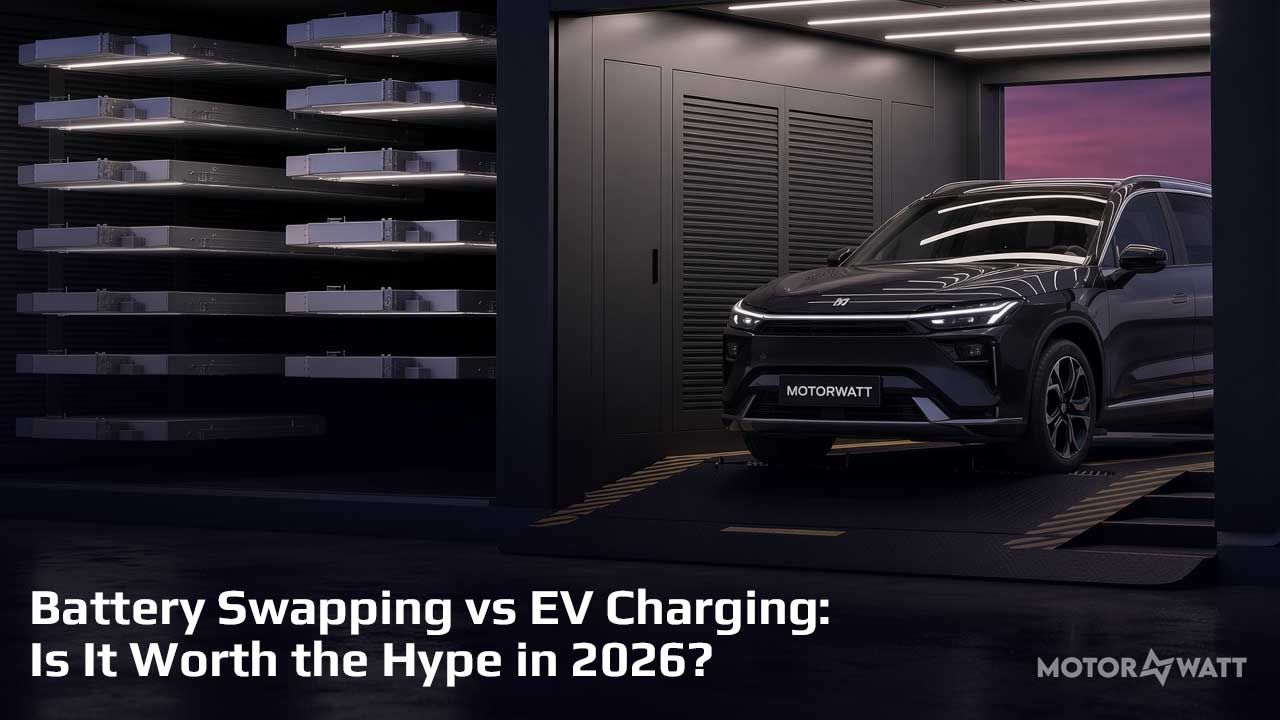
Battery swapping trades a charging cable for a robotic pit stop: drive in with a depleted pack, drive out minutes later with a full one. As of mid-2026 it's a fast-growing complementary technology to plug-in charging — dominant in China for fleets, taxis, and heavy trucks — rather than a replacement for the plug in your garage.
What Is Battery Swapping?
Battery swapping means exchanging a depleted EV battery pack for a pre-charged one at a dedicated station, rather than plugging the car in and waiting. It's a fundamentally different energy-replenishment model from charging — one built to mimic the speed of a traditional gas-station fill-up while sidestepping some of the battery and grid headaches that come with high-power charging.
The concept isn't new, but it has matured fast. Automated stations now handle the entire process — unlocking the pack, lowering it, swapping in a fresh one, and re-securing everything underneath the car — without the driver leaving the seat.
How Fast Is a Swap, Really?
Speed is the headline selling point. A full swap typically takes 3–5 minutes, and the most advanced automated systems have pushed that down to under 3 minutes — some reporting swaps as quick as roughly 99 seconds. That's squarely in gas-station territory, and it's a meaningful step up even on DC fast charging, which commonly needs 15 to 45-plus minutes for a substantial top-up, before even considering slower Level 2 charging.
Approximate time to get back on the road with a substantial charge. Advanced swap figure reflects the fastest automated systems reported as of mid-2026.
Pros of Battery Swapping
- Speed and convenience. A 3–5 minute swap (sometimes faster) means drivers leave with a full battery and minimal downtime — a real edge over even the fastest DC charging.
- Built for high-utilization vehicles. Fleets, taxis, ride-hailing, delivery vans, and heavy-duty trucks benefit most, since less idle time directly boosts operational efficiency and revenue.
- Lower upfront vehicle cost via Battery-as-a-Service (BaaS). Buyers can purchase the car without the expensive battery pack and lease or subscribe to it instead, cutting the purchase price and shifting degradation risk to the operator.
- Better battery health and management. Stations charge packs under controlled conditions — often slower, off-peak, professionally monitored — which can extend lifespan versus frequent high-power fast charging, plus support centralized diagnostics and upgrades.
- Grid and space advantages. Batteries can be charged during low-demand periods, easing peak grid loads, and swap stations can achieve higher vehicle throughput in a denser footprint than an equivalent bank of chargers in some urban settings.
- Reduced range anxiety without home charging. Particularly useful for drivers in dense cities or without dedicated parking and charging access.
Cons of Battery Swapping
- Standardization and design constraints. Success needs common battery sizes, shapes, connectors, and interfaces — but most automakers prefer proprietary packs tightly integrated for their own architecture, energy density, crash safety, and thermal management. Swappable designs often need extra packaging that can eat into range.
- High infrastructure and inventory costs. Stations require automation, storage, and a large pool of spare (expensive) batteries. Capital costs run well above equivalent charging stations, and break-even typically needs high utilization.
- Compatibility, ownership, and quality concerns. Drivers may receive a pack with unknown prior usage or residual capacity, and networks are often brand- or operator-specific, locking users into one ecosystem.
- It doesn't eliminate charging. Swapped-out batteries still need charging at the station, and high demand can drain the ready inventory, turning a fast process into a wait.
- Limited scalability outside specific markets. Dense networks are capital-intensive and best suited to high-traffic corridors or urban hubs; rural or low-volume areas remain uneconomical.
- Economic and competitive pressure. Per-kWh energy costs at swap stations can run higher than home or public charging, and ultra-fast charging advances are closing the pure speed gap.
Who's Building the Swap Networks?
China is where battery swapping has scaled fastest, led by two very different players: an automaker running its own proprietary network, and a battery maker pushing an open standard across the industry.
Battery-Swapping Network Snapshot (2026)
|
Operator
|
Stations (2026)
|
Swap Speed
|
Notable Reach
|
|---|---|---|---|
|
NIO
|
120M+ cumulative swaps by August 2026, across its own brand lineup
|
||
|
CATL Choco-SEB
|
Passenger cars, commercial vehicles and heavy trucks; partners including Sinopec; early moves into Hong Kong and Europe (truck-focused, with Octopus Energy)
|
Figures reflect network status as reported for mid-to-late 2026.
Market Growth and Outlook
Analysts project strong growth for the sector — roughly 30% CAGR — with the market valued in the low billions of dollars in 2025 and potentially reaching tens of billions by the early 2030s, driven largely by Asia-Pacific demand and commercial fleets. Standardization pushes from CATL and others, combined with Chinese government support, are helping the category mature. Battery swapping looks especially promising for electric heavy-duty trucks, where a meaningful share of new Chinese models already support swapping, and for high-mileage urban fleets.
Challenges remain real: some operators report losses or slow utilization ramp-up, industry-wide standards are still incomplete, fast-charging and longer-range batteries keep improving, and adoption outside Asia remains limited — Europe and the US have only pilot-scale deployments so far. Solid-state and other next-generation battery chemistries could still reshape the trade-offs by enabling faster charging or different pack architectures.
Swapping vs. Charging: Which One Wins?
Neither, really — they're built for different jobs. Charging stations remain more universal, compatible with nearly all EVs, and easier and cheaper to deploy widely, which makes them ideal for overnight home or workplace charging and opportunistic top-ups. Their main drawbacks are time, potential battery stress from frequent DC fast charging, and strain on the grid at peak hours.
Battery swapping earns its keep where downtime is the enemy — fleets, taxis, ride-hailing, and trucks — and in dense urban markets where drivers lack reliable home charging. Private passenger-car owners with a driveway and a charger will likely keep favoring plugging in.
Expect coexistence, not conquest. Battery swapping will keep growing as critical infrastructure for commercial fleets, high-utilization vehicles, and dense urban markets — especially in China — while charging networks remain the backbone for most private and long-distance driving, sharpened by faster tech and smarter grid integration.
Frequently Asked Questions
- How long does an EV battery swap take?
Most swaps take 3–5 minutes. The fastest automated systems have brought that down to under 3 minutes, with some reporting swaps in around 99 seconds — comparable to a gas-station fill-up.
- Is battery swapping cheaper than charging?
Not necessarily. While Battery-as-a-Service can lower the upfront price of the vehicle, per-kWh energy costs at swap stations can run higher than home or public charging, and the stations themselves are far more capital-intensive to build.
- Which companies lead the battery-swapping market?
NIO operates the largest branded network, with roughly 4,000 stations in China and over 120 million cumulative swaps as of August 2026. CATL's Choco-SEB standardized system has scaled aggressively too, reaching around 2,000 stations by mid-2026 and expanding into trucks and international markets.
- Will battery swapping replace plug-in charging?
Unlikely in the near term. Swapping is expanding fast but remains complementary — strongest for fleets, taxis, and heavy trucks, and concentrated in China. Charging remains the more universal, lower-cost option for most private vehicle owners.
- Why don't more automakers support battery swapping?
It requires standardized battery sizes, shapes, and interfaces across brands, but most automakers design proprietary, tightly integrated packs optimized for their own vehicle's energy density, crash safety, and thermal management — making swappable designs a harder engineering trade-off.