
Why Humanoids Are the Future of Manufacturing: Insights from Boston Dynamics
Why Humanoids Are the Future of Manufacturing: Insights from Boston Dynamics
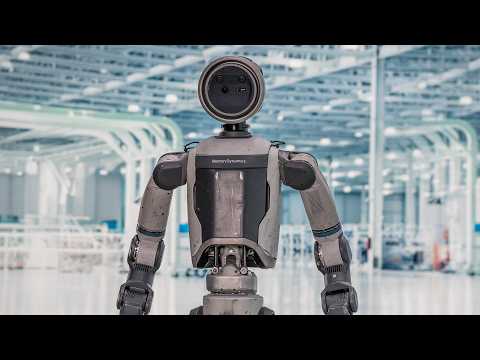
In the evolving landscape of industrial automation, where factories grapple with unprecedented variability in production lines—from customizing thousands of car parts daily to adapting to endless trim options and colors—traditional robots often fall short. Hard-coded machines excel at repetitive, predictable tasks but falter in dynamic environments requiring dexterity, adaptability, and quick reconfiguration. Enter humanoid robots, not as sci-fi novelties but as pragmatic solutions poised to shatter these limitations. A recent webinar hosted by Boston Dynamics, featuring Product Lead Aya Durbin and Director of Robot Behavior Alberto Rodriguez, makes a compelling case for why their Atlas humanoid robot could redefine manufacturing, unlocking efficiency and scalability that humans alone can't sustain.
At the heart of the argument is a simple truth: manufacturing's "variability ceiling" demands generality over specialization. Consider an automotive assembly line, where workers must deftly pick bolts from a cluttered bowl, wield a driver tool, and secure components while navigating tight spaces and maintaining balance. These aren't isolated actions but a symphony of perception, planning, and execution that varies with every shift. Traditional industrial arms, tethered to fixed fixtures, require costly retooling for even minor changes, rendering them uneconomical for high-mix, low-volume production. Humanoids like Atlas flip this script. Their human-like form—bipedal legs, dexterous hands, and a full range of motion—allows them to operate in human-designed spaces without alterations. "The real value is addressing directly that variability, that generality, that can unlock the ceiling of current automation techniques," Rodriguez asserts, emphasizing that the pursuit of a humanoid shape isn't about anthropomorphism but about leveraging existing infrastructure for maximum retaskability.
Skeptics often question the choice of legs over wheels, citing stability concerns or added complexity. Durbin counters this head-on: while wheeled robots like Boston Dynamics' own Stretch shine in warehouses, legs offer unparalleled versatility for the factory floor and beyond. They enable slimmer profiles for navigating narrow aisles, rapid pivots around obstacles, and access to elevated or low-clearance areas that wheels can't reach without bulky add-ons. Crucially, dynamic balance is no longer a hurdle; advancements in actuators and control systems have made it a solved problem. The cost parity is striking too—humanoids don't inherently demand more actuators than wheeled counterparts, and their ROI stems from performing diverse tasks across environments, from structured plants to unstructured retail or homes.
Achieving this vision hinges on reliability, a trifecta of hardware robustness, behavioral consistency, and intuitive software. Drawing lessons from the widespread deployment of Spot (their quadruped robot) and Stretch, Boston Dynamics is methodically advancing Atlas through three phases: initial hardware validation, customer-driven software refinement, and mass scaling to thousands of units. Early focus remains on manufacturing's low-hanging fruit—gross pick-and-place operations in safe, controlled settings—before tackling finer assembly. Yet the ambition is bolder: "manipulation completeness," where robots handle any human-equivalent task, from tool-wielding to object reorientation.
Powering this is a sophisticated AI "brain," blending old-school robotics with cutting-edge machine learning. Gone are purely layered algorithms that cascade from perception to motion; instead, a hybrid model starts with pre-training. Neural networks ingest vast datasets from teleoperation—where human demonstrators don VR gear to "embody" Atlas, capturing 5-10 hours of nuanced behaviors per task—supplemented by simulations and observational learning from human hands. This yields an initial "behavior guess," refined on the job through demonstrations and real-time corrections. The result? Robots that don't just mimic but adapt, approaching the 99.7% uptime of top human workers. As Durbin puts it, "We want a robot that’s capable of actually performing the task... reliably, and most importantly, perform the task the exact way that the customer expects."
Looking ahead, Boston Dynamics envisions thousands of Atlas units humming in factories within 5-10 years, starting with partnerships like Hyundai to co-develop applications. Sales aren't imminent—reliability must precede revenue—but the trajectory is clear. Humanoids won't replace workers wholesale; they'll augment them, handling the dull, dirty, or dangerous while humans oversee and innovate. In an era of labor shortages and supply chain flux, this isn't just futuristic—it's essential. By embracing generality, Boston Dynamics isn't building robots to be human; they're engineering the flexibility to outpace us where it matters most. The manufacturing revolution has legs, and it's walking toward us.