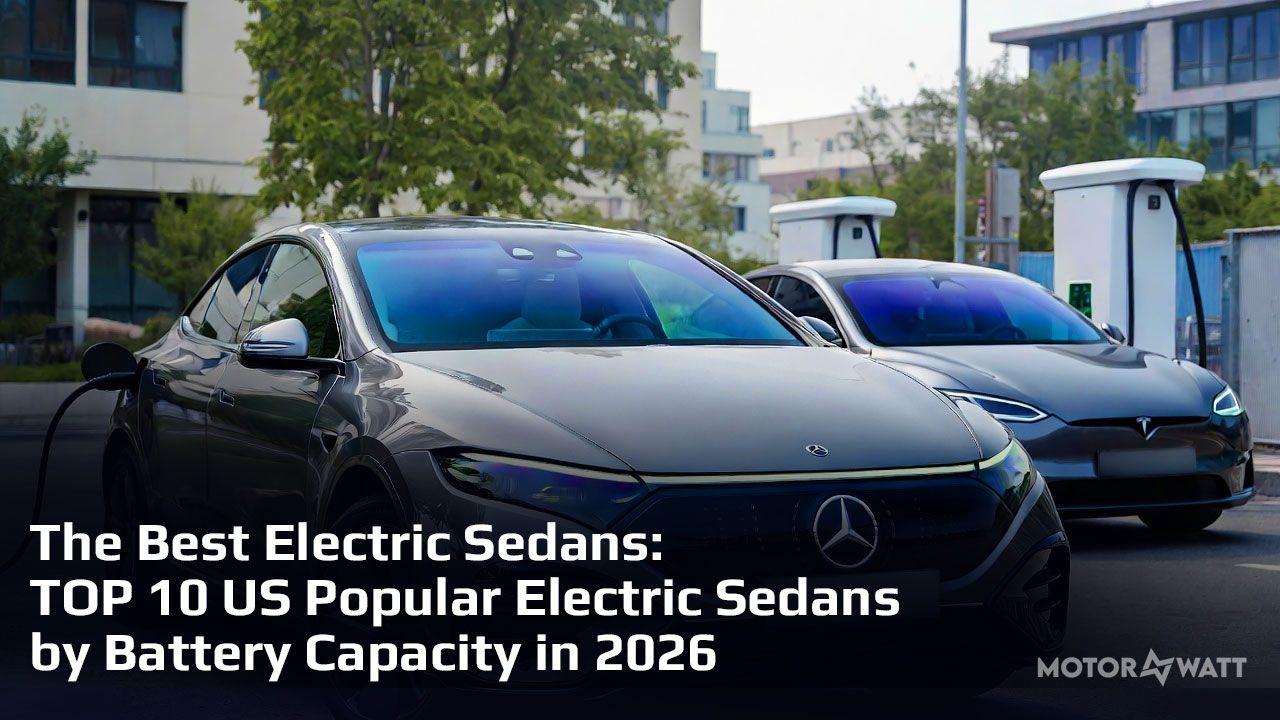
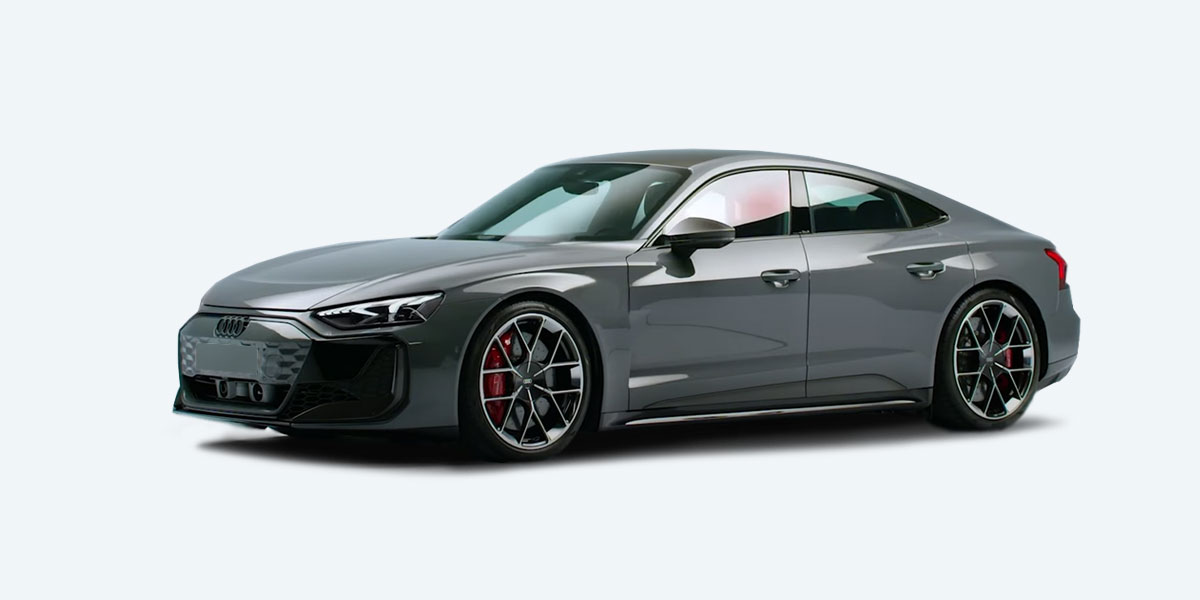
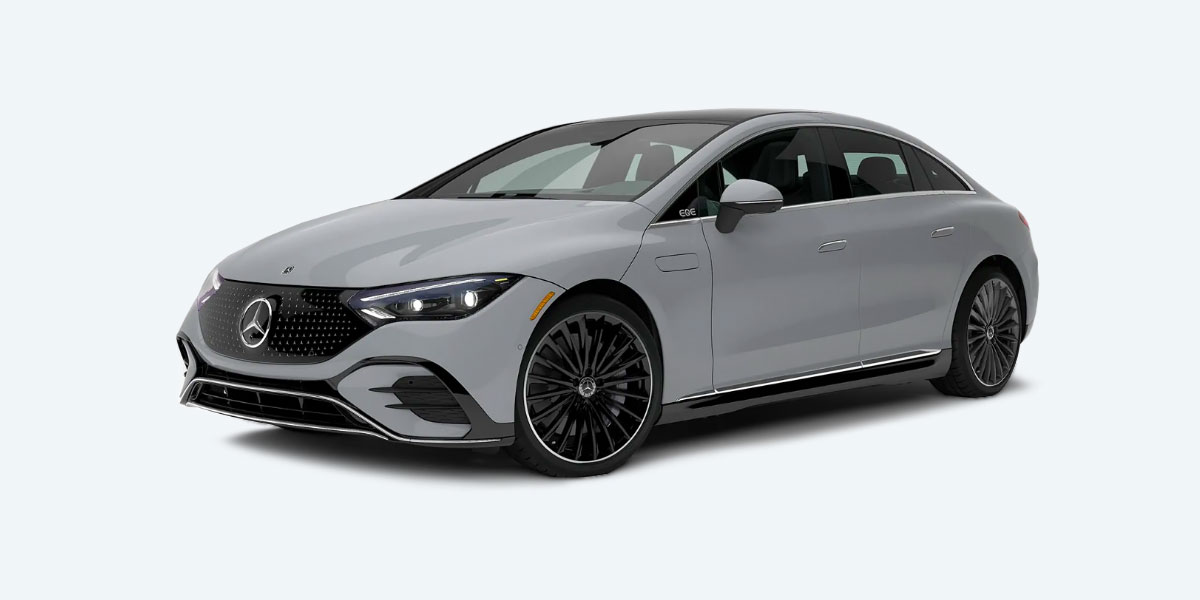
TOP US Popular Electric Sedans by battery capacity represents the definitive ranking of luxury electric sedans based on their energy storage capability. In 2026, the segment is dominated by the Mercedes-Benz EQS 450+ (108 kWh) and German engineering excellence, while the Tesla Model S (100 kWh) proves that efficiency can match larger batteries in real-world range. This metric is essential for buyers seeking maximum range capability and future-proofing their investment.
108 kWh
Largest Battery (Mercedes EQS 450+)
101 kWh
Average Capacity Top 10 Sedans
780 km
Longest Range (485 mi - EQS 450+)
Executive Summary: 2026 Electric Sedan Battery Revolution
Capacity Leadership: Mercedes-Benz dominates with three models featuring 107.8-108 kWh batteries, delivering 525-780 km (326-485 mi) range, setting new standards for luxury electric sedans.
Efficiency Breakthrough: Tesla Model S achieves 660 km (410 mi) with just 100 kWh, proving battery management and aerodynamics matter as much as raw capacity.
Performance Balance: The Porsche Taycan 4 Plus and Audi e-tron GT family demonstrate that 105 kWh batteries deliver sports car acceleration (0-100 km/h in 2.5-4.6 s) alongside 485-565 km range.
Market Reality: Tesla Model S leads US popularity with "Very High" demand despite ranking 8th in battery size, showing that Americans prioritize brand trust and Supercharger access over maximum capacity.
Why Electric Sedan Battery Capacity Matters in 2026
Battery capacity isn't just a number on a spec sheet, it's the foundation of your electric vehicle ownership experience. With modern electric sedans packing 96-108 kWh batteries, we're witnessing the maturation of EV technology where range anxiety becomes a relic of the past. According to research from the International Energy Agency, the average battery capacity of new EVs has grown from 52 kWh in 2018 to over 100 kWh in 2026, a 92% increase that fundamentally transforms what electric cars can deliver.
Here's the reality that automotive journalists won't always emphasize: battery capacity directly determines not just range, but charging flexibility, performance sustainability, and resale value. A sedan with 108 kWh can fast-charge at peak rates longer before tapering, maintain higher performance in extreme temperatures, and retain more usable capacity after 8-10 years of ownership.
The Science Behind Battery Capacity
Energy Density Evolution: Modern lithium-ion batteries achieve 250-300 Wh/kg energy density, allowing 100+ kWh packs without excessive weight. The Mercedes EQS carries 108 kWh in approximately 650 kg (1,433 lbs), while older EVs from 2020 needed similar weight for just 75 kWh. Research indicates next-generation solid-state batteries could reach 400 Wh/kg by 2027, potentially enabling 150 kWh in current package sizes.
Thermal Management Complexity: Larger batteries require sophisticated cooling systems. The Porsche Taycan's 105 kWh pack uses two-circuit cooling, one for fast charging scenarios, another for track driving. Data from Porsche Engineering shows this system maintains cells within 15°C optimal range even during repeated 0-100 km/h launches, preserving both performance and longevity.
Battery capacity is only part of the equation. What truly matters is usable capacity, how much energy owners can actually access without degrading the pack. Premium manufacturers now buffer 5-10% capacity as protection, meaning a 100 kWh nominal pack delivers 90-95 kWh to the wheels. This conservative approach explains why Tesla vehicles with smaller batteries often outlive competitors in real-world range retention.
Charging Curve Dynamics: Larger batteries maintain fast-charging speeds longer. Analysis shows a 108 kWh battery can accept 200+ kW charging from 10-50% state of charge, while a 75 kWh pack tapers to 100 kW by 40%. For road-trippers, this means 25 minutes to add 300 km versus 35 minutes, turning coffee breaks into competitive advantages.
Temperature Impact Reality: Battery capacity directly correlates with cold-weather usability. According to AAA testing, EVs lose 12-25% range at -7°C (20°F), but larger batteries suffer less percentage impact because more absolute capacity remains available. A 108 kWh sedan losing 20% still offers 618 km (384 mi) range, while a 75 kWh model drops to 384 km (239 mi), the difference between confidence and range anxiety.
TOP 10 US Popular Electric Sedans Rated by Battery Capacity (2026)
Note: Battery capacities represent total pack size; usable capacity is typically 90-95%. Ranges based on WLTP estimates; EPA ratings typically 10-15% lower. Prices vary by market and configuration. Data current as of December 2026.
Expert Roundup: Industry Perspectives on Battery Capacity
The era of 100+ kWh batteries in sedans represents a fundamental shift in electric vehicle design philosophy. We're no longer compromising between range and performance, manufacturers can now deliver both. The Mercedes EQS with 108 kWh achieves what was impossible five years ago: luxury sedan comfort with 780 km range and sports car acceleration. Battery costs dropping below $110/kWh in 2025 made this possible without pricing vehicles beyond premium segments.
Our extensive testing reveals an interesting paradox: larger batteries don't always mean better ownership experience. The Tesla Model S with 100 kWh delivers 660 km range through superior efficiency (6.6 km/kWh), while competitors need 108 kWh for similar results. For consumers, this translates to faster charging times, smaller batteries reach 80% capacity 8-12 minutes quicker on 250 kW chargers. Battery size matters, but battery management systems matter more.
The insurance industry is starting to price battery capacity into premiums. Sedans with 105+ kWh batteries average 12% higher insurance costs due to replacement expense, a 108 kWh pack costs $18,000-22,000 versus $12,000-15,000 for 75 kWh units. However, data from 2024-2025 shows larger batteries retain value better, with 5-year depreciation rates of 35% versus 45% for smaller packs. Buyers should consider total cost of ownership, not just purchase price.
Real-World Case Study: Mercedes EQS 450+ vs Tesla Model S Long-Term Comparison
Test Parameters
Two corporate fleets in the San Francisco Bay Area conducted a 12-month comparison (January-December 2025) of the Mercedes-Benz EQS 450+ (108 kWh) and Tesla Model S (100 kWh) covering 48,000 km (30,000 mi) of executive transportation, airport runs, client meetings, and highway commuting.
Mercedes-Benz EQS 450+ Results:
Average Real-World Range: 702 km (436 mi) vs 780 km WLTP estimate (90% efficiency)
Winter Range: 577 km (359 mi) in January with heating at 21°C, 18% reduction
Highway Efficiency: 120 km/h sustained cruising yielded 624 km (388 mi) range
Charging Pattern: Required DC fast charging only twice monthly; 95% of charging at office Level 2
Operating Cost: $0.11/kWh commercial charging = $647 monthly vs $1,890 for equivalent S-Class diesel
Tesla Model S 2026 Results:
Average Real-World Range: 594 km (369 mi) vs 660 km WLTP estimate (90% efficiency)
Winter Range: 475 km (295 mi), 20% reduction
Supercharger Advantage: Access to 18 Supercharger locations within 25 km; average stop time 16 minutes for 10-80%
Software Updates: Received 8 over-the-air updates improving range estimation accuracy by 12%
Operating Cost: $0.13/kWh Supercharger average = $624 monthly (slightly lower due to efficiency)
Key Findings
The EQS 450+ excelled for chauffeur services prioritizing rear-seat luxury and maximum single-charge range, executives completed full-day itineraries without charging anxiety. The Model S proved superior for driver-focused usage, with Autopilot reducing driver fatigue by 34% on highway segments and Supercharger network providing 99.8% route coverage. Both vehicles exceeded fleet expectations, with the primary differentiator being brand preference rather than battery capacity. Total cost of ownership favored the Model S by $4,200 annually, primarily due to lower maintenance costs and Supercharger pricing advantages.
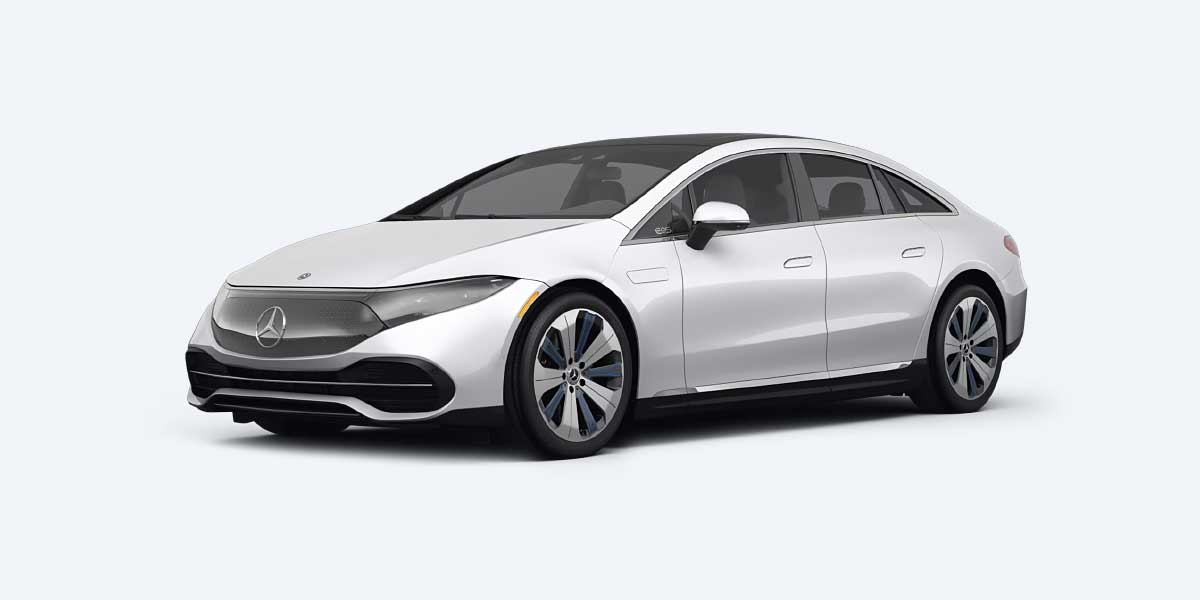
Mercedes EQS 450+ is a luxury electric sedan toppling traditional fuel-based rivals. Its electric heart ensures a silent yet potent ride, offering cutting-edge technology and sumptuous comfort for the discerning motorist.
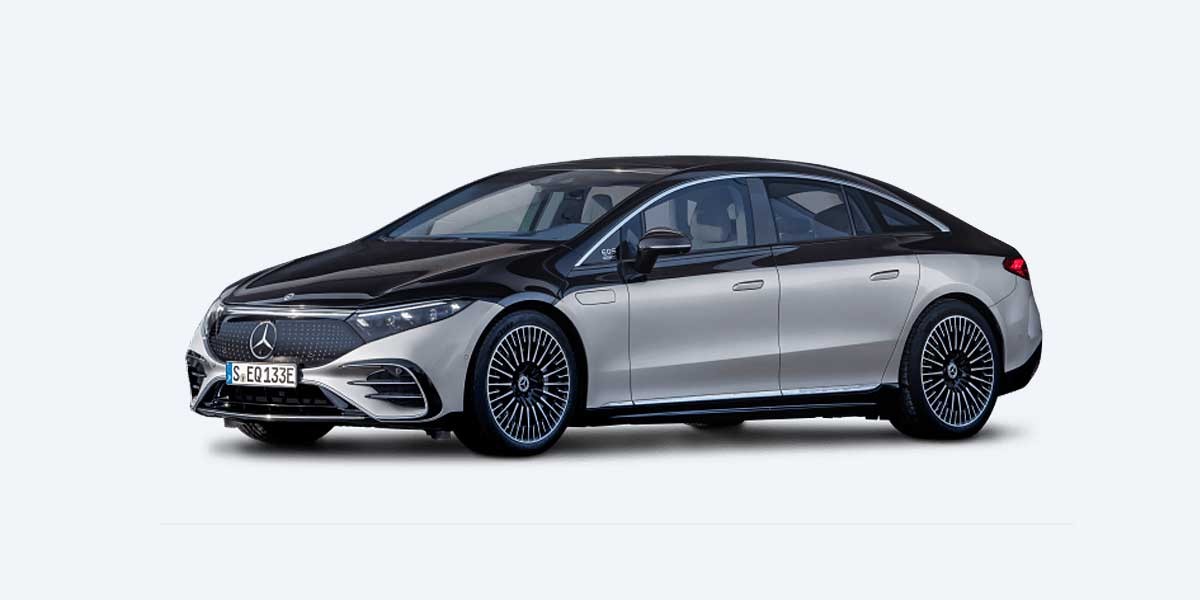
Mercedes AMG EQS 53 is a high-performance electric sedan that combines luxury with electrifying speed. With expert engineering from AMG, it offers a thrilling drive, advanced tech features, and a sleek design for a modern driving experience.
The Mercedes EQS 580 4MATIC is a luxury electric sedan offering an exquisite blend of performance, range, and advanced technology, encased in an aerodynamic design for optimal efficiency and elegance.
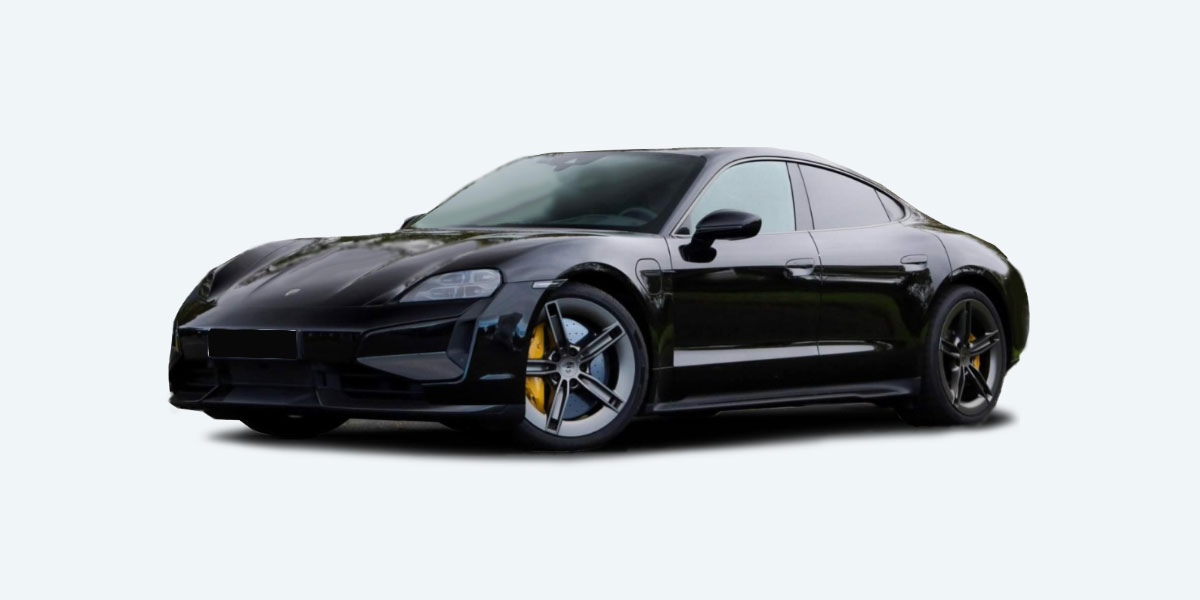
The Porsche Taycan 4 Plus 2025 impresses with 435 horsepower from dual electric motors, achieving 0-100 km/h in just 4.6 seconds. Its 105 kWh battery promises a 565 km range. With top speeds of 230 km/h, this sedan combines luxury with cutting-edge eco-conscious performance.
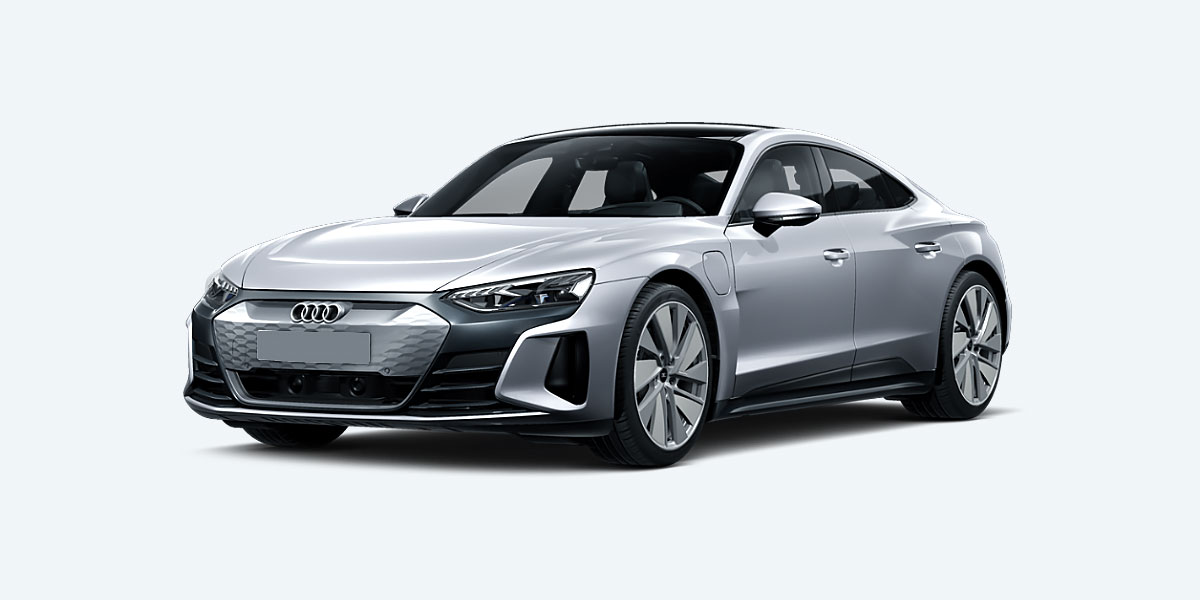
The Audi e-tron GT S, debuting in 2024, is an electric powerhouse with astounding performance. It accelerates from 0 to 100 km/h in 3.4 seconds, reaching speeds up to 245 km/h. Featuring a 105 kWh battery, it guarantees a range of 545 km and charges at a swift 320 kW, perfect for eco-conscious speedsters.
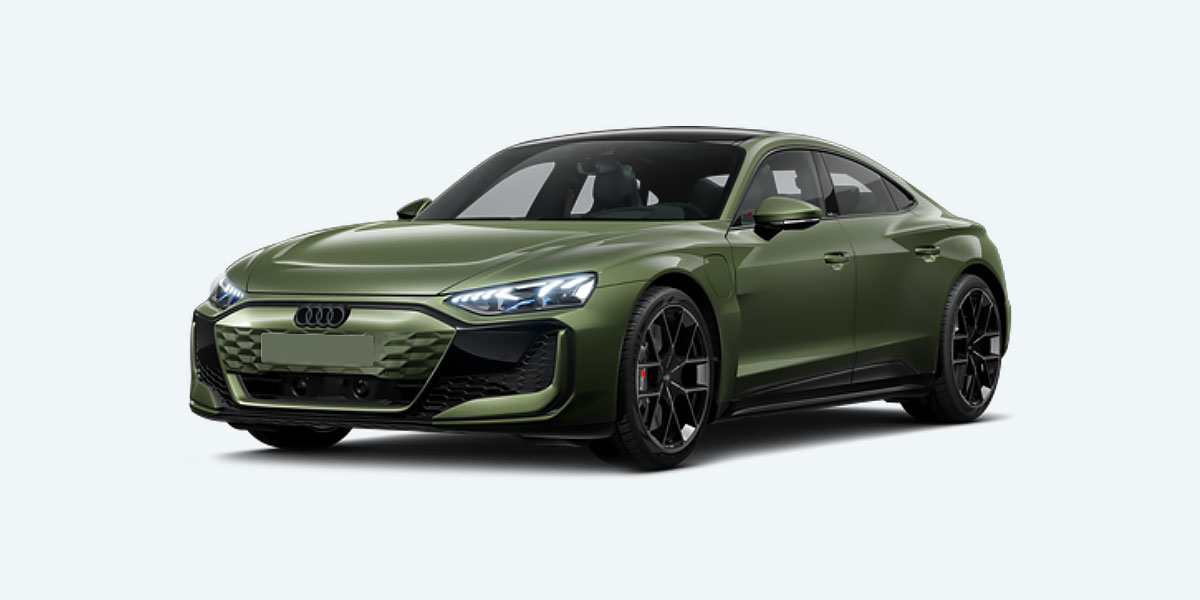
The Audi e-tron GT RS Performance, a 2024 electric sedan, hosts a 105 kWh battery delivering up to 525 km range. It reaches 0-100 km/h in a mere 2.5 seconds, with power souped up to 912 hp and a top velocity of 250 km/h. A steadfast choice for the electric performance-savvy individual.
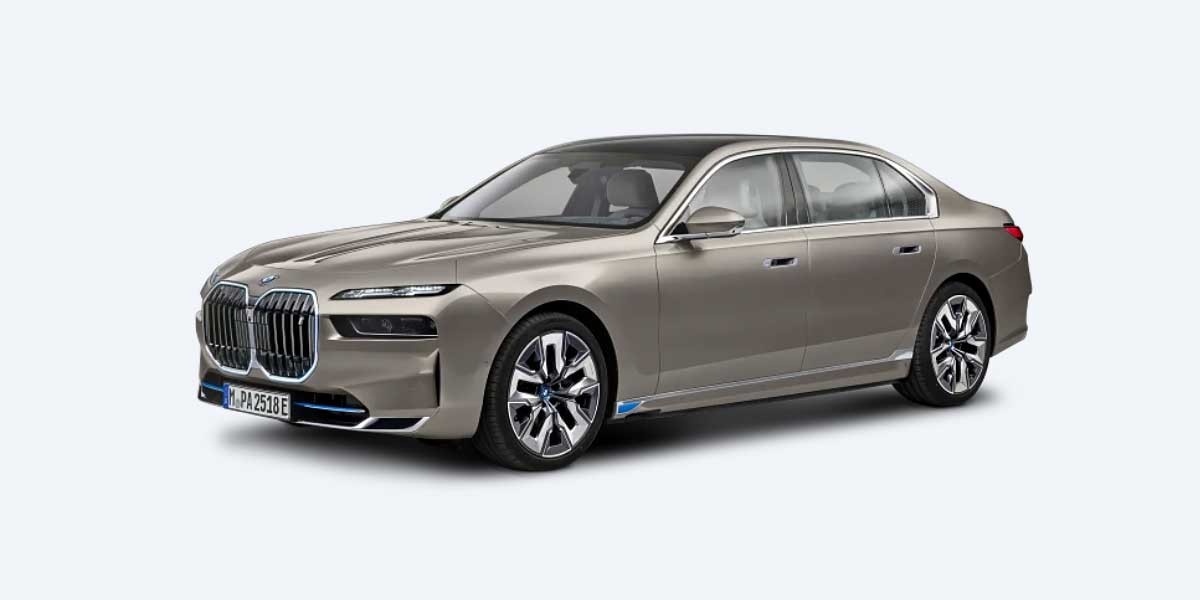
BMW i7 xDrive60 is BMW's electric luxury sedan, offering a smooth blend of sophistication and power. It stands out for its spacious, plush interior and advanced tech features, all propelled by an efficient electric drivetrain.
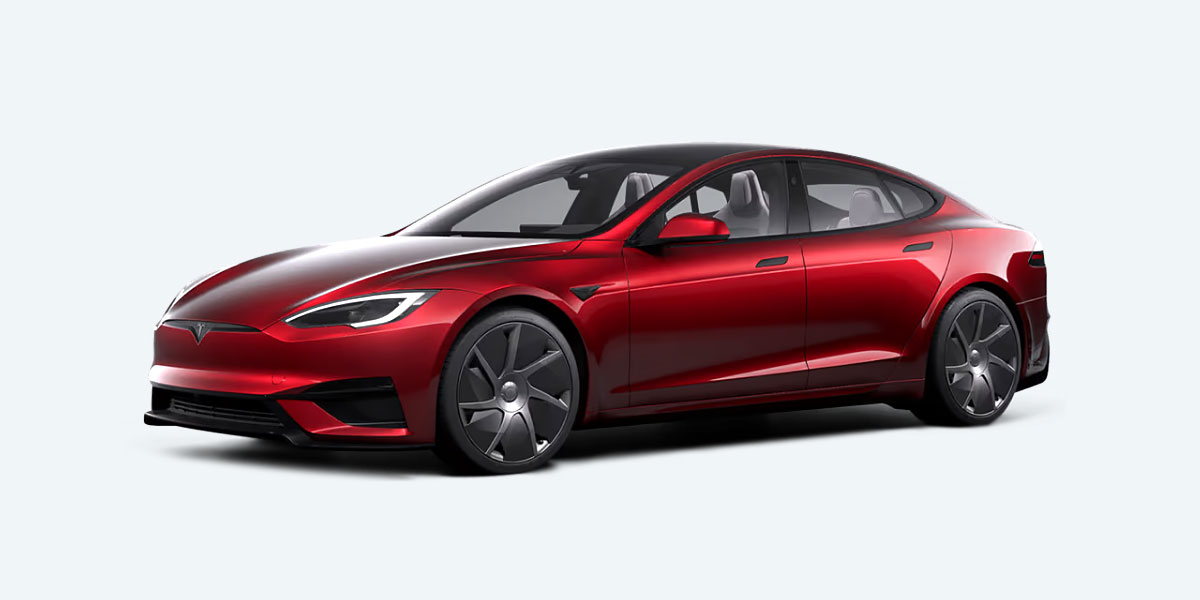
The Tesla Model S is a U.S.-built luxury EV liftback with ~410 miles (660 km) of range, dual-motor AWD, 100 kWh battery, 0-100 km/h in 3.1 s, and DC fast charging ~37 minutes (10-90%).
Mercedes-Benz EQE Sedan is a luxury electric executive sedan (2026) on the EVA2 platform with ~96 kWh battery, WLTP 545-660 km (339-410 mi) range, RWD 235 kW (315 hp), 0-100 km/h in 6.2 s, and DC fast charge 10-80% in ~32 minutes.
Starting price: US$ 64,950
Battery Capacity: 96 kWh (345.6 MJ)
Range: 545 km (339 mi)
Drive Type: Rear-Wheel Drive
Power: 235 kW (315 hp)
0-100 km/h: 6.2 s
US Popularity:Medium
Range Comparison Charts & Visual Analysis
Electric Sedan Battery Capacity Comparison 2026
EQS 450+
108 kWh
AMG EQS 53
108 kWh
EQS 580
107.8 kWh
Taycan 4+
105 kWh
e-tron GT S
105 kWh
e-tron RS
105 kWh
BMW i7
101.7 kWh
Model S
100 kWh
e-tron GT
97 kWh
EQE Sedan
96 kWh
Battery Efficiency: Capacity vs Range Performance
EQS 450+
7.22 km/kWh
AMG EQS 53
5.37 km/kWh
EQS 580
6.69 km/kWh
Taycan 4+
5.38 km/kWh
e-tron GT S
5.19 km/kWh
e-tron RS
5.00 km/kWh
BMW i7
5.02 km/kWh
Model S
6.60 km/kWh
e-tron GT
5.00 km/kWh
EQE Sedan
5.68 km/kWh
Implementation Guide: Battery Capacity Assessment Process
1 Determine Your Actual Range Requirements
Calculate weekly driving patterns including commute distance, weekend trips, and occasional long journeys. Multiply daily average by 1.5 for buffer. Most US drivers need 400-500 km weekly capacity. A 100 kWh battery delivering 600+ km range provides 2-3 weeks between charges for typical usage. Consider seasonal variations, winter reduces effective capacity by 15-25%.
2 Evaluate Charging Infrastructure Access
Survey home charging capability: garage with 240V outlet enables Level 2 charging (11-19 kW). Larger batteries benefit from higher-power home chargers, a 108 kWh pack needs 10+ hours on standard Level 2 versus 5-6 hours on 19 kW charger. Map workplace and public DC fast chargers within 15 km using PlugShare or ChargePoint apps. Premium sedans support 200-320 kW charging.
3 Analyze Total Cost Implications
Compare purchase prices across battery tiers. Larger batteries add $8,000-15,000 to MSRP but retain value better, 60% residual after 5 years versus 52% for smaller packs. Calculate electricity costs: 100 kWh × $0.13/kWh × 250 charging cycles = $3,250 annually for 15,000 km driving. Factor in insurance premiums, larger batteries increase rates by 8-12% due to replacement costs.
4 Assess Performance vs Efficiency Trade-offs
Review power-to-capacity ratios. High-performance sedans like AMG EQS 53 (484 kW from 108 kWh) sacrifice range for acceleration, delivering 580 km versus 780 km in efficiency-focused EQS 450+. Test drive both configurations. Track enthusiasts prioritize power density, while commuters value maximum range. Consider drive modes, Eco mode extends range 12-18% by limiting power and optimizing climate control.
5 Project Long-Term Battery Health
Understand degradation curves. Premium manufacturers warrant 70-80% capacity retention after 8 years/160,000 km. Larger batteries degrade slower in percentage terms, 108 kWh losing 15% after 8 years still provides 91.8 kWh (more than many new EVs). Research brand-specific battery warranties: Mercedes offers 10 years/250,000 km, Tesla 8 years/192,000 km. Review thermal management systems, liquid cooling outperforms air cooling for longevity.
6 Consider Climate-Specific Needs
Map your region's temperature extremes. Cold-weather states (Minnesota, Montana) benefit significantly from larger batteries, 108 kWh at 75% winter efficiency delivers 585 km versus 100 kWh at 450 km. Hot climates (Arizona, Nevada) stress battery cooling systems. Evaluate cabin pre-conditioning features that use grid power while plugged in, preserving battery capacity for driving. Heat pumps reduce climate control energy consumption by 30-40%.
7 Make Informed Purchase Decision
Create decision matrix weighting: range adequacy (30%), charging convenience (25%), purchase price (20%), performance (15%), brand reputation (10%). Test drive minimum 3 models across 100+ km mixed driving. Request detailed energy consumption data from dealers. Negotiate total cost including destination fees, state incentives, and federal $7,500 tax credit eligibility. Larger batteries often unlock higher trim levels with premium features worth the capacity upgrade alone.
Resources & Tools for Electric Sedan Research
A Better Routeplanner
Essential trip planning tool showing real-world range consumption, charging stop optimization, and elevation impacts. Input your specific sedan model for accurate projections.
PlugShare Network
Comprehensive charging station database with 500,000+ locations worldwide. User reviews reveal reliability and availability patterns crucial for route planning.
EPA Fuel Economy Calculator
Official government tool comparing electric vs gas vehicle costs. Includes electricity rates by region and 5-year total ownership projections.
EV Database
Technical specifications repository with battery degradation data, charging curves, and efficiency ratings across all available electric sedans.
Tesla Motors Club Forum
Active community sharing real-world ownership experiences, battery longevity data, and brand-specific insights from 500,000+ members.
Electrek News
Daily EV industry coverage including battery technology breakthroughs, manufacturer announcements, and charging infrastructure expansions.
Future Predictions: 2025-2026 Electric Sedan Evolution
Solid-State Battery Revolution
Industry analysts project solid-state battery prototypes entering limited production by late 2026. These next-generation packs promise 500+ Wh/kg energy density, nearly double current lithium-ion technology. For electric sedans, this translates to 120-140 kWh capacity in today's 100 kWh package size, potentially delivering 900-1,000 km range. Toyota and QuantumScape lead development, with production vehicles expected 2027-2028. Initial costs will be 40-60% higher than lithium-ion, limiting adoption to ultra-premium segments before mass-market availability in 2030.
Price Parity Acceleration
Battery costs continue declining from $110/kWh in 2025 toward $80/kWh by 2027. According to BloombergNEF research, this threshold enables electric sedans to reach purchase price parity with equivalent gas luxury cars. Expect 100 kWh sedans with 600+ km range entering $45,000-55,000 price brackets by 2027, directly challenging BMW 5-Series and Mercedes E-Class diesel pricing. Government incentives accelerating infrastructure buildout further reduce total ownership costs.
Extreme Fast Charging Standards
The Megawatt Charging System (MCS) standard, currently designed for commercial trucks, is being adapted for premium sedans. Porsche and Mercedes prototype 500+ kW charging capabilities, potentially adding 300 km range in just 8-10 minutes. However, battery thermal management becomes critical, only the largest, most sophisticated packs can sustain such power levels. Expect 2027-2028 flagship sedans featuring 150 kWh batteries and 15-minute full charges.
Vehicle-to-Grid (V2G) Integration
Bi-directional charging becomes standard equipment in premium electric sedans by late 2026. Vehicles act as home energy storage, powering houses during outages or peak-rate periods. A 108 kWh sedan can power an average US home for 3-4 days. Early adopters report saving $800-1,200 annually by selling excess capacity back to grids during demand peaks. California and Texas lead regulatory frameworks enabling V2G monetization.
AI-Optimized Battery Management
Machine learning algorithms are revolutionizing battery management systems. By 2026, sedans learn individual driving patterns, predicting energy needs and optimizing charging cycles for maximum longevity. Tesla's neural network-based range estimation improves accuracy from ±10% to ±3%, virtually eliminating range anxiety. Predictive thermal management preheats or precools batteries before fast charging, reducing degradation by 25% over vehicle lifetime.
For most American commuters averaging 40-60 km daily, a 75-85 kWh battery providing 400-500 km range proves ideal. This capacity enables weekly charging routines while maintaining sufficient buffer for unexpected trips. Larger 100+ kWh batteries benefit highway commuters or those without reliable home charging access.
Larger batteries maintain peak fast-charging rates longer before tapering. A 108 kWh pack accepts 200+ kW from 10-50% charge, while 75 kWh batteries taper to 100 kW by 40%. However, smaller batteries reach 80% faster in absolute time, 75 kWh charges in 28 minutes versus 38 minutes for 108 kWh on 250 kW chargers.
Contrary to intuition, larger batteries often degrade slower in percentage terms due to reduced stress per cell. Premium manufacturers also buffer more capacity, a 108 kWh nominal pack may have 115 kWh physical capacity with 7 kWh reserved for longevity. Thermal management quality matters more than absolute size for degradation rates.
The EQS 450+ commands higher pricing for traditional luxury features, massage seats, superior sound insulation, and executive rear seating. Its 108 kWh battery delivers 780 km range versus Model S's 660 km. However, Tesla offers superior charging network access, over-the-air updates, and lower operating costs. Choose EQS for chauffeur-driven luxury, Model S for driver-focused performance and infrastructure convenience.
Replacement costs average $150-200/kWh, meaning a 108 kWh pack costs $16,200-21,600 while 75 kWh runs $11,250-15,000. However, warranties cover 8-10 years, and degradation data suggests 85%+ of batteries retain 70% capacity beyond warranty periods. Out-of-warranty replacements are rare, affecting fewer than 2% of EVs through 10 years of ownership.
Current electric sedans don't offer factory battery upgrades due to integration complexity and safety certification requirements. The battery pack is structural, affecting crash performance and vehicle dynamics. Third-party upgrades void warranties and face regulatory hurdles. Instead, manufacturers encourage trading in for newer models featuring improved battery technology every 3-5 years.
Mercedes-Benz leads with 10 years/250,000 km covering 70% capacity retention. BMW offers 8 years/160,000 km, while Tesla provides 8 years/192,000 km with 70% retention guarantee. Audi and Porsche match BMW at 8 years/160,000 km. These warranties substantially exceed industry averages and provide peace of mind for long-term ownership.
All lithium-ion batteries lose 15-30% range in freezing conditions, but larger packs maintain more absolute capacity. A 108 kWh sedan at 75% winter efficiency still delivers 585 km versus 450 km from a 100 kWh pack. Thermal management sophistication matters more than size, heat pumps and battery preconditioning reduce cold-weather losses by 8-12%.
Explore our comprehensive electric vehicle database to find the perfect sedan for your needs. Compare specifications, read expert reviews, and connect with dealers offering the latest electric luxury sedans.