

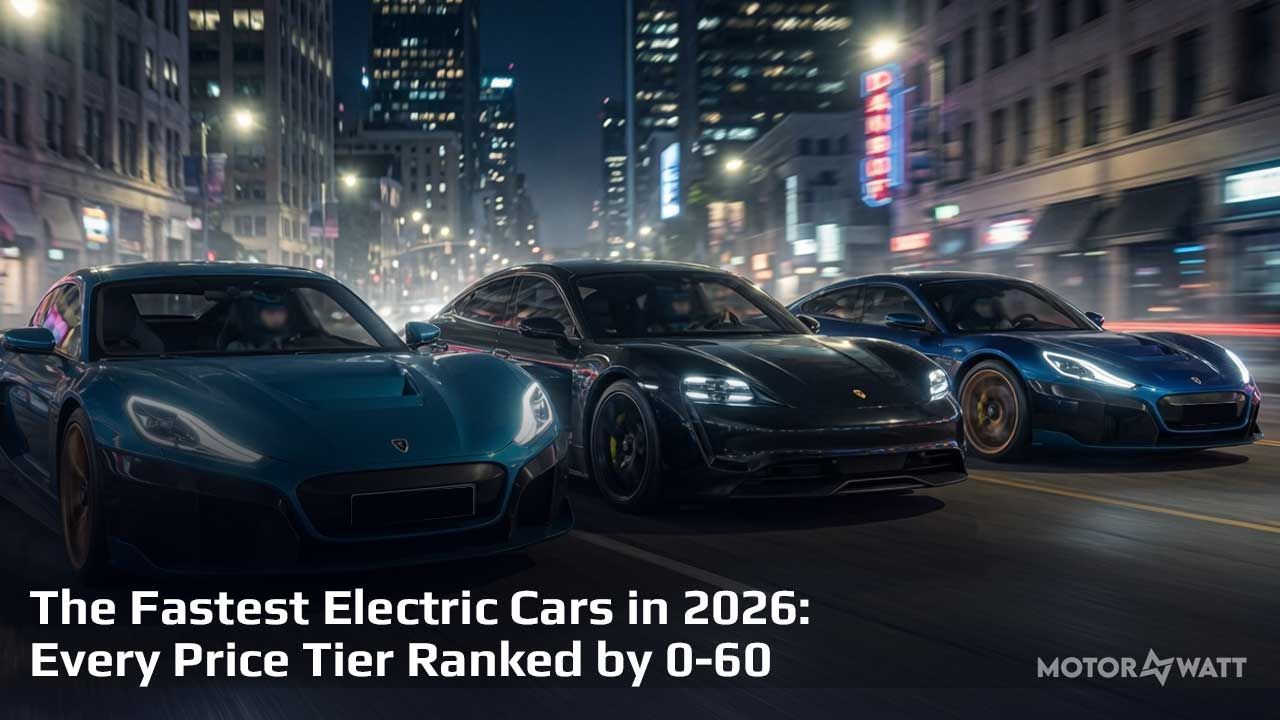
Fast EV cars in 2026 are redefining what acceleration means. The Porsche Taycan Turbo GT hits 60 mph in 2.17 seconds in independent testing. A $49,990 Tesla Model 3 Performance does it in 3.1. But most rankings ignore price — this one tiers every fast EV by budget so you can find the quickest car you can actually buy. We've also included the one thing no one else covers: what going fast actually costs you in range.
But here's what the other rankings miss: most of them only cover the top 10 by raw speed, which means they're ranking cars that cost $100k to $2 million. If you're shopping for fast EV cars and your budget is somewhere south of $150,000 — or, let's be honest, south of $60,000 — those lists don't help you. This one does.
We've tiered every fast EV by price bracket, included a full data table with both 0-60 and top speed, and added the one thing nobody else covers: what high-speed driving actually costs you in range. Figures come from independent testing (Edmunds, Car and Driver, MotorTrend) where available; manufacturer-stated specs are labeled as such.
Quick link: See our fastest home EV charger guide to match charging speed to the car's performance.
Key Numbers at a Glance
How We Ranked These EVs
The rankings use three inputs in order of preference:
- Independently tested 0-60 (Edmunds, Car and Driver, MotorTrend, Road & Track). When a publication has published a test result, that number takes precedence over everything else.
- Manufacturer-stated 0-60 where independent testing isn't available. Labeled as "(mfr)" throughout.
- Top speed from confirmed track runs or manufacturer specs. Many EVs are electronically speed-limited — we note where that applies.
All pricing is 2026 US MSRP before destination charges, federal tax credit, or options. Model year is 2026 unless otherwise noted.
Full 0-60 and Top Speed Rankings Table
Twenty of the fastest production EVs available in the US in 2026, sorted by 0-60 time.
Fast EV Cars — Complete 0-60 and Top Speed Data
| Vehicle | 0-60 (sec) | Top Speed (mph) | Motor Config | MSRP (from) | Tier |
|---|---|---|---|---|---|
| Rimac Nevera | |||||
| Pininfarina Battista | |||||
| Tesla Model S Plaid | |||||
| Porsche Taycan Turbo GT | |||||
| Lucid Air Sapphire | |||||
| Tesla Model X Plaid | |||||
| Rivian R1S Tri-Motor | |||||
| Mercedes-AMG EQS 53 | |||||
| Tesla Model 3 Performance | |||||
| Hyundai Ioniq 5 N | |||||
| Kia EV6 GT | |||||
| Hyundai Ioniq 6 N | |||||
| Audi RS e-tron GT | |||||
| BMW iX M60 | |||||
| Porsche Taycan 4S | |||||
| Tesla Model Y Performance | |||||
| Cadillac Escalade IQ Sport | |||||
| Rivian R1T Dual Max | |||||
| Ford Mustang Mach-E GT | |||||
| Volkswagen ID.5 GTX |
Fastest Affordable EVs (Under $60,000)
The performance gap between affordable and exotic EVs has almost closed at the bottom of the 0-60 table. A $49,990 Tesla Model 3 Performance does 3.1 seconds. That's quicker than a 2015 Porsche 911 Carrera S. Let that sit for a second.
Tesla Model 3 Performance — 3.1 seconds, from $49,990
The fastest affordable electric car you can buy in 2026 is the Tesla Model 3 Performance. The 3.1-second 0-60 is manufacturer-stated; real-world testing from Car and Driver has clocked it in the low 3s on a good launch. Top speed is 162 mph. Range takes a hit compared to the Long Range model — EPA-rated at 315 miles, but expect closer to 220 on a sustained 80 mph highway run.
The dual-motor setup delivers 510 hp and 660 lb-ft of torque. Track Mode is included, with adjustable stability, regenerative braking, and a cooling system upgrade. For the money, nothing in this tier comes close.
Hyundai Ioniq 6 N — 3.4 seconds, from $54,000
Hyundai's N Division took the already-quick Ioniq 6 and made it something else. The Ioniq 6 N produces 641 hp, hits 60 mph in a manufacturer-stated 3.4 seconds, and has an N Grin Boost function that temporarily unlocks maximum power for 10-second bursts — useful for a drag race, unnecessary for anything else. Top speed is 155 mph (electronically limited). The N Shift feature simulates gear changes and sound, which either sounds fun or offensive depending on where you stand. EPA range is around 220 miles in this trim.
Kia EV6 GT — 3.4 seconds, from $61,600
The EV6 GT sits just above the $60k threshold but belongs in this conversation. It's mechanically related to the Ioniq 5 N and shares the same 576 hp dual-motor setup. Manufacturer-stated 0-60 is 3.4 seconds. Top speed is 161 mph. The GT packs a Sport sound generator, Boost mode, and dedicated GT calibration for the chassis — it's a proper hot hatch in EV form. One issue: 206 miles of EPA range means you're stopping more often if you drive it hard.
Tesla Model Y Performance — 3.5 seconds, from $52,490
The best-selling EV in America also happens to be genuinely fast. The Model Y Performance does 0-60 in 3.5 seconds (mfr), tops out at 155 mph, and seats five. That's the core appeal: it's a family crossover that embarrasses sports cars. Range is 277 miles EPA. If you need the seat count and the speed and the budget is under $55k, this is the pick.
Fastest Mid-Range EVs ($60,000–$150,000)
This is where performance gets serious — and where the value calculations get complicated. The Tesla Model S Plaid at $89,990 is among the fastest production cars ever built, period, not just EVs.
Tesla Model S Plaid — 1.99 seconds (mfr), from $89,990
Tesla's manufacturer-stated 1.99-second 0-60 is with a one-foot rollout, which is how drag strips measure but not how most tests do. In real-world conditions, independent testers have clocked the Model S Plaid in the 2.1–2.3 second range consistently — still extraordinary. The Plaid produces 1,020 hp across three motors. Quarter mile is around 9.2–9.4 seconds (tested). Top speed is electronically capped at 200 mph with the optional Track Package ($20,000). Without it: 163 mph.
The cabin, software, and Supercharger network remain class-leading. Range is 396 miles EPA, which means even if you push it hard you're not stopping constantly.
Rivian R1S Tri-Motor — 2.8 seconds (tested), from ~$78,000
The fastest electric SUV you can buy in 2026 is a six-passenger, seven-seat family hauler. Car and Driver tested the Rivian R1S Tri-Motor at 2.8 seconds to 60 — faster than a 2024 Ferrari Roma. It weighs 7,100 lbs and has 11.2 inches of ground clearance. The physics here are genuinely strange.
The R1S uses Rivian's Quad-Motor architecture (the Tri-Motor uses three of the four motor positions) to deliver over 850 hp. Max towing capacity is 7,700 lbs. EPA range on the Tri-Motor is around 390 miles on the large pack. If you need fast and practical and don't want to give up seven seats, the Rivian R1S is in a class of one.
Audi RS e-tron GT — 3.1 seconds (tested), from $139,900
The RS e-tron GT is what you buy when you want the Taycan performance profile without paying $230,000 for a Turbo GT. Car and Driver tested it at 3.1 seconds — matching the model-year 2023 data Audi has consistently hit. It produces 637 hp and 612 lb-ft of torque. Top speed is electronically limited to 155 mph. The RS e-tron GT is still one of the best driving EVs under $150k.
BMW iX M60 — 3.6 seconds (tested), from $108,900
The iX M60 produces 610 hp and hits 60 mph in 3.6 seconds (Car and Driver tested). Top speed: 155 mph electronically limited. Range is 288 miles EPA. The M60 is the most natural EV transition if you're coming from an M car background — the performance is real, the interior is genuinely luxurious, and the chassis dynamics are the best BMW has shipped in an EV.
Fastest Exotic/Hypercar EVs ($150,000+)
At this price point the question stops being "which one is faster" and starts being "does physics even apply anymore."
Porsche Taycan Turbo GT — 2.17 seconds (tested), from $230,000
The fastest production EV you can actually walk into a dealer and order. Edmunds tested the 2025 Taycan Turbo GT at 2.17 seconds in April 2026 — an independent, verified number. It produces 1,093 hp with the Weissach Package active. Quarter mile: 9.4 seconds (Edmunds). Top speed: 190 mph.
What's interesting about the Taycan Turbo GT is that it's also, by most accounts, the best-handling EV ever built. The chassis, steering feedback, and overall balance are something the competition hasn't matched. You're not just getting a fast EV — you're getting what most automotive journalists call a better driver's car than the equivalent gas-powered Porsche 911 Turbo S.
Lucid Air Sapphire — 2.26 seconds (tested), from $249,000
The Lucid Air Sapphire holds a claim no other production car can match: it's the fastest four-door sedan ever built, and it has a confirmed top speed of 205 mph. Edmunds tested it at 2.26 seconds to 60 — not as quick as the Taycan in a standing start, but it closes the gap by 100 mph. Tri-motor, 1,234 hp, and a 410-mile EPA range even on the Sapphire's high-output setup.
If top speed matters as much as 0-60, the Sapphire wins. If you want a more driver-focused car with track-calibrated dynamics, the Taycan is better. Both are genuinely otherworldly.
Rimac Nevera — 1.74 seconds (tested), from ~$2.4M
The Rimac Nevera is not really a car for buying. It's a car for knowing about. But it's real: 1,914 hp, four motors, and a 1.74-second 0-60 that Rimac verified at their test track. Top speed is rated at 258 mph. Only 150 will ever be made. Every conversation about fast EVs starts and ends here.
Fastest EV SUVs: A Separate Ranking
SUVs dominate US EV sales, so a standalone ranking is warranted. These are the quickest electric SUVs available in 2026:
Ranked by 0-60 time. (tested) = independent test result. (mfr) = manufacturer-stated. Starting MSRPs shown.
The Rivian R1S Tri-Motor holds the overall crown for fastest EV SUV by independent testing. The Tesla Model X Plaid has a quicker manufacturer-stated 0-60, but Rivian's tested number is more trustworthy. For under $55k, the Tesla Model Y Performance is the answer — it won't beat the R1S off the line, but it's a lot easier to park.
Why EVs Beat Gas Cars Off the Line (The Physics)
Electric motors deliver instant torque — maximum twist at zero RPM. That's the whole story, really. A gas engine needs to rev into its powerband — it reaches peak torque somewhere between 2,000 and 6,000 RPM depending on the engine — which means those first few feet off the line, it's fighting itself.
An EV motor doesn't rev. It just pushes. From the moment you hit the accelerator, you're at peak torque. Add a dual- or tri-motor setup with torque vectoring and launch control, and 0-60 times that used to be the exclusive territory of $500,000 supercars are now reachable in a $90,000 sedan. That's why EVs are the new supercar killers in a straight-line drag race — the electric drivetrain simply doesn't have the mechanical limitations that hold gas engines back off the line.
The physics cap is tire friction, not power. The Rimac Nevera's 1.74-second run required purpose-built Michelin Pilot Sport Cup 2 tires at elevated temperature. The Tesla Model S Plaid doing under 2 seconds requires perfect conditions, a drag strip surface, and pre-warmed battery and tires. Under street conditions, you'll usually see 0.3–0.5 seconds slower than the best published numbers. Regenerative braking also plays a role: by recapturing energy on deceleration, EVs stay battery-ready for the next launch in a way a gas car can't replicate.
The Speed vs. Range Tradeoff: What Fast Driving Costs You
EV range ratings come from the EPA's combined cycle test — a mix of city and highway driving at moderate speeds. The moment you start driving fast consistently, you hit the speed-range penalty: the range drops, sometimes sharply. Aerodynamic drag increases with the square of speed — driving at 80 mph requires roughly four times the aerodynamic effort of driving at 40 mph. Track mode and performance modes further increase battery draw. EVs don't get the benefit of engine braking efficiency that gas cars do at speed, though regenerative braking recaptures some energy on every slowdown.
Here's the practical picture for four representative fast EVs:
Estimated Range at Speed — EPA vs. Real-World Highway
| Vehicle | EPA Range | 75 mph Est. | 85 mph Est. |
|---|---|---|---|
| Tesla Model 3 Performance | |||
| Tesla Model S Plaid | |||
| Lucid Air Sapphire | |||
| Rivian R1S Tri-Motor |
If you buy the fastest EV you can find and then drive it like you're always late, you're going to see 25–40% fewer miles per charge than the EPA sticker suggests. Plan charging stops accordingly — and make sure your home setup can keep up. Our fastest home EV charger guide covers every tier from 32A to DC home superchargers.
Frequently Asked Questions
The Porsche Taycan Turbo GT is the fastest production EV available in 2026, clocking 2.17 seconds to 60 mph in independent testing by Edmunds (April 2026). The Lucid Air Sapphire is close at 2.26 seconds and has the higher top speed at 205 mph. For hypercar territory, the Rimac Nevera does 1.74 seconds — but at $2.4 million and only 150 units ever made, it barely qualifies as a car you can buy.
The Porsche Taycan Turbo GT (2.17s, tested), Lucid Air Sapphire (2.26s, tested), Rimac Nevera (1.74s, tested), and Pininfarina Battista (1.86s, mfr-stated) are all faster than the Tesla Model S Plaid's manufacturer-stated 1.99 seconds. In independent testing, the Model S Plaid typically runs 2.1–2.3 seconds — putting it in the same bracket as the Taycan and Sapphire rather than ahead. In the affordable tier, the Hyundai Ioniq 6 N and Kia EV6 GT are faster than every Tesla under $60,000.
The Lucid Air Sapphire is the production EV with the highest confirmed top speed at 205 mph. The Tesla Model S Plaid reaches 200 mph with the Track Package installed. The Rimac Nevera is rated at 258 mph but that hasn't been verified in a public run. The Porsche Taycan Turbo GT tops out at 190 mph.
The Tesla Model 3 Performance is the fastest EV under $60,000 in 2026 — 3.1 seconds to 60 mph (manufacturer-stated), starting at $49,990. The Hyundai Ioniq 6 N ($54,000, 3.4 seconds) and Tesla Model Y Performance ($52,490, 3.5 seconds) are the next closest options.
Yes, significantly. Aerodynamic drag grows with the square of speed — sustained highway driving at 80 mph typically reduces range by 30–40% from the EPA-rated range. A Tesla Model 3 Performance rated at 315 miles delivers around 195–235 miles depending on conditions when driven at sustained 80–85 mph. If range matters as much as speed, the Lucid Air Sapphire has the best combination of both in the high-performance segment.
Sources
Edmunds, "These Are the 10 Quickest EVs We Tested in 2025" — edmunds.com, April 2026. Taycan Turbo GT 2.17s and Lucid Air Sapphire 2.26s independently verified test results. edmunds.com ↗
Car and Driver, "The Quickest EVs We've Tested" — caranddriver.com, May 2025. Rivian R1S 2.8s and RS e-tron GT 3.1s test data.
Car and Driver, "Tested: 2025 Hyundai Ioniq 5 N" — caranddriver.com, 2025. Ioniq 5 N 3.25s test result.
MotorTrend, "Fastest Electric Cars From 0–60 MPH Tested" — motortrend.com, February 2025.
Rimac Automobili, Nevera performance specifications — rimac-automobili.com, 2024. Nevera 1.74s, 258 mph, 1,914 hp figures.
Lucid Motors, Air Sapphire specifications — lucidmotors.com, 2026. 205 mph top speed, 1,234 hp, 410-mile EPA range.
Porsche AG, Taycan Turbo GT specifications — press.porsche.com, 2025. 1,093 hp (Weissach Package), 190 mph top speed.
Tesla Motors, Model 3 Performance and Model S Plaid specifications — tesla.com, 2026.
Rivian, R1S specifications and testing data — rivian.com, 2026. R1S Tri-Motor 850+ hp, 390-mile EPA range.
EV Database, "Quickest electric cars" — ev-database.org, accessed June 2026.
Fast EV cars have permanently changed what performance means. You no longer need $200,000 and a supercar to hit 3 seconds to 60 mph — a $50,000 Tesla Model 3 Performance does it today. And if you want to go further, the Taycan Turbo GT and Lucid Air Sapphire are doing things with electrons that combustion engines have never come close to. The era of the supercar killer is here, and it's electric.
Find a performance EV you can actually buy
Move from acceleration figures to current electric-car listings, then compare price, range and body style before building your shortlist.
Browse electric cars