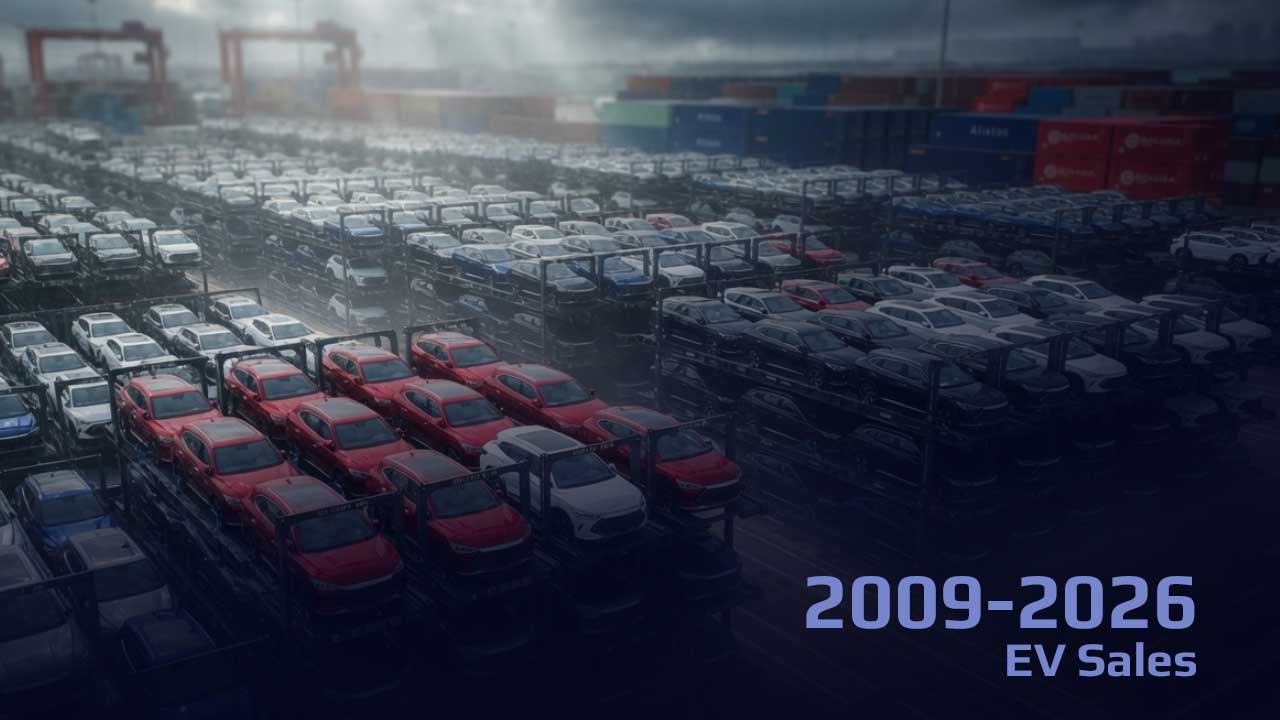
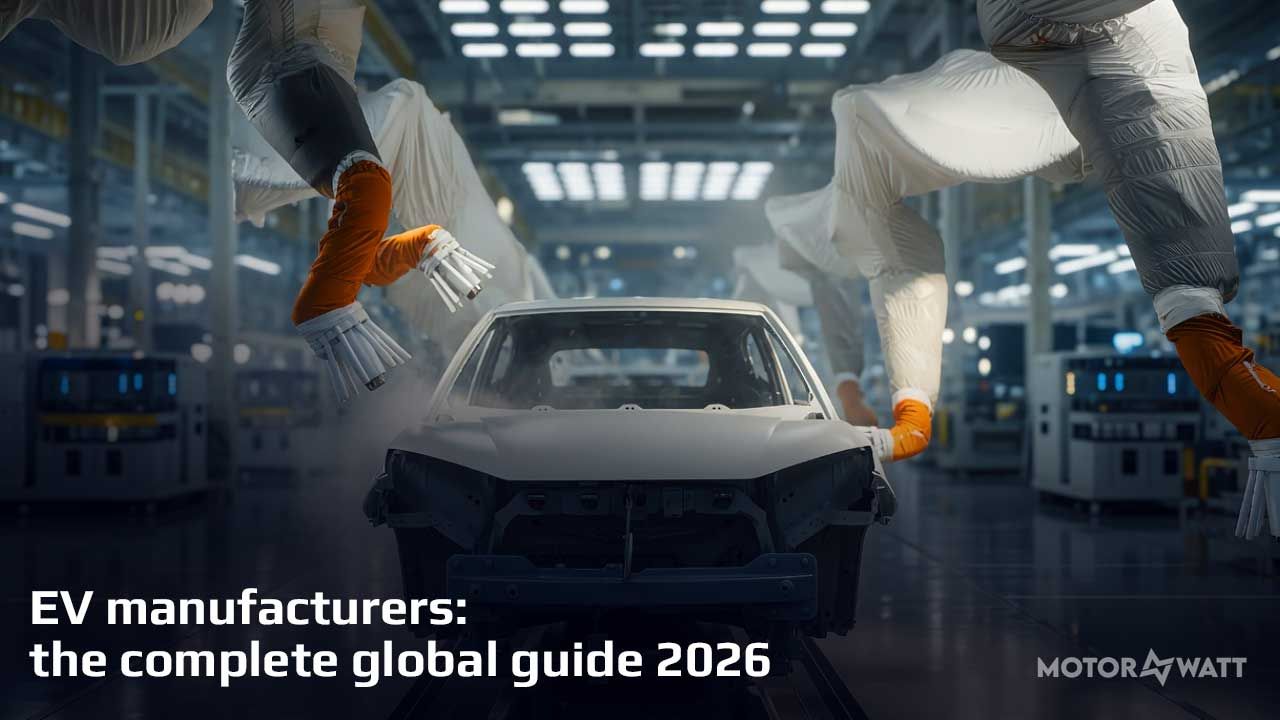
Global electric vehicle sales exceeded 20 million units in 2025 — one in every four new cars sold worldwide was electric. BYD overtook Tesla as the world's largest EV maker by the end of that year. This guide covers every major manufacturer: who leads by sales, who leads by market cap, the Chinese brands reshaping global trade, the US and European players, and the startups that have already gone bankrupt and why. Every manufacturer links to its live profile and model database on MOTORWATT.
The 2025 EV market: what the numbers actually show
The IEA Global EV Outlook 2026 — published in May 2026 — is the most comprehensive picture of where the EV industry stands. The headline numbers are striking but the regional breakdown is even more telling.
The US figure — roughly flat year-on-year — reflects two converging forces: the end of federal EV tax credits under the IRA coincided with a demand dip at the end of 2025, and political headwinds slowed some fleet electrification mandates. Europe's 30% growth came directly from stricter EU CO2 standards that took effect in 2025, forcing automakers to push more EVs or face substantial fines. And China? Nearly 55% of every new car sold there was electric — a figure that would have seemed impossible in 2020.
For 2026, BloombergNEF projects global passenger EV sales to reach 23.3 million — an 11% rise on 2025 — driven by continued growth in China, Europe's strengthening mandate environment, and accelerating uptake in Southeast Asia, Brazil, and Mexico.
Primary sources
IEA Global EV Outlook 2026 — Published 20 May 2026. Licence CC BY 4.0. All regional market share figures, oil displacement data, and sales growth rates in this section are drawn directly from the IEA executive summary. iea.org/reports/global-ev-outlook-2026
BloombergNEF Electric Vehicle Outlook 2026 — The 23.3 million 2026 forecast and drivetrain-level projections cited here are from BNEF's flagship annual EV report, published June 2026. about.bnef.com/electric-vehicle-outlook
Who are the largest EV manufacturers in 2026?
BYD became the world's largest electric vehicle manufacturer by units sold in 2025, overtaking Tesla — a shift confirmed by both Wikipedia's verified company data and the IEA's 2026 report noting Chinese automakers supplied 60% of global EV sales. BYD produced 4.6 million total vehicles in 2025 (BEV + PHEV combined), with revenue of ¥804 billion (~$116 billion USD). Tesla produced 1.66 million vehicles in 2025 with revenue of $94.83 billion.
By market capitalisation, Tesla remains dominant — the company re-crossed $1 trillion in valuation in May 2025 and has held there since. By manufacturing volume, BYD is now the larger EV company. Both facts are true simultaneously; they measure different things.
Top EV manufacturers by 2025 production / deliveries
| Manufacturer | HQ country | EV units 2025 | Type | Key brands |
|---|---|---|---|---|
| BYD Auto | ||||
| Tesla | ||||
| Volkswagen Group | ||||
| SAIC Motor | ||||
| Geely Group | ||||
| Hyundai Motor Group | ||||
| BMW Group | ||||
| GAC Aion | ||||
| Stellantis | ||||
| General Motors |
Sources
Wikipedia — BYD Auto (verified 2025 data): Production output 4,602,436 vehicles (2025); Revenue CN¥804 billion (~$116B). BYD overtook Tesla as world's largest EV maker in 2025, and overtook Ford in total auto sales. 77% of BYD's 2025 sales from Chinese market.
Wikipedia — Tesla, Inc. (verified 2025 data): Production output 1.66 million vehicles (2025); Revenue $94.83B; Net income $3.79B. Tesla held 17.6% global BEV market share in 2024. Market cap re-crossed $1 trillion in May 2025.
IEA Global EV Outlook 2026: Chinese automakers supplied 60% of global EV sales in 2025; European and North American automakers ~15% each. iea.org ↗
BYD: total NEVs (BEV + PHEV). Tesla: BEV deliveries. All others: approximate BEV figures, mostly 2024 data (2025 figures for legacy OEMs not yet fully reported). Sources: Wikipedia verified company data; IEA GEO 2026; JATO Dynamics.
EV companies by market capitalisation (mid-2026)
Tesla's market cap re-crossed $1 trillion in May 2025 and has remained above that threshold since. The gap between Tesla and every other EV-exposed company reflects that Tesla is valued partly as a software, autonomy, and energy company — not just a car maker. BYD's ~$100 billion valuation is closer to a traditional automaker multiple despite its scale. Rivian and Lucid trade significantly below their 2021 SPAC-era peaks.
Approximate figures, mid-2026. Tesla figure from Wikipedia (re-crossed $1T May 2025, held since). Others from public market data. Traditional OEMs included where EV strategy is significant.
Source
Wikipedia — Tesla, Inc.: Tesla exceeded $1 trillion market cap between November 2024 and February 2025, and again since May 2025. All other figures are approximate public market data, Bloomberg, mid-2026.
US electric vehicle manufacturers
The United States has more EV startups than any other market but relatively few have reached meaningful scale. The IEA notes that the US held its EV share at just under 10% of new car sales in 2025 — flat year-on-year — partly because the end of IRA EV tax credits hit demand in Q4 2025. Here are the companies that matter.
Tesla: $94.83 billion in revenue, and still losing ground on units
Tesla built the modern EV industry and remains its defining brand. By the end of 2025, Tesla's production reached 1.66 million vehicles and revenue hit $94.83 billion. The company holds $82.14 billion in equity and employs 134,785 people. The Supercharger network — 7,791 stations globally — has become the industry's de facto charging standard, with Ford, GM, Rivian, Polestar, and others all adopting NACS connectors.
But context matters: Tesla's production declined from 2024 levels, and BYD took the unit-sales crown by end of 2025. The company's $1 trillion valuation today is grounded in Autopilot/FSD software revenue potential, the Cybercab robotaxi programme, and its Megapack energy storage business — not car volumes alone. Browse the full Tesla lineup on MOTORWATT.
General Motors: Ultium and the affordability gamble
GM's Ultium battery platform underpins the Chevrolet Equinox EV (~$35,000), Blazer EV, Silverado EV, and Cadillac Lyriq and Celestiq. Production ramp-ups faced repeated delays through 2024–2025, but by mid-2026 GM has approximately 300,000 BEVs per year in market. The Equinox EV is the strategic product: it's the first credible mass-market US EV that doesn't require a $50,000+ price tolerance. If it succeeds in converting mainstream buyers, GM wins the transition. If it doesn't, GM faces an existential restructuring problem.
Ford: steady with the Mach-E, troubled with the Lightning
Ford's Mustang Mach-E has been a consistent, well-reviewed seller that competes directly with the Tesla Model Y. The F-150 Lightning has had a harder run: a battery fire recall, production cuts, and price reductions. Ford announced in 2025 it was scaling back some EV investment to prioritise hybrids while the US market matures — a pragmatic adjustment that reflects weak sub-10% US EV penetration.
Rivian: profitable on the commercial side, still building retail scale
Rivian's R1T and R1S remain the most design-distinctive premium EVs in the US market, with a genuinely loyal owner base. Consumer Reports' 2025 reliability survey ranked Rivian highest among EV brands in overall owner satisfaction. The Amazon commercial van contract — 100,000 EDV units — provides a production floor that pure-consumer EV startups don't have. Amazon holds a ~17% minority stake; Rivian operates independently. More on global EV sales data.
Key data point
The IEA estimates the global EV fleet avoided consuming approximately 1.7 million barrels of oil per day in 2025. At current oil prices, that represents roughly $120 million in daily fuel cost savings across all EV owners globally — a figure that grows every year as the fleet expands.
Source
IEA Global EV Outlook 2026: 1.7 million barrels/day oil displacement figure. US EV share at just under 10% in 2025 with demand drop in Q4 linked to end of EV tax credits. iea.org ↗
Consumer Reports Annual Auto Reliability Survey 2025: Owner satisfaction rankings across 300,000+ member-reported surveys, tracking 17 problem areas including powertrain, electronics, and charging systems.
Lucid: the range record holder
Lucid Air holds the EPA-rated range record at 516 miles (Grand Touring Performance). Efficiency of ~4.5 miles/kWh — well ahead of any production competitor — comes from proprietary motor design by ex-Tesla engineers. Saudi Arabia's Public Investment Fund owns a majority stake. The Lucid Gravity SUV launched late 2024 from ~$79,900. Find luxury EVs in the MOTORWATT marketplace.
Chinese EV manufacturers: 60% of global supply
According to the IEA Global EV Outlook 2026, Chinese automakers supplied 60% of global electric car sales in 2025. That's not domestic sales — that's global supply share. European and North American automakers accounted for roughly 15% each. This is the single most important structural fact about the EV industry in 2026, and it is almost entirely absent from Western automotive media coverage.
BYD: 4.6 million vehicles, $116 billion in revenue
BYD (Build Your Dreams) was founded in 1995 as a battery manufacturer and entered automotive in 2003. In 2025, it produced 4,602,436 total vehicles — BEVs plus plug-in hybrids — generating ¥804 billion (~$116 billion USD) in revenue. Wang Chuanfu set a goal in 2008 for BYD to be the world's largest car manufacturer by 2025. He was 17 years early on that ambition; the company hit it on schedule.
BYD's vertical integration is its structural moat: it manufactures its own batteries (FinDreams Battery, the world's second-largest EV battery producer behind CATL), its own electric motors, and most other core components. The Seagull city EV at ~¥75,800 (~$10,500 USD) is the world's cheapest new EV at production scale. The Seal, Han, Tang, and Atto 3 are the primary export models. 77% of BYD's 2025 sales came from China; the remaining 23% — roughly 1 million vehicles — went to over 70 countries. See our analysis of how BYD overtook Tesla.
SAIC, Geely, Great Wall: the giants behind the headline names
SAIC Motor is best known internationally through the MG brand — the MG4 and MG ZS EV are top-selling EVs in Europe and Australia. Geely Group owns Volvo, Polestar, Lotus, ZEEKR, and holds a stake in Mercedes-Benz: the most structurally complex EV portfolio of any company in the world. Great Wall Motor reaches Western buyers through the Ora (affordable city EVs) and Tank (off-road) sub-brands, which have begun entering European and Australian markets.
NIO, XPENG, Li Auto: the premium pure-plays
NIO's battery swap network — 2,400+ stations capable of replacing a depleted pack in ~3 minutes — is its primary differentiation against Tesla in the Chinese premium segment. XPENG is China's most technology-forward EV company; its XNGP driver assistance system covers a broader road network than any Western ADAS competitor. Li Auto has been the most consistently profitable of the three, driven by its extended-range approach that eliminates charging infrastructure dependency for long trips.
Leapmotor, ZEEKR, GAC Aion: the scale players Western media ignores
These three manufacturers collectively sold well over 1 million EVs in 2025 — more than Ford, GM, and Rivian combined. Leapmotor is now a Stellantis joint-venture brand selling through European dealer networks (C10 crossover from ~€36,000). ZEEKR (Geely sub-brand) offers 800V fast charging and legitimate premium interior quality; the 001 fastback and X9 MPV are the key models. GAC Aion, growing at ~40% year-on-year, is actively building distribution in Southeast Asia and the Middle East.
Source
IEA Global EV Outlook 2026: Chinese automakers' 60% global supply share; Southeast Asia sales more than doubled to ~20% share; Latin America grew 75% led by Brazil and Mexico. iea.org ↗
European EV manufacturers
Europe's 28% EV share in 2025 — up 30% year-on-year according to the IEA — came directly from tightened EU CO2 standards. Automakers faced the choice of selling more EVs or paying substantial per-vehicle fines. The market responded. The challenge now is whether European manufacturers can close the cost and software gap to Chinese competitors without requiring permanent subsidy support.
Volkswagen Group: 1.1 million BEVs and a software crisis
VW Group sold approximately 1.1 million BEVs in 2024 across VW, Audi, Porsche, Skoda, and SEAT/Cupra. The MEB platform (ID.3, ID.4, ID.5, ID.7) is the volume workhorse; the PPE platform handles premium (Taycan, e-tron GT, Q6 e-tron). VW's Cariad software subsidiary fell years behind schedule and significantly over budget, delaying multiple product launches. The 2026 model year lineup shows real improvement, but the software-defined vehicle capabilities still trail Tesla. Browse BMW's EV lineup.
BMW Group, Mercedes-Benz, Stellantis
BMW's multi-powertrain approach — selling EVs alongside combustion and hybrid versions of the same platforms — has kept margins high while demand builds. The i4, iX, i5, and i7 are the key BEV models. Mercedes has positioned the EQS and EQS SUV at the premium end; the EQA and EQB provide volume. Stellantis has arguably Europe's broadest affordable EV portfolio: Peugeot e-208/e-2008, Opel/Vauxhall Mokka-e and Astra-e, Fiat 500e, Citroën ë-C3 — particularly strong in urban markets where city-car segment EVs outperform larger formats.
Volvo, Polestar, and Renault Group
Volvo (Geely-owned) has committed to full electrification by 2030 and currently sells the EX30, EX40, EC40, EX90, and EM90. Renault's comeback story is the Renault 5 E-Tech — a retro-styled affordable EV that became France's best-selling EV in its first year on sale, proving European buyers will adopt EVs when the product and price are right. Renault's "Ampere" EV division IPO remains delayed pending better market conditions.
EV companies that have gone out of business
The EV startup wave of 2018–2022 raised enormous amounts of capital — and by 2024–2025, the failures were severe. Understanding what went wrong is as important as understanding who is succeeding.
Failed EV companies: the complete record
| Company | Filing type | Date | Peak valuation | Primary cause |
|---|---|---|---|---|
| Fisker Inc. | ||||
| Arrival | ||||
| Lordstown Motors | ||||
| Nikola | ||||
| Electric Last Mile Solutions | ||||
| Better Place |
The pattern: all failed EV companies raised capital in favourable market conditions, underestimated manufacturing complexity, and ran out of cash before reaching the production scale needed to become self-sustaining. Manufacturing a car is categorically harder than shipping software. The companies that survived — Tesla, Rivian, Lucid — all shipped real cars at real (if imperfect) scale and improved from there.
Sources
SEC EDGAR: Bankruptcy filings for Fisker Inc. (Case 24-11390, D.Del.), Arrival (Case 24-10161), Lordstown Motors (Case 23-10831), Electric Last Mile Solutions (Case 22-10537), and Nikola (Case 25-10258) are publicly accessible at sec.gov/cgi-bin/browse-edgar ↗
Bloomberg: Peak market capitalisation figures drawn from Bloomberg terminal data at each company's highest recorded closing price.
How to explore every EV manufacturer and their models
MOTORWATT's manufacturer database covers 1,000+ electric vehicle companies across 80+ countries — every brand mentioned in this guide and hundreds more. Each profile links to the current model lineup, historical vehicles, and available marketplace listings. The database spans all six EV vehicle categories: passenger cars and SUVs, motorcycles, bicycles, trucks, buses, and specialty vehicles. For Chinese manufacturers not yet available in your local market, profiles include international availability status. Browse the full EV marketplace or search the database by vehicle type.
FAQ: electric vehicle manufacturers
By total NEV production (BEV + PHEV), BYD is the world's largest with 4,602,436 vehicles in 2025. By pure BEV deliveries, Tesla produced 1.66 million in 2025 — BYD's BEV-only figure is not separately published but is estimated at roughly 1.7–1.8 million, making them essentially tied on BEV volume. By revenue, Tesla leads ($94.83B vs BYD's ~$116B, though BYD's revenue includes buses and commercial vehicles). By market capitalisation, Tesla leads by a massive margin ($1T+ vs BYD ~$100B). Source: Wikipedia verified company data; IEA Global EV Outlook 2026.
Major publicly traded pure-play EV companies include Tesla (TSLA, Nasdaq), BYD (002594, Shenzhen; HK:1211), NIO (NIO, NYSE), XPENG (XPEV, NYSE), Li Auto (LI, Nasdaq), Rivian (RIVN, Nasdaq), Lucid (LCID, Nasdaq), and VinFast (VFS, Nasdaq). Legacy automakers with significant EV exposure — GM, Ford, VW Group, Hyundai, BMW, Mercedes, Toyota — are all publicly traded. MOTORWATT doesn't provide investment advice.
Amazon does not own Rivian. Amazon holds a minority equity stake of approximately 17% (as of 2025), making it the largest single shareholder — but Rivian is an independent, publicly traded company (RIVN, Nasdaq). The stake originated from a 2019 commercial agreement for 100,000 electric delivery vans. Rivian's management and board operate the company independently.
Consumer Reports' 2025 reliability survey ranks Rivian and BMW highest among EV brands in overall owner satisfaction. Tesla's reliability has improved materially since 2020 but still trails luxury brand standards on initial quality. Chinese EV brands have limited reliability data in Western markets. For new EV buyers, the safest choice is a brand with at least 3–5 years of production history and an established local service network. Source: Consumer Reports Annual Auto Reliability Survey 2025.
Confirmed EV company bankruptcies: Fisker Inc. (Chapter 11, June 2024), Arrival (Chapter 11, January 2024), Lordstown Motors (Chapter 11, June 2023), Electric Last Mile Solutions (Chapter 7, June 2022), Nikola (Chapter 11, February 2025), Fisker Automotive (2013), Better Place (2013). Source: SEC EDGAR public filings.
Global electric car sales grew 20% in 2025 to exceed 20 million units — one in four new cars sold globally. BloombergNEF forecasts 23.3 million passenger EVs in 2026, an 11% increase. Growth is uneven: China (~55% EV share), Europe (~28%), and the US (~10%). Southeast Asia more than doubled its EV sales in 2025. Sources: IEA Global EV Outlook 2026; BloombergNEF Electric Vehicle Outlook 2026.
The EV manufacturer landscape changed fundamentally in 2025: 20 million EVs sold globally, BYD overtook Tesla on production volume, and Chinese automakers now supply 60% of the world's EVs. MOTORWATT's database covers all 1,000+ manufacturers across 80+ countries. Browse every company's profile, model lineup, and current marketplace listings at ev.motorwatt.com.
Find every electric vehicle manufacturer
Search MOTORWATT’s live EV database by manufacturer, vehicle type and model instead of working from a static brand list.
Explore the EV manufacturer databaseRelated MOTORWATT guides
Related Video