







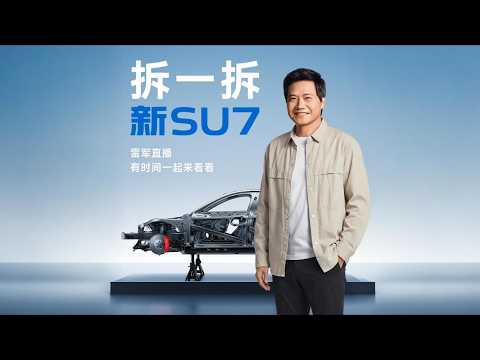
Xiaomi SU7 Teardown: Inside Lei Jun’s Bold EV Reveal (Full Analysis)
In an industry where automakers guard their secrets, Xiaomi just did the unthinkable.
During a live 3.5-hour broadcast, Lei Jun personally led a full teardown of the Xiaomi SU7, exposing everything from paint layers to battery architecture.
No edits. No PR filters. Just raw engineering.
And that move may have instantly positioned Xiaomi as a serious player in the global EV race.
Most car brands rely on polished marketing and carefully controlled messaging.
Xiaomi chose radical transparency.
By dismantling the SU7 live, the company sent a clear signal:
This isn’t just another tech company experimenting with cars—it’s a manufacturer confident enough to be scrutinized.
From an SEO and market perspective, this event generated massive search demand around terms like:
“Xiaomi SU7 specs”
“Xiaomi EV teardown”
“Is Xiaomi competing with Tesla?”
The teardown focused on the SU7 Pro, a mid-tier configuration that already delivers strong value.
Core Specifications:
Drivetrain: Rear-wheel drive (RWD)
Battery: 96.3 kWh LFP battery
Suspension: Advanced air suspension system
Estimated Price: ~$36,000 USD
Segment: Premium electric sedan
These specs place the SU7 directly in competition with models from Tesla and other global EV leaders.
One of the most discussed elements of the teardown was the battery system.
Xiaomi showcased:
High-density LFP battery architecture
Efficient thermal management design
Clean integration within the chassis
This suggests a focus on durability, safety, and cost efficiency, rather than chasing headline-grabbing range numbers alone.
Build Quality: What the Teardown Revealed
The live disassembly exposed details rarely shown to the public:
3C2B multi-layer paint process for enhanced durability
Corrosion-resistant materials including galvanized steel
Multiple baking cycles for improved finish longevity
These are not superficial upgrades—they reflect manufacturing maturity, especially for a first-generation vehicle.
Unlike traditional automakers, Xiaomi brings a major advantage:
Software integration.
The SU7 is designed to seamlessly connect with Xiaomi’s broader ecosystem—smartphones, IoT devices, and cloud services.
This positions the car not just as transportation, but as:
A fully connected smart device on wheels.
Xiaomi vs Tesla: A New EV Rival Emerges?
Can Xiaomi compete with Tesla?
While it’s still early, the SU7 shows strong potential:
Feature Xiaomi SU7 Tesla Model 3
Price Lower (~$36K) Higher (varies)
Battery Type LFP LFP / NCA
Ecosystem Xiaomi IoT Tesla ecosystem
Transparency High (teardown) Limited
Xiaomi’s strategy is clear:
Deliver strong hardware + aggressive pricing + deep software integration.
Early indicators suggest strong traction.
Reports show tens of thousands of orders shortly after launch, signaling:
High consumer curiosity
Strong brand trust in China
Growing global interest in Xiaomi EVs
Search trends around “Xiaomi SU7 price” and “Xiaomi car availability” continue to climb.
The Xiaomi SU7 teardown wasn’t just a technical showcase.
It was a strategic statement.
By exposing its engineering in public, Xiaomi did something most automakers avoid:
It invited scrutiny—and passed the test.
For SEO, market positioning, and consumer trust, this move is powerful.
And if Xiaomi continues at this pace, the SU7 may not just be a competitor—
It could become a defining force in the next wave of electric vehicles.