





The End of "No Plates Needed"? California's Trio of Bills Bringing E-Bikes Under DMV Rules
Three California bills introduced in the 2025–2026 legislative session—AB 1942, AB 1557, and SB 1167—collectively move Class 2 and Class 3 electric bicycles closer to the regulatory framework applied to motor vehicles under the Department of Motor Vehicles (DMV).
These measures address rising safety concerns, enforcement challenges with high-speed or modified e-bikes, and the blurring line between true e-bikes and e-motorcycles (“e-motos”). While Class 1, 2, and 3 e-bikes have historically been treated as bicycles (no registration, licensing, or insurance required), these bills impose new definitions, disclosure rules, and direct DMV obligations—particularly on throttle-equipped Class 2 (up to 20 mph) and faster-pedal-assist Class 3 (up to 28 mph) models that dominate the market.
AB 1942 – The E-Bike Accountability Act (Author: Assemblymember Rebecca Bauer-Kahan)
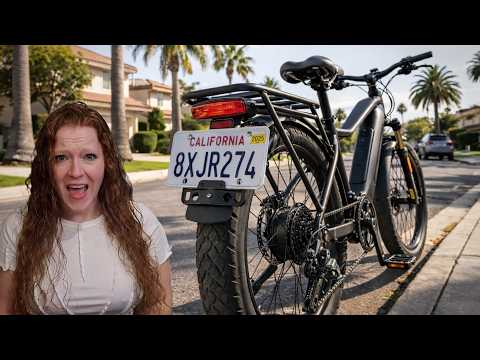
This is the most direct push toward DMV treatment. Introduced in February 2026, AB 1942 would require all Class 2 and Class 3 e-bikes (new and existing) to be registered with the California DMV and display a state-issued special license plate. Owners would need to provide proof of ownership tied to the bike’s serial number. The DMV would create a streamlined process (no driving test required) and establish an Electric Bicycle Registration Fund to cover costs—meaning annual or one-time registration fees paid by owners.
Violations (riding without registration or plates) become infractions with escalating fines. The bill’s stated goal is better accountability for reckless riding, theft recovery, and crash investigations, since unlabeled e-bikes have made it hard for law enforcement to identify operators. It explicitly targets Class 2 and 3 models because they are more powerful and frequently modified to exceed legal speeds (sometimes 60+ mph). Class 1 pedal-assist-only bikes would remain exempt.
Critics (including bike advocacy groups like Bike East Bay and the California Bicycle Coalition) argue it creates financial and bureaucratic barriers, especially for low-income riders and seniors, and could discourage e-bike adoption at a time when the state wants to reduce car use for climate goals. Supporters, including local officials in areas seeing e-bike injury spikes, say plates enable enforcement without reclassifying e-bikes as full motorcycles.
AB 1557 – Tightening the Power Definition to Peak Watts (Author: Assemblymember Diane Papan)
Introduced in January 2026, this bill clarifies and strengthens the legal definition of an “electric bicycle.” Current law vaguely says an e-bike motor “does not exceed 750 watts.” AB 1557 changes it to a motor that is not capable of exceeding 750 watts of peak power (the highest output the motor can briefly produce).
Many popular Class 2 and Class 3 e-bikes (and aftermarket motors) can spike well above 750 watts during acceleration or hill climbs—even if their continuous/average rating is lower. Under the new definition, those vehicles would no longer qualify as e-bikes. They would instead fall into existing motor-vehicle categories (e.g., motor-driven cycles or mopeds), which already require:
DMV registration
License plates
Rider licensing
Insurance
Helmet and age restrictions
The bill includes a grandfather clause for pre-2027 models that met the old rules, and it adds civil penalties for manufacturers and retailers who sell or advertise non-compliant bikes as e-bikes. The intent is to close loopholes that let high-performance “e-bikes” operate on bike paths and trails without motor-vehicle oversight.
SB 1167 – Truth-in-Labeling and Disclosure Requirements (Author: Senator Catherine Blakespear)
Introduced in February 2026, SB 1167 works in tandem with AB 1557 by cracking down on mislabeling. It prohibits manufacturers, distributors, and retailers from advertising, selling, or labeling any vehicle that exceeds e-bike limits (including the new peak-power standard) as an electric bicycle. Sellers must clearly disclose that such devices are actually motor vehicles subject to DMV registration, licensing, insurance, and other rules.
This targets the flood of imported “e-motos” sold online or in stores as Class 2/3 e-bikes—devices that often reach motorcycle-level performance but are marketed to avoid regulations. By forcing honest labeling and buyer warnings, the bill ensures consumers know they’re buying something that will require DMV interaction (and potentially lose trail/bike-lane access). Bike safety and industry groups broadly support it as a consumer-protection measure.
How the Three Bills Work Together
Individually, each addresses a piece of the problem:
AB 1557 and SB 1167 shrink the e-bike category by tightening definitions and stopping false marketing. Many current Class 2/3 models (or easily modified ones) get reclassified outright as motor vehicles that must go through the DMV.
AB 1942 then layers direct DMV requirements (registration, plates, fees, fines) onto whatever still qualifies as a legal Class 2 or 3 e-bike.
The combined effect is a clear policy direction: higher-performance e-bikes move from “bicycle” status (no paperwork) toward “motor vehicle” status (DMV oversight). This is driven by data showing sharp increases in e-bike-related injuries and fatalities, especially among youth, and the difficulty enforcing rules on unlabeled, high-speed devices.
As of March 2026, all three bills are in early committee stages. AB 1942 has drawn the most public debate and opposition from cycling advocates, while AB 1557 and SB 1167 enjoy broader support for targeting unsafe e-motos. Their fate will shape whether California treats everyday Class 2/3 e-bikes more like mopeds or keeps them accessible as bicycles. Riders should monitor leginfo.legislature.ca.gov for updates, as passage could mean new costs, paperwork, and compliance rules starting as early as 2027. These bills reflect a broader national tension: balancing e-bike growth for clean transportation against public safety and trail-access concerns.