






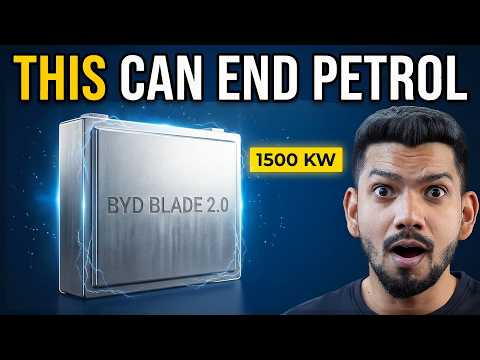
The BYD Blade Battery 2.0, unveiled in early March 2026
The BYD Blade Battery 2.0, unveiled in early March 2026, represents a major evolution of BYD's innovative lithium iron phosphate (LFP) battery technology, first introduced in 2020. This second-generation version builds on the original's renowned safety and longevity while delivering breakthroughs in charging speed, energy density, and real-world performance.
The Blade Battery's signature design features long, flat, blade-like cells arranged in a space-efficient honeycomb structure, eliminating traditional modules for higher pack density and better structural integration. The 2.0 iteration enhances this foundation with advanced LMFP (lithium manganese iron phosphate) chemistry, boosting cell-level energy density to 190-210 Wh/kg—a roughly 5% improvement over the first generation (and up to 30-40% in some reported comparisons to earlier baselines).
The standout feature is ultra-fast charging capability. Paired with BYD's new 1,000-volt architecture and up to 1,500 kW FLASH Charging system, the Blade Battery 2.0 achieves remarkable recharge times:
Even in extreme cold (after 24 hours at -30°C), it charges from 20% to 97% in just 12 minutes—only slightly slower than at room temperature. This addresses one of the biggest remaining hurdles for EV adoption: charging convenience comparable to refueling a gasoline vehicle.
- 10% to 70% in approximately 5 minutes
- 10% to 97% in about 9 minutes
Even in extreme cold (after 24 hours at -30°C), it charges from 20% to 97% in just 12 minutes—only slightly slower than at room temperature. This addresses one of the biggest remaining hurdles for EV adoption: charging convenience comparable to refueling a gasoline vehicle.
Range benefits are equally impressive. Models equipped with the new battery, such as the Yangwang U7 and Denza Z9GT, achieve over 1,000 km (CLTC cycle), with some demonstrations exceeding 1,036 km. This translates to strong real-world potential, often north of 400-500 miles depending on conditions and testing standards.
Safety remains a core strength. The Blade Battery 2.0 passes rigorous tests—including nail penetration during fast charging, multi-cell short-circuit scenarios reaching over 700°C without fire or explosion, and extensive cycle endurance—while showing reduced capacity degradation (about 2.5% better than the original).
BYD has already integrated Blade Battery 2.0 into multiple production vehicles, including premium models from its Yangwang, Denza, and mainstream lines like updated Sealion and Seal variants. With plans for widespread adoption and supporting infrastructure (including thousands of high-power FLASH stations), this technology positions BYD at the forefront of making EVs more practical, affordable, and competitive globally.
In short, the Blade Battery 2.0 doesn't just incrementally improve— it redefines expectations for speed, range, resilience, and safety in mass-market electric vehicles.