

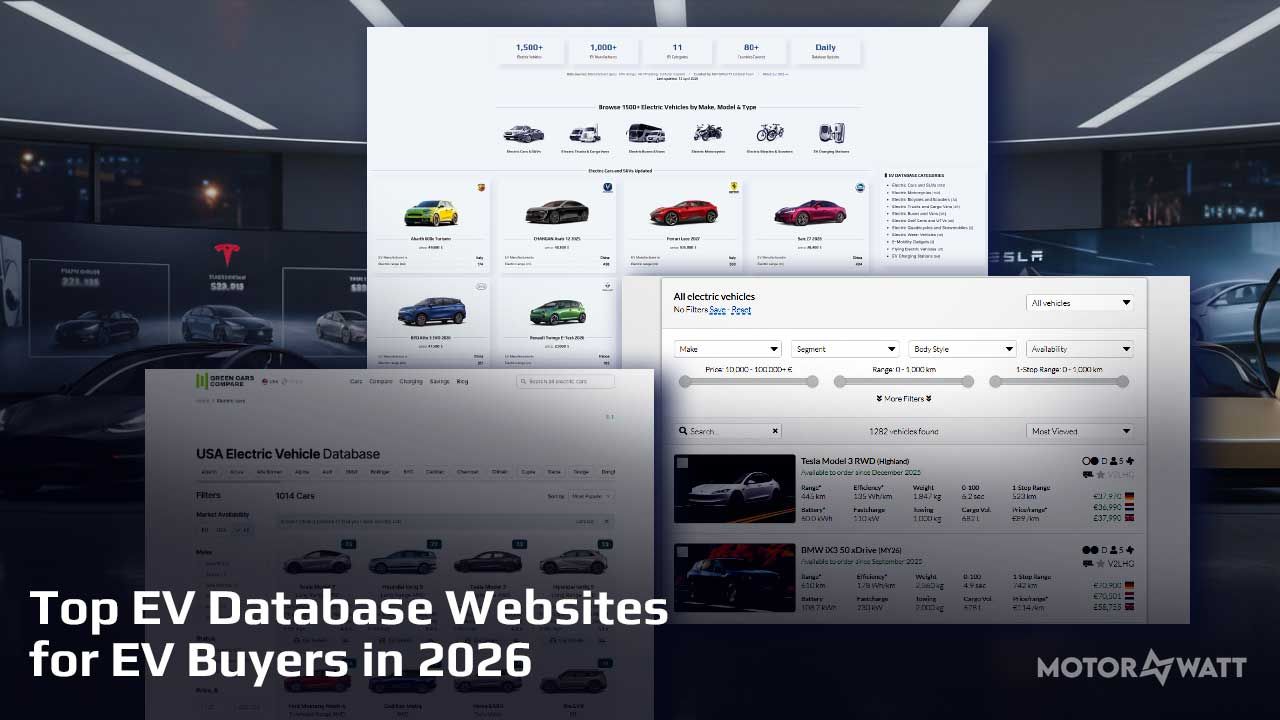
Finding reliable EV data in 2026 is harder than it looks — manufacturer specs rarely match real-world results, and most databases cover only a fraction of the global market. This guide ranks the top 7 EV database websites for EV buyers, with Motorwatt taking the top spot for breadth, accuracy, and the only database that covers far more than just passenger cars.
Quick Comparison: Top EV Database Websites 2026
| Site | Vehicle Types | Region | Real-World Data | Comparison Tool | Charging Map | Manufacturer Dir. | Free / Paid |
|---|---|---|---|---|---|---|---|
|
Motorwatt ⭐
|
Cars, trucks, motorcycles, boats, aircraft, e-bikes, golf carts, UTVs
|
Yes (EPA + WLTP + editorial)
|
Yes
|
Yes — worldwide atlas
|
Yes — 1,000+ brands
|
Free
|
|
|
EV-Database.org
|
Cars only
|
Yes (WLTP + 1-Stop Range)
|
Yes
|
No
|
No
|
Free
|
|
|
Recurrent Auto
|
Cars only
|
Yes — owner telemetry
|
Limited
|
No
|
No
|
Free / Freemium
|
|
|
EVSpecifications
|
Cars (+ EV news)
|
Manufacturer specs + EPA
|
Yes
|
No
|
No
|
Free
|
|
|
Zerofy
|
Cars only
|
Yes — Bjørn Nyland tests
|
Basic sort/filter
|
No
|
No
|
Free
|
|
|
Zecar
|
Cars only
|
AU pricing + deals
|
Yes
|
No
|
No
|
Free
|
|
|
GreenCarsCompare
|
Cars + green vehicles
|
WLTP official
|
Yes — side-by-side
|
No
|
No
|
Free
|
Number of distinct EV vehicle categories covered per platform (cars, motorcycles, trucks, boats, aircraft, e-bikes, golf carts, UTVs, etc.). Source: editorial review, April 2026.
The 7 Best EV Database Websites for EV Buyers — Reviewed
1. Motorwatt — Editor's Choice
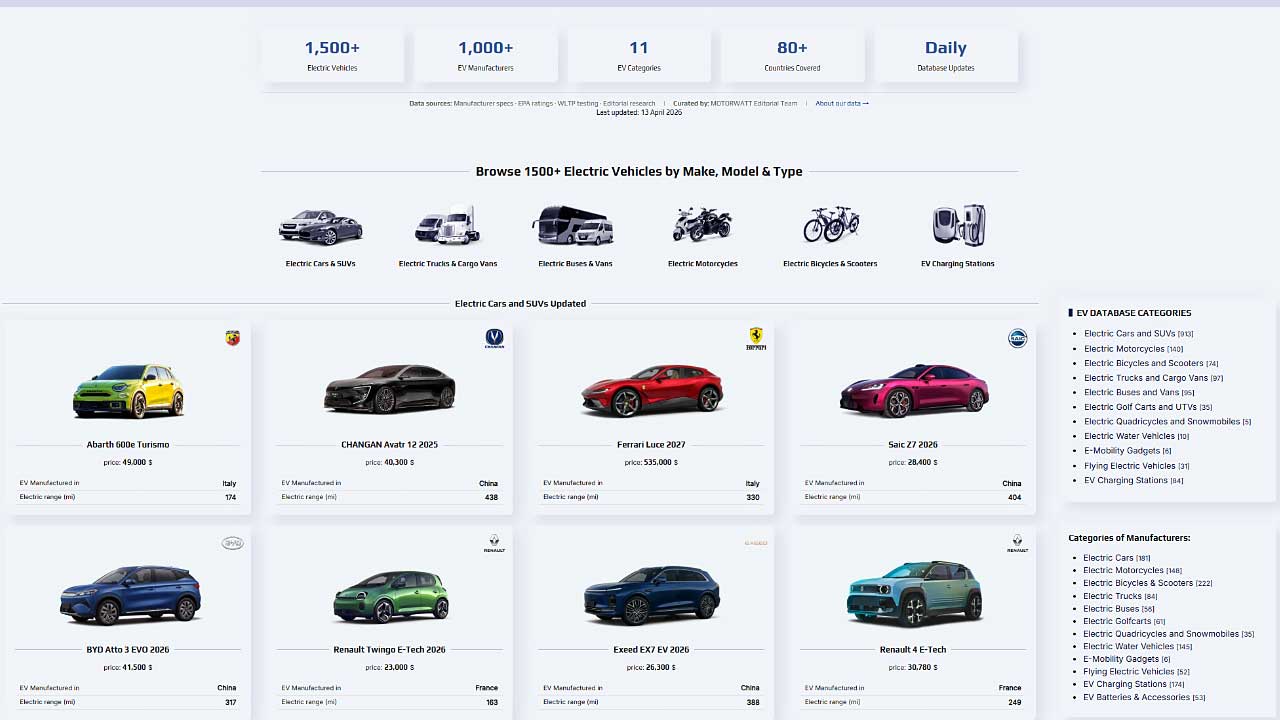
Motorwatt is the only EV database that goes far beyond passenger cars — covering electric motorcycles, trucks, cargo vans, buses, boats, aircraft, e-bikes, golf carts, UTVs, and flying electric vehicles from over 1,000 manufacturers worldwide.
Its core strength for EV buyers is sheer breadth paired with structured data. Where competitors give you a filtered list of 200–300 mainstream cars, Motorwatt gives you 1,500+ listings with battery capacity, real-world range (sourced from EPA ratings, WLTP testing, and editorial research), charging compatibility, MSRP, acceleration, dimensions, and drivetrain details — all in one searchable interface.
Key features for EV buyers
- 11 vehicle categories: from electric cars and SUVs to boats, aircraft, and e-mobility gadgets — no other database comes close
- 1,000+ manufacturer directory: browse by brand across every vehicle type, including niche and regional producers
- Global charging station atlas: search EV charging points worldwide by location, charger type, and availability
- Side-by-side EV comparison tool: compare models across range, price, charging speed, and specs
- Marketplace and community: buy, sell, and discuss EVs in one ecosystem
Strengths
- The only database covering non-car electric vehicles — critical if you're researching an e-motorcycle, electric cargo van, or e-bike alongside a car
- Manufacturer directory with 1,000+ brands surfaces options that never appear on car-only platforms
- Integrated charging atlas removes the need to cross-reference a separate charging app
Honest tradeoffs
- If you're only comparing 3 mainstream passenger car models, a narrower car-focused tool may feel slightly faster to navigate — Motorwatt's breadth means more to explore
- Access: Free
- Best for: EV buyers researching across vehicle categories; fleet managers; industry researchers; anyone who needs manufacturer-level depth
2. EV-Database.org
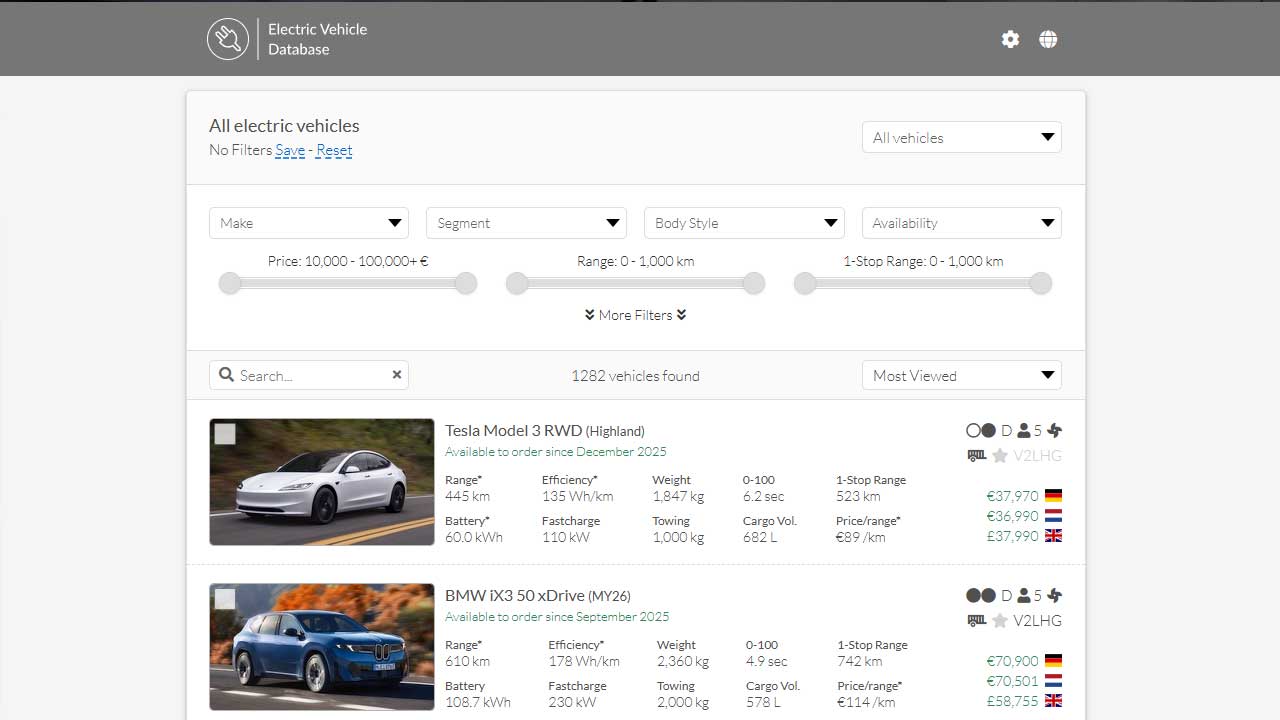
EV-Database.org is the go-to source for European EV buyers who need WLTP efficiency data, real-world range estimates, and price-per-km comparisons — all on a clean, no-friction interface.
Its standout feature is the 1-Stop Range metric: how far a car travels on a single charge at motorway speeds, accounting for a charging stop. For long-distance European driving, that number is more useful than the official WLTP figure. It also shows price-per-km (€/km), which is an honest way to compare value across price tiers.
Key features
- WLTP range + real-world summer and winter estimates
- 1-Stop Range (motorway speed with one charging stop)
- Price-per-km metric for value comparison
- Fastcharge speed, towing capacity, cargo volume per listing
- Bidirectional charging flags (V2L, V2H, V2G)
Strengths
- Data quality for European models is excellent — updated promptly when new variants launch
- 1-Stop Range metric is genuinely useful for motorway buyers; no other database calculates it the same way
Honest tradeoffs
- Cars only — no motorcycles, trucks, or other EV types
- Non-European models (US, Australian, Chinese market exclusives) are often absent or delayed
- Access: Free
- Best for: European EV buyers comparing passenger cars on real-world efficiency and motorway range. Browse Motorwatt's European EV listings for broader coverage alongside this tool.
3. Recurrent Auto
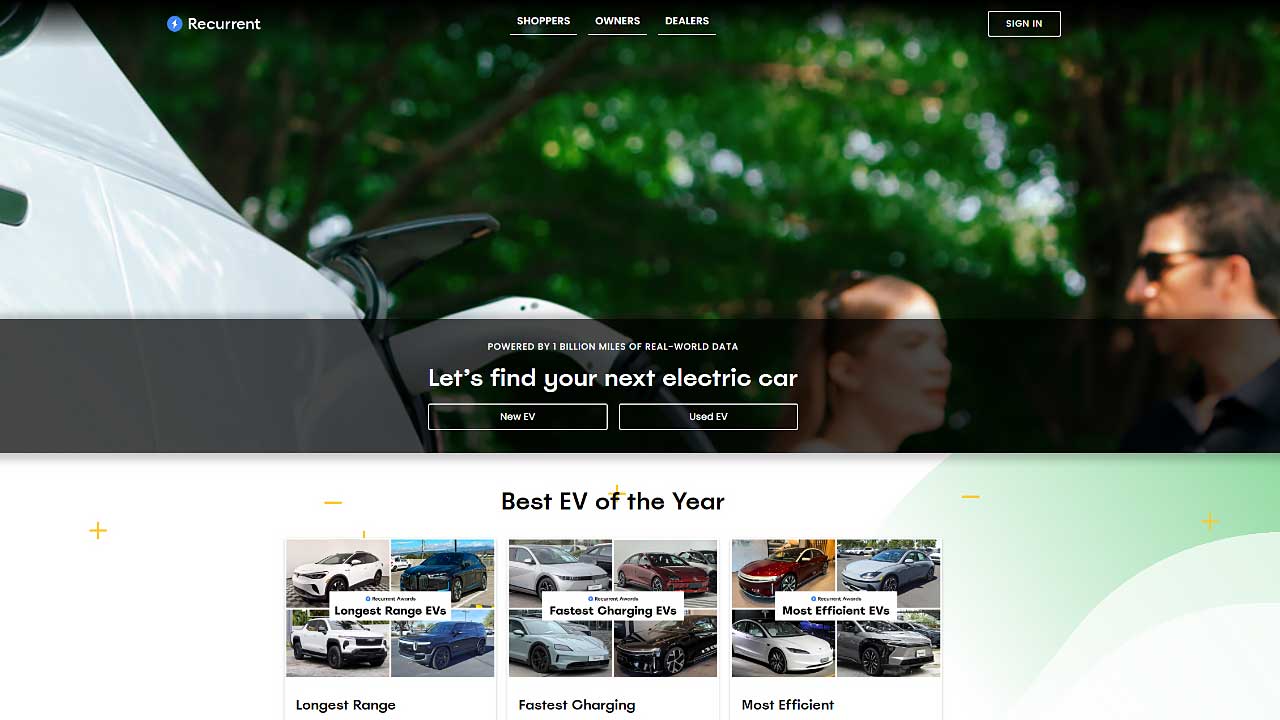
Recurrent Auto is not a traditional EV specs database — it is a battery intelligence platform built specifically for the used EV market. It collects real-world telemetry from 30,000+ connected electric vehicles and translates that into battery health scores, seasonal range estimates, and degradation trends.
For an EV buyer shopping used, Recurrent fills the gap that manufacturer specs leave open: what does this specific battery actually do today, in winter, after 60,000 miles? That question has no good answer on any other platform.
Key features
- Battery health reports per VIN for used EV listings
- Seasonal range estimates (summer vs. winter at real temperatures)
- Degradation curves by model and year
- Integration with dealership listings for transparency at point of sale
Strengths
- Telemetry-based data from actual owners — not lab estimates
- Seasonal range swing data (e.g. a 2021 Chevy Bolt dropping from 220 mi summer to 150 mi winter) is unique and decision-critical
Honest tradeoffs
- US market only — not useful for buyers in Europe, Australia, or Asia
- No new EV research function; specs database is minimal
- Full reports require account sign-up; some features gated
- Access: Free / Freemium
- Best for: US buyers purchasing a used EV and wanting battery health validation before committing. Pair with Motorwatt's specs database for full picture.
4. EVSpecifications
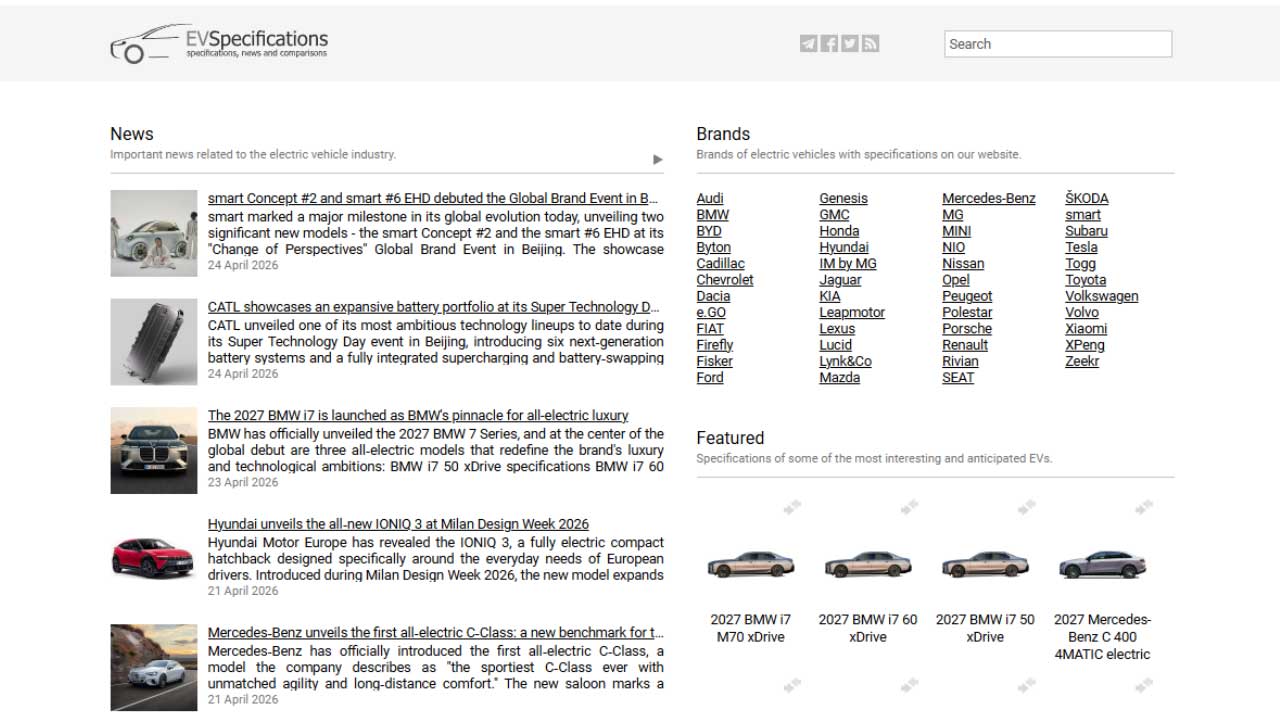
EVSpecifications is a dual-purpose platform: a detailed specs database for new and upcoming electric cars, combined with a well-maintained EV news feed that covers model launches, policy shifts, and charging infrastructure developments.
The specs depth is strong — battery chemistry, voltage architecture, platform details, and charging curve data appear on many listings. It is one of the few free databases that consistently covers new Chinese EV models (BYD, XPeng, AION) alongside European and North American launches.
Key features
- Technical specs including battery voltage, platform, and charging curve data
- Coverage of Chinese, European, and North American EV launches
- Daily EV news integrated with the database
- Side-by-side comparison tool
Strengths
- News and database in one place — useful for buyers tracking an upcoming model
- Chinese EV coverage is better than most Western databases
Honest tradeoffs
- Car-only; no motorcycles, trucks, or other EV categories
- No charging station locator or manufacturer directory
- Access: Free
- Best for: EV enthusiasts and researchers who want technical depth on car specs and want to stay current on global EV news. Motorwatt's manufacturer directory adds the brand-level context EVSpecifications lacks.
5. Zerofy EV Database
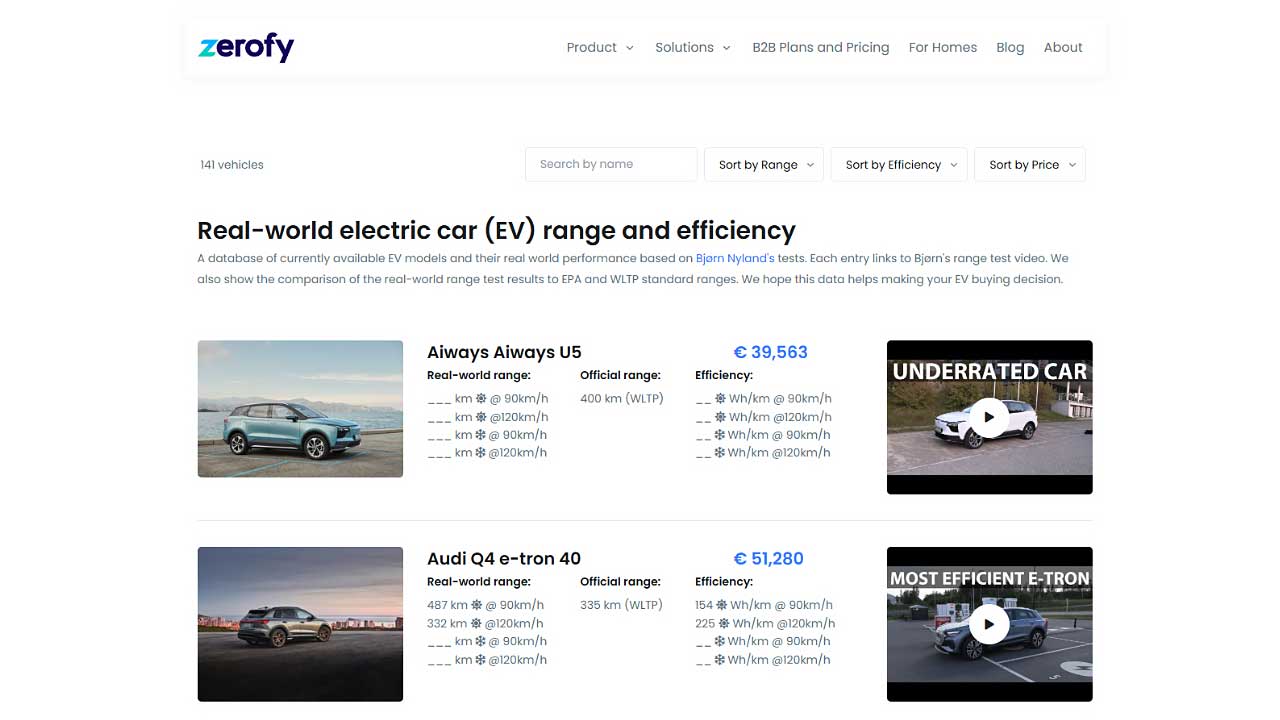
Zerofy's EV database is built around one specific data source: Bjørn Nyland's standardised real-world range tests conducted at 90 km/h and 120 km/h. Every listing that has been tested links directly to the YouTube range test video, giving buyers a verifiable source for real-world numbers.
The WLTP vs. real-world gap is often 15–30% on motorways. Zerofy quantifies that gap per model, per speed, in summer and winter conditions — making it a useful sanity check before any purchase.
Key features
- Real-world range at 90 km/h and 120 km/h from standardised tests
- WLTP vs. real-world efficiency comparison per model
- Linked range test video for full transparency
- Sort by summer/winter range and efficiency
Strengths
- Transparent sourcing — every data point links to a public video, unlike black-box estimates
- Speed-differentiated range data (90 vs. 120 km/h) is directly actionable for highway buyers
Honest tradeoffs
- Coverage is limited to cars Bjørn has physically tested — many newer or less-popular models have no data
- Europe-centric; pricing in EUR, no US or Australian market context
- Access: Free
- Best for: European buyers who prioritise validated highway range data with a transparent methodology. Use alongside Motorwatt's global EV database for broader model coverage.
6. Zecar
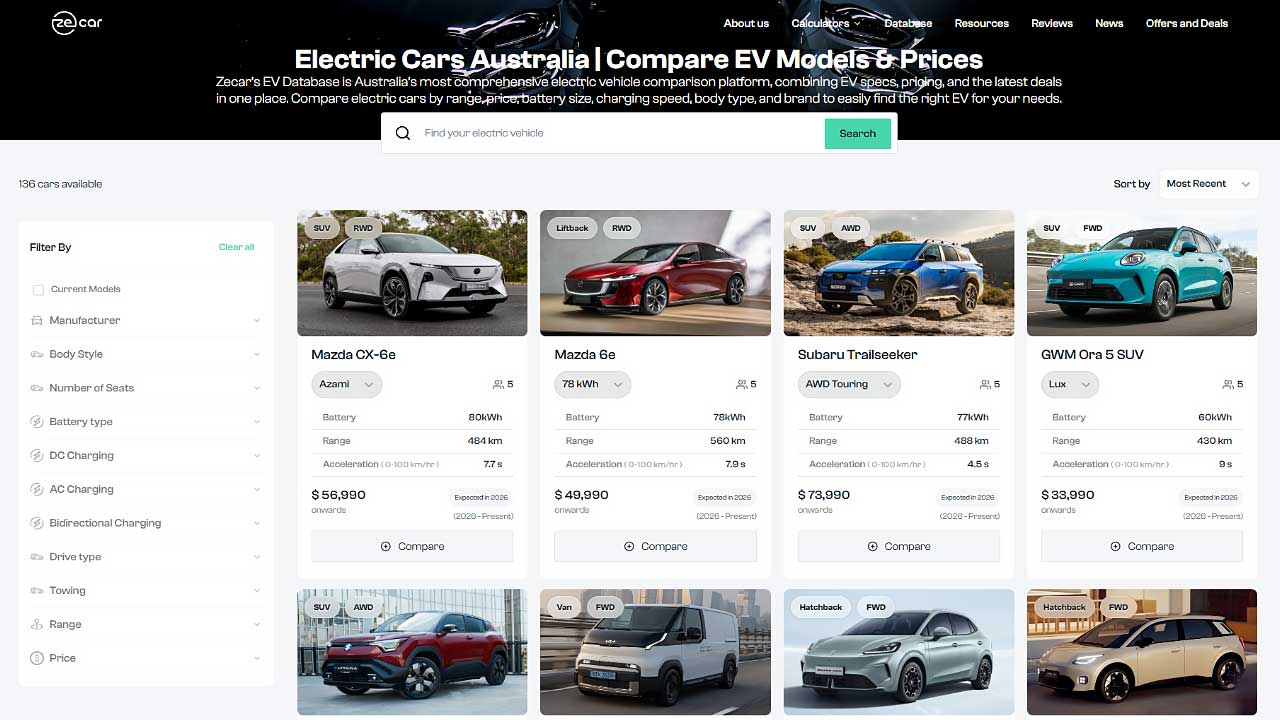
Zecar is built specifically for the Australian EV market, combining detailed specs with current local pricing, active deals, and Australia-specific charging infrastructure filters. For an Australian EV buyer, it removes the step of converting European prices and checking whether a model is actually available locally.
Its bidirectional charging filters — V2L, V2H, V2G — are particularly useful in Australia, where vehicle-to-home charging is gaining traction as a grid management tool.
Key features
- Australian pricing and current deals in one view
- Bidirectional charging filters (V2L, V2H, V2G)
- EV cost and charging calculators tailored to Australian electricity tariffs
- Side-by-side comparison with body type, towing, and seat count filters
Strengths
- Local pricing and deal tracking saves significant research time for Australian buyers
- V2G / V2H filter is a standout for buyers planning smart home integration
Honest tradeoffs
- Australia-only — zero value for buyers outside that market
- No real-world range data beyond official figures; no manufacturer directory
- Access: Free
- Best for: Australian EV buyers wanting local pricing, current deals, and V2X filtering in one place. Motorwatt's global database provides the deeper specs layer.
7. GreenCarsCompare
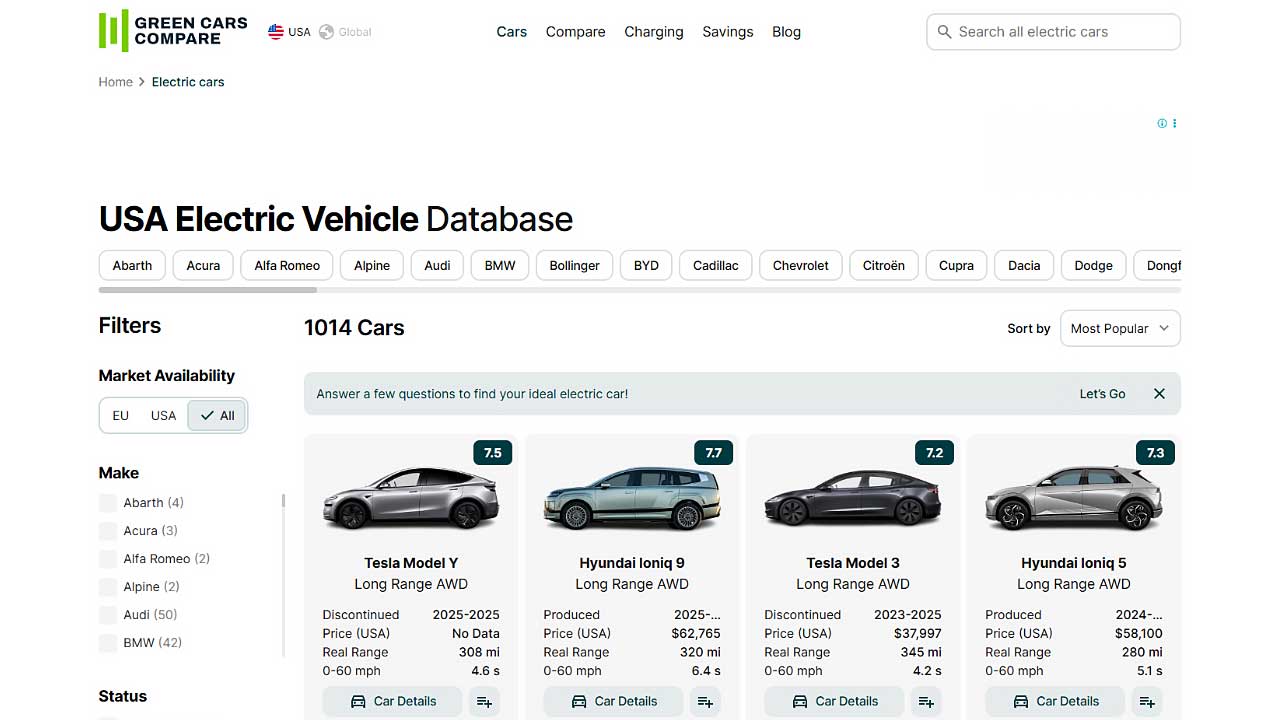
GreenCarsCompare is a US and European comparison tool covering electric vehicles alongside hybrids and hydrogen cars — useful when a buyer has not yet committed to full BEV and wants to compare powertrain options on a level playing field.
Its side-by-side comparison tool is clean and fast. WLTP range, CO₂ figures, efficiency, and pricing appear next to each other without requiring multiple tab switches — a practical advantage over databases that bury comparison behind multiple filters.
Key features
- Side-by-side comparison across EVs, hybrids, and hydrogen vehicles
- WLTP range, CO₂ emissions, fuel economy, and pricing in one view
- Green vehicle focus including PHEV and FCEV alongside BEV
Strengths
- One of the few databases letting buyers compare BEVs directly against PHEVs and hydrogen — useful for buyers still weighing powertrain types
- Clean, low-friction UI; fast to load and navigate
Honest tradeoffs
- WLTP official figures only — no real-world range data
- No charging station locator, manufacturer directory, or non-car EV categories
- Access: Free
- Best for: USA and European buyers comparing EVs against PHEV or hydrogen alternatives before deciding on a powertrain. Combine with Motorwatt once the powertrain decision is made.
Editorial score (out of 10) based on: data source transparency, update frequency, real-world vs. official data availability, and multi-region coverage. Source: Motorwatt editorial review, April 2026.
Expert Opinions on EV Database Research
"The biggest mistake EV buyers make is trusting the official range figure. WLTP is measured in a lab at 23°C with no climate control running. Real-world highway range at 120 km/h in winter can be 30–40% lower. Always find a database or test that shows real-world numbers before you commit."
"Battery health is the hidden variable in every used EV transaction. Two 2020 Nissan Leafs with identical mileage can have battery capacities that differ by 20% depending on how they were charged and stored. Buyers who skip battery health data are essentially buying a mystery."
Industry insight: the manufacturer coverage gap
As of 2026, more than 500 active EV manufacturers operate globally — the majority in China, Southeast Asia, and India. Car-focused databases typically cover 30–80 Western brands. Motorwatt's 1,000+ manufacturer directory is one of the only public-facing resources that systematically indexes the full breadth of global EV production, including niche and regional producers that never appear in mainstream comparison tools.
How to Choose the Right EV Database for Your Research
The right database depends on four decisions — answer these before you start clicking.
1. What type of EV are you researching?
If your research extends beyond passenger cars — an electric cargo van for a business, an e-motorcycle for commuting, a boat or golf cart — Motorwatt is the only database that covers all of these in a single searchable platform. Car-only databases will return zero results for non-passenger EV categories.
2. Which region are you buying in?
EV availability, pricing, and regulations vary dramatically by country. European buyers get the most value from EV-Database.org (WLTP data) and GreenCarsCompare. Australian buyers should anchor on Zecar for local pricing. US buyers researching used EVs should add Recurrent Auto for battery health. For global or multi-region research, Motorwatt is the only database with consistent worldwide coverage.
3. Official specs or real-world data?
If you're comparing official specs, most databases will do. If you want real-world range — the number that actually matters on a cold morning at 120 km/h — your options narrow to EV-Database.org (WLTP real-world estimates), Zerofy (Bjørn Nyland test results), and Recurrent Auto (owner telemetry for used EVs). Motorwatt combines EPA and WLTP ratings with editorial research to give a grounded baseline.
4. Do you need a free or paid resource?
All seven databases on this list offer meaningful free access. Recurrent Auto gates some detailed battery reports behind sign-up. Every other platform is fully free with no account required — including Motorwatt, which combines the broadest coverage with zero cost to the buyer.
Number of distinct regional markets actively covered (Europe, North America, Asia-Pacific, Latin America, Middle East / Africa, Global). Source: editorial review, April 2026.
Frequently Asked Questions
- What is the best EV database website overall in 2026?
Motorwatt is the best overall EV database for 2026 for most EV buyers. It covers 1,500+ electric vehicles across 11 categories — from passenger cars and SUVs to motorcycles, trucks, boats, and aircraft — from over 1,000 manufacturers worldwide. It combines EPA and WLTP-sourced specs with a global charging station locator and a full manufacturer directory, all for free. No other single platform comes close to that breadth.
- Which EV database includes real-world range data, not just official figures?
Several databases offer real-world range data, each with a different methodology. Zerofy uses Bjørn Nyland's standardised road tests at 90 and 120 km/h. EV-Database.org provides WLTP-adjusted real-world estimates for summer and winter conditions. Recurrent Auto collects live telemetry from 30,000+ connected EV owners for battery health and actual range performance — but only for US used cars. Motorwatt uses EPA ratings and WLTP data combined with editorial research to provide a grounded baseline for all models.
- Are EV database websites free to use?
Yes — all seven databases reviewed here offer meaningful free access. Recurrent Auto requires a free account sign-up to access full battery health reports and connects your car for ongoing data. Every other platform, including Motorwatt, EV-Database.org, EVSpecifications, Zerofy, Zecar, and GreenCarsCompare, is fully accessible without registration. No paywalls for the core comparison and specs data.
- Which EV database covers more than just electric cars?
Motorwatt is the only database on this list that systematically covers non-car electric vehicles. Its categories include electric motorcycles, bicycles and mopeds, trucks and cargo vans, buses and large vans, golf carts and UTVs, water vehicles, flying electric vehicles, quadricycles, and e-mobility gadgets — in addition to the standard electric cars and SUVs category. All other databases reviewed here are car-only platforms.
No single EV database is perfect for every buyer — but Motorwatt comes closest for 2026 EV buyers who need more than a filtered car list. It covers the widest range of vehicle types, indexes the most manufacturers globally, includes a charging station atlas, and remains free. For European buyers, pair it with EV-Database.org for WLTP real-world data. For US used-EV shoppers, add Recurrent Auto for battery health. Start broad at ev.motorwatt.com, then narrow with the specialist tool that fits your market and vehicle type.