

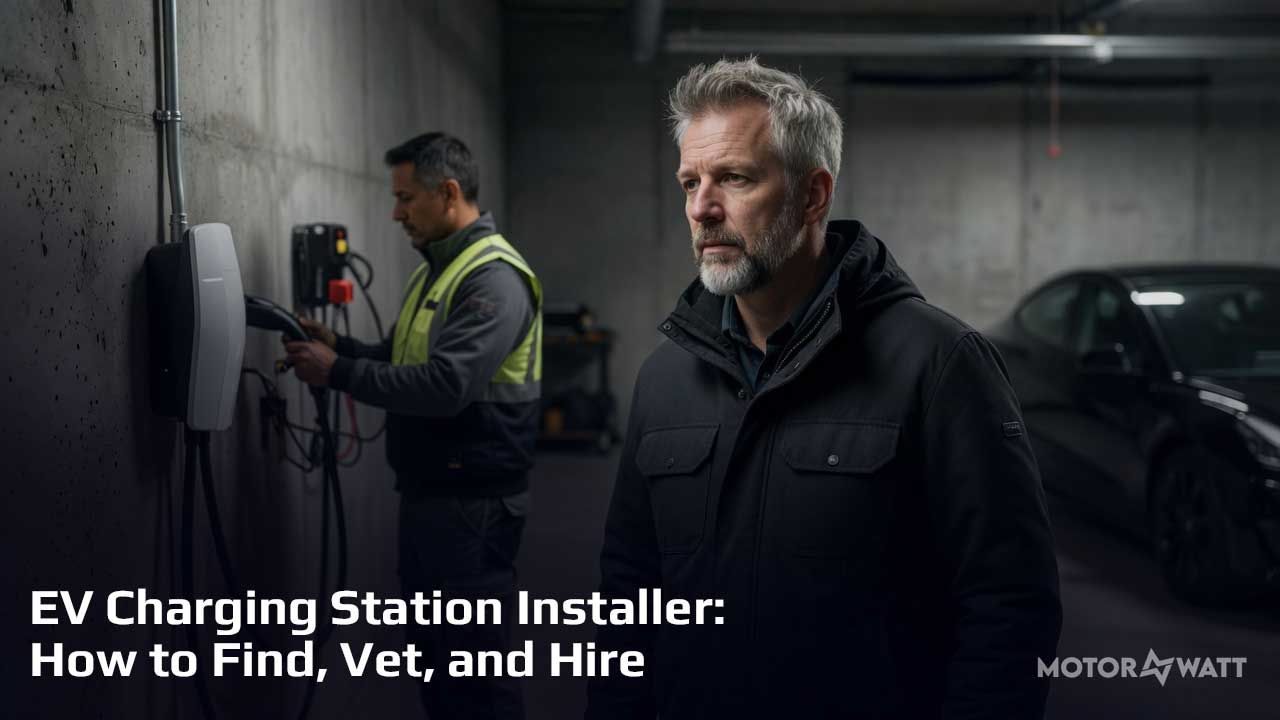
This guide is written from the buyer's side. Here's what a certified EV charging station installer actually does, what installation costs at each charger level, who is and isn't qualified to do the work, how to find qualified installers near you, and - most usefully - seven questions to ask before you sign anything.
You just bought an EV. Or you're running a commercial property and tenants keep asking about charging. Either way, you're looking for someone to install EV charging equipment - and you've quickly discovered that "call a local electrician" is not the complete answer.
There are over 18,000 searches every month for "EV charging station installer." Most of those searches land on pages from the companies that sell installation services. Qmerit wants you to book through Qmerit. Home Depot wants you to call their install team. There's nothing wrong with those options, but you're getting one perspective - the seller's.
What does an EV charging station installer do?
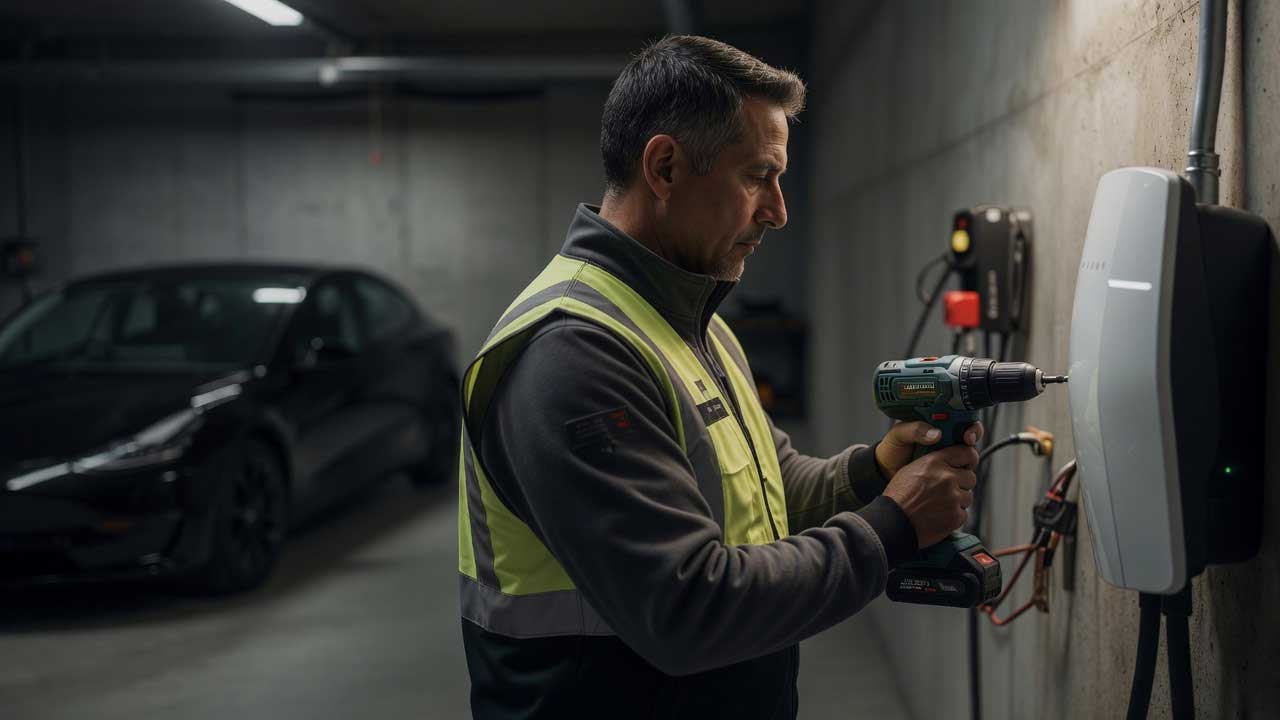
An EV charging station installer is a licensed electrician - often with additional EV-specific training - who handles the full scope of work between your electrical panel and your new charger. That includes running conduit, installing a dedicated circuit, mounting the EVSE (Electric Vehicle Supply Equipment), pulling permits, and arranging the final inspection.
The key difference between a general electrician and an EV charger installer is the scope of EV-specific knowledge required. EV installations involve load calculations to ensure your panel can handle the added draw, familiarity with EVSE equipment brands and their wiring requirements, knowledge of which permits are required in your jurisdiction, and understanding of National Electrical Code (NEC) Article 625, which governs EV charging equipment specifically.
Not every electrician has worked through those requirements. Some have. The job is to figure out which ones before you hire.
Types of EV charger installations (Level 1, Level 2, DC fast)
Before you hire an installer, know what you're installing. The type of charger determines the scope of work, the cost, and whether a specialist is needed or a general electrician is sufficient.
Approximate miles of range delivered per hour, at typical home power levels. DC fast charger rate shown at 50 kW for a 300-mile EV. Data: DOE Alternative Fuels Data Center, ChargePoint technical specs, 2025.
Level 1 (120V) - when it's sufficient
Level 1 uses a standard 120V household outlet. No dedicated circuit is required if a 20-amp outlet is already available near your parking spot. Many EVs ship with a Level 1 charging cable.
In practice, Level 1 delivers roughly 4 to 5 miles of range per hour of charging. If you drive under 40 miles a day and charge overnight, Level 1 works fine. If you're regularly driving 60+ miles and need a full charge by morning, it won't keep up.
Level 1 installations are the lowest-cost option - sometimes $0 if the outlet already exists. A new 20-amp dedicated circuit runs $100 to $300. Consider a portable EV charger for travel if your setup is temporary or you travel frequently.
Level 2 (240V) - the standard home and commercial choice
Level 2 uses a 240V circuit - the same voltage as a clothes dryer or oven. It delivers 10 to 30 miles of range per hour depending on the charger's power output (typically 7.2 kW to 11.5 kW for home units, up to 19.2 kW for higher-end units).
This is what most homeowners install. If you're looking for the fastest EV home charger option, Level 2 is where the comparison starts.
For commercial properties - offices, retail centers, apartment buildings - Level 2 is the standard for employee and tenant charging. A charger running 8 hours can deliver enough charge for two or three average daily commutes per stall.
Level 2 installations always require a dedicated 240V circuit and almost always require a permit.
DC fast charger (Level 3) - commercial and fleet use
DC fast chargers bypass the car's onboard charger and push direct current straight into the battery. A 50 kW DC fast charger adds roughly 150 to 200 miles of range in 30 minutes. A 350 kW ultra-fast unit can charge many EVs to 80% in under 15 minutes.
DC fast charger installation is commercial-grade electrical work. It requires three-phase power, significant conduit and cabling, potentially a new electrical service entrance, and in many cases a utility upgrade. Installation typically takes 1 to 3 days depending on site complexity - longer if a utility service upgrade is involved. This is not DIY territory and should be handled by a contractor with specific DCFC experience.
For a look at what's actually available in the commercial charging space, the EV charging stations database tracks equipment and locations across the US.
How much does EV charging station installation cost?
A standard Level 2 home installation runs $400 to $1,500 when your existing electrical panel has available capacity. If your panel needs upgrading, budget $1,500 to $4,500 total. Commercial DC fast charger installation starts around $10,000 and can exceed $40,000 depending on power level and site infrastructure.
Those are the numbers. Here's what actually drives the variation.
Home installation cost breakdown
| Scenario | Typical cost range |
|---|---|
|
Level 1 (existing outlet, no work needed)
|
|
|
Level 1 (new 20A dedicated circuit)
|
|
|
Level 2 (standard, panel has capacity)
|
|
|
Level 2 (panel upgrade required)
|
|
|
Level 2 (long conduit run, e.g. detached garage)
|
Median installed cost including labor, conduit, and hardware where applicable. Panel upgrade scenario includes both the upgrade and charger installation. Data: EnergySage national installer survey, 2025.
"The median cost of a home EV charger installation is around $1,100 - but that number masks a wide range. Homes built before 2000 with smaller panels often need an upgrade, which can push total cost to $3,000 or more. Getting a panel assessment before quoting is not optional; it's the only way to give a homeowner an accurate number."
For a deeper look at where costs come from and how to reduce them, see MOTORWATT's guide to how to reduce EV home charger installation cost.
Commercial EV charging station installation cost
| Charger type | Equipment cost | Installation cost | Total estimate |
|---|---|---|---|
| Level 2 (single port, 7.2 kW) | |||
| Level 2 (multi-port pedestal) | |||
| DC fast charger (50 kW) | |||
| DC fast charger (150-350 kW) |
Commercial installation costs vary enormously based on utility infrastructure at the site. A property with three-phase power already available will spend far less on the electrical side than one requiring a service upgrade or transformer installation.
Factors that affect total cost
The biggest cost variable, for both residential and commercial, is how far the new circuit needs to run from the panel to the parking location. Each additional foot of conduit adds material and labor cost.
Panel capacity is the next biggest factor - a panel at or near its limit may need a circuit breaker upgrade or load management device before EV charging can be added. Building age matters too: older structures with aluminum wiring or knob-and-tube wiring may require remediation before the EV circuit can be safely installed. Permit complexity varies significantly by jurisdiction - some municipalities have multi-step processes that add 1 to 3 days to the project timeline. For commercial work, networked charger requirements (access control, billing, load management) add both equipment and configuration cost on top of the electrical work.
Can a regular electrician install an EV charger?
Yes - but with conditions that matter.
A licensed electrician in any US state can legally pull the permits and install an EV charger. The electrical work is not technically exotic: a dedicated 240V circuit, a J1772-compatible EVSE, proper grounding. Any competent electrician can do it.
The issue is familiarity, not capability. EV-specific requirements that a general electrician may not be current on include: NEC Article 625 (which governs EVSE installations and was updated in the 2023 code cycle), EVSE equipment compatibility with your specific vehicle, load calculation methods for EV circuits, and jurisdiction-specific permit requirements that vary significantly by city and county.
A general electrician who hasn't recently installed EV equipment may miss requirements that cause permit failures or, worse, installation problems that only surface later. That's the practical reason why EVITP certification matters.
EVITP certification: what it means and why it matters
EVITP stands for the Electric Vehicle Infrastructure Training Program. It's the national certification standard for electricians who install EV charging equipment, developed in partnership with the IBEW (International Brotherhood of Electrical Workers), NECA (National Electrical Contractors Association), and major EV manufacturers.
An EVITP-certified electrician has completed specific coursework covering:
- NEC Article 625 requirements for EVSE installations
- Load calculations and panel assessment for EV circuits
- EVSE equipment types (Level 1, Level 2, DCFC) and their wiring requirements
- Permit procedures and inspection standards
- Safety procedures specific to high-current EV circuits
"EVITP training ensures electricians understand the unique requirements of EV charging installations - from proper load calculations to equipment compatibility and local permit requirements. As EV adoption accelerates, having a certified workforce is not just good practice; it's what keeps homeowners and businesses safe and compliant."
You can verify an electrician's EVITP status directly at evitp.com. The database is searchable by name and zip code.
The certification doesn't mean an uncertified electrician is incompetent. It means the certified one has specifically practiced the EV workflow. For a standard home Level 2 install, many experienced licensed electricians do fine without EVITP. For commercial DCFC work or anything involving a panel upgrade, EVITP is a meaningful qualifier.
When to use a certified EV installer vs. a general electrician
Go with an EVITP-certified installer when your installation requires a panel upgrade or load management system, you're doing commercial or multi-unit work, your jurisdiction requires EVSE-specific permits, your EV manufacturer requires certified installation for warranty coverage, or you're installing a DC fast charger.
A general licensed electrician is fine when you're adding a simple Level 2 circuit to a modern panel with available capacity, they have documented EV install experience (ask for examples), and your municipality doesn't require EVITP certification for permits.
When in doubt, ask directly: "How many EV charging installations have you done in the past year?" The answer tells you more than any certification badge.
How to find a certified EV charging station installer
There are three main paths: manufacturer installer networks, OEM programs, and independent search.
Installer networks: Qmerit, Home Depot, and manufacturer programs
Qmerit is the largest dedicated EV installer network in the US, active in 900+ cities. It's the default recommendation from General Motors, BMW, Hyundai, and a growing list of other OEMs. Qmerit-connected electricians are pre-vetted, EVITP-certified, and carry required insurance. Pricing is standardized, which removes some of the negotiation variance but also means you're unlikely to find a bargain through their platform. For most homeowners who just want the job done right without shopping around, Qmerit is a reasonable first call.
Home Depot offers install services for Level 2 chargers purchased through their store, primarily through their partnership with Qmerit. If you're buying equipment at Home Depot anyway, the bundled install is worth pricing out.
Manufacturer programs: Tesla's wall connector installation is handled through Tesla-certified electricians (search via Tesla's website). Ford has a partnership with Qmerit. Chevrolet's Bolt/Equinox EV purchase includes install coordination through Qmerit. If your EV came with an install credit or recommendation, use the manufacturer's program first - it often comes with warranty protection on the installation work.
ChargePoint and other EVSE brands: Commercial ChargePoint installations are done through their certified partner network. For commercial buyers, the equipment vendor often manages the installer relationship.
Relative score out of 100 for each factor across the three main installer paths. Higher is better in all cases. Based on published network data, Qmerit.com pricing, and independent contractor market surveys, 2025.
How to find a local certified EV installer
If you'd prefer to find an independent local installer rather than a national network, start with the EVITP.com directory - searchable by zip code, it lists certified electricians in your area. The MOTORWATT EV charging station finder also provides local installation references.
Your utility company is an underused resource. Many utilities run EV charging rebate programs and maintain lists of approved installers with pre-negotiated rates. Call their EV program line rather than using the general customer service number - the EV team knows exactly who's on their approved list. Many state energy offices publish similar lists tied to their EV incentive programs, and the DOE's Alternative Fuels Station Locator (afdc.energy.gov) lists certified contractors in some states.
Get at least three quotes from independent installers. The spread can be meaningful - as much as $500 to $1,000 for the same Level 2 home install, depending on the contractor.
How to vet an EV charger installer: 7 questions to ask
These seven questions filter out the unprepared before the job starts:
- Are you licensed and what license type covers this work in my state? Every state has different licensing requirements for electrical work. A master electrician's license is the gold standard; journeyman-level work requires supervision. Verify the license number with your state licensing board - it takes two minutes.
- Are you EVITP-certified, and can I see your certificate? This is a simple yes/no with documentation. If they're EVITP-certified, the certificate is on file at evitp.com.
- Do you pull the permit, and who schedules the inspection? Any legitimate installer pulls their own permit. If an installer suggests skipping the permit to save money, end the conversation. An uninspected install can void your homeowner's insurance and create liability issues if there's ever an electrical fault.
- Will you do a panel assessment before quoting? A proper quote requires looking at your actual panel - not just the info you give over the phone. An installer who quotes a flat rate without seeing your electrical setup is guessing.
- What charger brands and models do you install, and are you manufacturer-certified? Some equipment brands (Tesla, ChargePoint, Enel X) have certified installer programs. For those brands, a manufacturer-certified installer has brand-specific training. This matters more for commercial networked chargers than for standard home EVSE.
- What does your warranty cover, and for how long? Labor warranties vary from 1 to 5 years. Equipment warranties are typically separate (covered by the manufacturer). Know what you're getting before the job starts.
- Do you carry liability insurance and workers' comp? Ask for a certificate of insurance. If a contractor damages your home or a worker is injured on your property and the contractor lacks proper coverage, you may have exposure. This is standard practice - any professional installer will provide it without hesitation.
Run through these seven questions before getting a formal quote. Anyone who can't answer them clearly and confidently is not the right contractor for this job.
EV charger installation incentives and tax credits
Installation costs are real, but they're often meaningfully offset by federal and state incentives. The 30C federal credit alone can return $300 to $1,000 on a residential install - that's 30% back.
Federal tax credit (30C)
The Alternative Fuel Vehicle Refueling Property Credit (IRS Form 8911, Section 30C) covers:
- Residential: 30% of total installation cost, up to $1,000 per location
- Commercial: 30% of total installation cost, up to $100,000 per location
- Eligibility period: Through December 31, 2032, under the Inflation Reduction Act
- Requirement: The charger must be installed at your primary residence (for residential) or at a commercial property you own or lease
The credit applies to the installation cost - not just the equipment. That means labor, permit fees, and materials all count toward the calculation. For a $1,500 total installation, you'd receive a $450 credit. For a $3,000 install (e.g., panel upgrade included), the credit is $900.
File Form 8911 with your federal tax return. If you're unsure whether your installation qualifies, the IRS provides guidance in Publication 463 and in the FAQs on the 30C credit on irs.gov.
NEVI program and state incentives
The National Electric Vehicle Infrastructure (NEVI) Formula Program distributes $5 billion in federal funding to states for EV charging infrastructure, primarily along designated EV corridors. NEVI funding is primarily available to commercial and government entities building public charging networks - it's not a direct consumer rebate, but it funds the public charging build-out that supports EV adoption broadly.
"The NEVI Formula Program represents a once-in-a-generation investment in EV charging infrastructure. By requiring that funded stations meet minimum reliability and interoperability standards - including 97% uptime and open payment options - it's raising the bar for all public charging, not just federally funded sites."
For commercial property owners, NEVI-connected state programs sometimes include co-funding for workplace and fleet charging installations. Check your state energy office for NEVI program details - each state administers its own allocation.
State and utility rebates: These are where residential and commercial owners often find the biggest dollar amounts. Some utilities offer rebates of $250 to $1,500 per Level 2 charger installation - sometimes higher for low-income households or commercial multi-unit properties. The DOE's Alternative Fuels Station Locator (afdc.energy.gov) has a searchable incentives database by state. Your utility's EV program page is another direct source.
EV charger grants: "Grant" is the right word for some of these programs, though the application varies. At the federal level, the 30C credit is a tax credit (not a grant - it reduces your tax bill rather than sending you a check). State and utility programs use both rebate structures (direct payment after installation) and grant structures (pre-approved funding before the job). For commercial and municipal installations, the DOE's Office of Energy Efficiency and Renewable Energy (EERE) administers direct grant programs periodically. Check your state energy office for current open-application grant programs - availability changes year to year.
If you're pairing EV charging with solar, solar-powered EV charging covers how those two investments interact and stack incentive programs.
Frequently asked questions
- Can a normal electrician install an EV charger?
Yes, a licensed electrician can legally install an EV charger in most US states. But not all electricians are familiar with EV-specific requirements - dedicated circuits, load calculations, permit requirements, and EVSE-specific wiring codes. An EVITP-certified electrician has completed training specifically for EV infrastructure and is less likely to miss code requirements that could cause permit failures or insurance issues.
- How much does it cost to install an EV charging station?
A standard Level 2 home installation costs between $400 and $1,500 if your electrical panel has capacity. If a panel upgrade is required, expect $1,500 to $4,500 total. Commercial DC fast charger installation runs $10,000 to $40,000+, depending on power level and site infrastructure.
- Is there an IRS tax credit for EV charger installation?
Yes. The 30C Alternative Fuel Vehicle Refueling Property Credit covers 30% of installation costs, up to $1,000 for residential installations and up to $100,000 per location for commercial. The credit runs through 2032 under the Inflation Reduction Act.
- What is the 80/20 rule for EV charging?
The 80/20 rule refers to the common recommendation to charge your EV battery to 80% for daily use, rather than 100%, to reduce degradation. This is most relevant for lithium nickel manganese cobalt (NMC) batteries. LFP batteries - common in Tesla Standard Range and many BYD models - can safely charge to 100% daily without meaningful degradation.
- Can I make money by owning an EV charging station?
Yes, but profitability depends heavily on location and utilization. High-traffic commercial locations - retail centers, hotels, workplaces - see the best returns. Residential charging stations are not typically run as revenue-generating assets. For commercial station ownership, NEVI program funding and utility incentives can significantly reduce upfront capital costs.
- How long does a Level 2 EV charger installation take?
Most Level 2 home installations take 2 to 6 hours for the electrical work itself. Add time if a panel upgrade is needed, which is typically scheduled as a separate job. If permits are required, the inspection may happen 1 to 5 business days after installation - the charger should not be energized until inspection is complete.
- How much is the EV charger grant?
It depends on the program type. The federal 30C credit is a tax credit - not a grant - worth 30% of installation cost, up to $1,000 for residential. State and utility programs offer rebates of $250 to $1,500 per charger for residential, and in some cases $2,000 to $5,000 for commercial properties. True grant programs (where you receive funding before the job) are more common for commercial and municipal installations, and are administered at the state level. Check afdc.energy.gov for current programs by state.
- What is EVITP certification?
EVITP stands for Electric Vehicle Infrastructure Training Program. It's the national certification standard for electricians who install EV charging equipment. Certified electricians complete training in EV-specific NEC code requirements, EVSE equipment types, load calculations, and permit procedures. You can verify an electrician's EVITP certification at evitp.com.
The short version
A good EV charging station installer is a licensed electrician who knows EV-specific code requirements, pulls their own permit, and doesn't cut corners to save you money upfront.
For a standard home Level 2 install: get EVITP-certified if possible, skip it if the installer has solid documented EV experience and you're doing a straightforward job. Budget $400 to $1,500 without a panel upgrade. File Form 8911 for the 30% federal credit.
For commercial or DC fast charger work: EVITP certification is the floor, not the ceiling. Get three bids from installers with documented DCFC experience. The cost spreads are large enough to justify the comparison shopping.
The seven questions in this guide will tell you in ten minutes whether an installer is serious. Use them.