EXCLUSIVE: Citroën ELO | The MPV Comeback Nobody Asked For…
Citroën ELO Concept (rEst, pLay, wOrk)
The Citroën ELO is a groundbreaking concept car, serving as a “laboratory of ideas” that reimagines personal mobility for the future, prioritizing multifunctionality, space utilization, and sustainability. It is not slated for immediate production but represents the brand's clear direction for future subcompact electric vehicles, blending the utility of a minivan with the quirkiness of classic French design. The ELO, whose name derives from rEst, pLay, and wOrk, is designed to be a flexible living space on wheels, maximizing utility in a compact, urban-friendly footprint.
Overview
|
Detail |
Specification |
|
Full name and model year |
Citroën ELO Concept (2026 Ideas Laboratory) |
|
Manufacturer and country of origin |
Citroën (Stellantis), France |
|
Launch date or expected release window |
Public Debut: January 2026 (Brussels Motor Show) |
|
Short summary |
The ELO is a pure electric concept minivan built on a dedicated modular platform with a rear-mounted motor. It champions a “small is the new big” philosophy, offering a hyper-modular cabin, a central driving position, and up to six seats in a compact 4.10-meter body. |
Technical Specifications (Concept Data)
Technical specifications reflect the concept's architecture and dimensions, as powertrain details are intentionally limited for a show car.
|
Specification |
Detail |
|
Body type |
Compact MPV / Minivan (5-door) |
|
Powertrain type |
Full-Electric (BEV) |
|
Drive type |
RWD (Rear-Wheel Drive), Rear-mounted motor |
|
Battery capacity (kWh) |
Undisclosed (Designed for optimal urban range) |
|
Range (km) |
Undisclosed (Estimated to be similar to e-C3: ~320 km WLTP) |
|
Power (kW) |
Undisclosed |
|
Power (hp) |
Undisclosed |
|
Torque (Nm) |
Undisclosed |
|
Acceleration 0–100 km/h (seconds) |
Undisclosed (Focus is utility, not speed) |
|
Top speed (km/h) |
Undisclosed (Designed for urban agility) |
|
Charging time (AC/DC) |
Undisclosed (Expected to support standard compact EV rates) |
|
Length (mm) |
4,100 mm |
|
Width (mm) |
Undisclosed (Estimated: ~1,800 mm) |
|
Height (mm) |
1,700 mm |
|
Wheelbase (mm) |
Undisclosed (Optimized for interior space) |
|
Cargo capacity (liters or kg) |
Exceptional Modular Volume (Boot capacity unaffected in 6-seat mode) |
|
Curb weight (kg) |
Undisclosed (Focus on limiting overall mass) |
Exterior Design
The Citroën ELO’s exterior is an iconic return to the brand’s history of functional, boxy, and clever designs, making a bold statement against the prevailing trend of large, heavy SUVs.
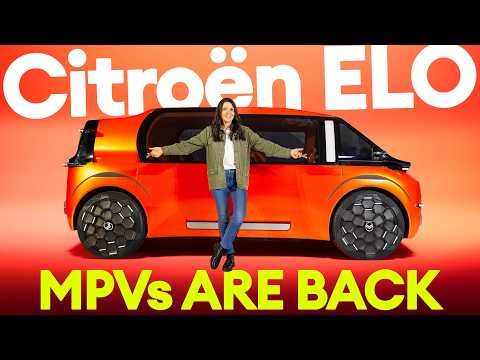
The overall design philosophy is Friendly, Compact Utility defined by a unique single-box minivan silhouette. The short, flat hood and upright stance maximize interior volume within a highly compact 4.10-meter footprint, similar to a subcompact hatchback. The aesthetic is cheerful, often presented in a vibrant light-shifting orange hue.
Lighting elements feature Citroën's contemporary vertical dual LED signature at the front and geometrically stylized, split LED taillamps at the rear. The bumpers and flat protective wing pads are made from a fully recyclable, durable plastic material (expanded polypropylene, 30% recycled content) designed to absorb minor knocks and act as resting shelves.
Aerodynamic elements are subtle, given the boxy shape, focusing on a clean break at the rear. The vehicle features opposing side doors (without a center pillar) that open to a massive $1.92 \text{ meter}$ width, creating an unhindered entrance to the cabin. The concept rides on 21-inch wheels fitted with innovative Goodyear outdoor-ready smart tires.
Interior and Features
The ELO’s interior is its defining feature: a highly flexible, multi-purpose living space built on a flat EV floor and designed for the maximum utilization of its footprint.
Dashboard and display technology eschew conventional touchscreens. The cockpit features a central driver's seat offering a panoramic $180^\circ$ view through the wraparound windscreen. Instrumentation uses a modern, ingenious interface where information from flat screens is reflected onto a transparent panel with a reflective film, creating a floating projection display with minimal cost and complexity compared to a traditional HUD. The steering wheel is a futuristic shape with joystick-style controls.
Infotainment and connectivity are simple and ergonomic. The design avoids reliance on complex, expensive screens, instead focusing on smartphone integration and adaptability. The vehicle includes V2L (Vehicle-to-Load) power output for running external devices like speakers or grills for outdoor activities.
Seating, materials, and comfort features define the ELO’s REST, PLAY, WORK mission. The interior utilizes durable, simple, and cleanable materials. The standard layout is four seats, with the driver in the middle. The second row has three seats, which are removable and convert into outdoor camping chairs. Two additional seats are cleverly concealed beneath the second-row outer seats and can be unfolded to create a six-seat configuration without compromising boot space. For REST, the cabin converts into a two-person sleeping space using high-rigidity Dropstitch inflatable mattresses (a collaboration with Decathlon), inflated by an integrated compressor. The rear lights even double as bedside lamps. For WORK, the central driver’s seat rotates $360^\circ$, and a pull-out desk/table can be attached for a mobile office setup.
Driver assistance and safety systems are designed to be safe and simple, though advanced ADAS is not the primary focus of the concept. The excellent visibility afforded by the central seating position and large glass area (4.5 $\text{m}^2$ glazing) is a key safety feature.
Performance and Driving Experience
While performance details are scarce, the ELO’s driving experience is centered on urban agility, easy maneuverability, and electric refinement, with an emphasis on its versatility when parked.
The ride quality, although unverified, is designed for urban comfort and easy access, aided by the high roofline. The motor is rear-mounted, which frees up the front end for better turning radius and maximizes the cabin floor space. Its compact length makes it agile and easy to park in crowded urban environments.
Efficiency is paramount, with the $4.10 \text{ meter}$ length and focus on lightweight, sustainable materials (like expanded polypropylene) ensuring optimal energy consumption for a family vehicle. The utility features, such as the V2L capability and the ultra-modular interior, redefine the vehicle's functional performance beyond simple transportation.
Pricing
As the Citroën ELO is a concept car and not a production model, no official pricing exists. Pricing is estimated based on its positioning relative to the brand's similar-sized compact electric offerings.
|
Configuration/Trim |
Price (USD) |
|
Concept Car (No Production Price) |
Priceless (Estimated production cost similar to a well-equipped e-C3) |
|
Estimated Base Production Price |
$25,000 (Based on European B-segment EV pricing) |
Market Positioning and Competitors
The Citroën ELO is a radical concept that, if produced, would challenge the dominance of compact SUVs by reinventing the Compact Electric MPV/Leisure Activity Vehicle segment.
Comparable EVs in the same category and price:
-
Citroën ë-C3: The ELO shares a similar footprint and is likely to influence the design of its future successor, competing on accessibility and urban utility.
-
Jeep Avenger / Peugeot e-2008: Stellantis rivals competing in the subcompact electric crossover space, which the ELO seeks to differentiate from by offering superior cabin versatility and space.
-
Renault Twingo E-Tech Electric (Future): A small urban EV competitor focusing on retro design and accessibility, though the ELO targets a higher level of functionality.
-
Kia PV1 / PV5 (Platform Competitors): Kia’s purpose-built vehicle (PBV) concepts share the ELO's focus on functional, modular interior space built on a dedicated electric platform.
The ELO’s key differentiators are its hyper-modularity (4-to-6 seats, sleeping area, mobile office), central driving position, and commitment to sustainability (30% recycled materials). It appeals to a niche audience seeking a responsible, fun, and highly adaptable vehicle that truly acts as a "living space" rather than just a conveyance.