The Westwell Q-Truck is "no driver's cab at all"
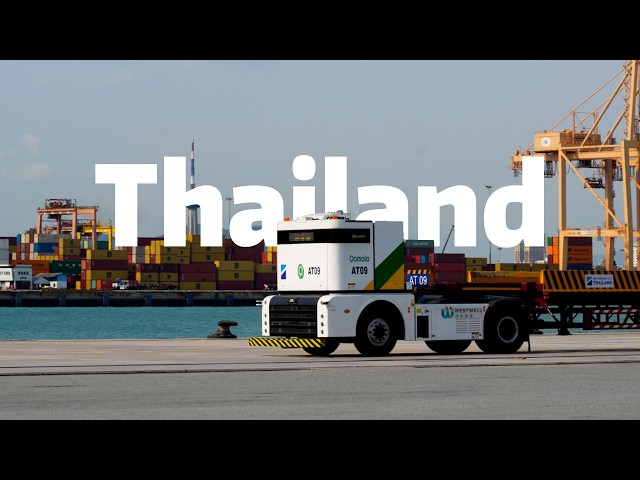
The Westwell Q-Truck is the vehicle that made "no driver's cab at all" a commercial reality rather than a concept-car gimmick. Since entering mass production in 2020, this cabless, battery-swappable autonomous hauler has gone from a Shanghai showcase to a working fleet moving containers at ports and logistics parks in Thailand, the UAE, Malaysia, Mexico, and the UK. Here's what it actually is, what it's built to do, and where it fits in.
75t
Maximum load capacity
150km
Full-battery range
5-6min
Battery swap time
97%+
First-attempt docking accuracy
What the Q-Truck Is
Developed by Westwell under its Qomolo autonomous-driving brand, the Q-Truck is a purpose-built, full-time autonomous new-energy commercial vehicle for container logistics. Rather than automating a normal tractor unit, Westwell removed the driver's cab entirely — the front end houses only the computing, sensing, cooling, and battery systems. Westwell calls it the world's first mass-produced unmanned commercial vehicle, and it has been in commercial operation since 2020.
That cabless layout isn't just styling. Dropping the cab frees up cargo space and lets the vehicle be optimized purely around the sensor suite, battery pack, and swap mechanism, since no human ever needs to see out of it or climb inside.
Specifications
|
Body style
|
Cabless autonomous tractor unit
|
|
Powertrain
|
Battery-electric, swappable pack
|
|
Maximum load
|
Up to 75 tonnes
|
|
Full-battery range
|
150 km
|
|
Battery swap time
|
Approx. 5-6 minutes
|
|
Charging
|
Supports both battery swapping and fast charging
|
|
LiDAR detection range
|
200 m
|
|
Stereo camera range
|
80 m
|
|
Positioning accuracy
|
±3 cm
|
|
Steering deviation control
|
0.5 degrees
|
|
Docking accuracy
|
Over 97% first-attempt success
|
|
Operating mode
|
Mixed operations — unmanned and manned driving
|
|
Certification
|
CE Certified
|
|
Target scenarios
|
Ports, logistics parks, industrial and mining sites
|
Specs reflect the current-generation Q-Truck as marketed by Westwell and reported in fleet deployments; battery swap time and load figures vary slightly by source and deployment site.
How the Q-Truck Has Evolved
Westwell has iterated the Q-Truck through several hardware generations since its 2020 debut, steadily pushing range and payload as battery and control systems matured.
Q-Truck maximum payload by generation
Reported maximum load capacity across publicly documented Q-Truck generations. Data: Pandaily, Port Technology International, WorldCargo News.
2021 debut unit
80 t
2022, 4th-gen upgrade
75 t
2025 fleet units (Abu Dhabi)
75 t
Range has followed a similar pattern: early units were rated around 200 km, while the fourth-generation trucks in current fleet service settle at 150 km per charge — likely a trade-off tuned for real-world duty cycles and battery-swap-first operation rather than a straight regression.
Autonomy and Safety Systems
The Q-Truck's autonomous stack runs on Westwell's WellDrive platform, combining sensor fusion, positioning, planning, and control for around-the-clock operation with high-precision control in tight, complex yards.
- Multi-sensor fusion: LiDAR, a Westwell proprietary long-range binocular camera, and multiple monocular cameras for 360° monitoring
- Perception continues to track surroundings even when the tractor and trailer are decoupled
- Precision docking in enclosed logistics roads under 3 m wide
- Redundant braking and dual power supplies with SOH monitoring on low-voltage batteries
- EHPS dual-source steering pumps to eliminate single-point steering failure
- EBS and EPB systems providing complementary braking redundancy
- Power-off redundant protection for a safe stop during power loss
- Four emergency stop buttons positioned around the vehicle exterior
- Impact-sensing collision beams that respond and stop on contact within milliseconds
Pros
- Proven at commercial scale — in service since 2020 across five countries
- Cabless design maximizes cargo space and removes cab-related cost and complexity entirely
- Fast battery swapping keeps utilization high without long charging downtime
- Layered safety redundancy (steering, braking, power, emergency stop) built for driverless operation
- CE certified and already integrated into large operators' daily terminal workflows
Cons
- 150 km range and enclosed-yard design limit it to port, park, and industrial settings — not a public-road truck
- Requires dedicated battery-swap infrastructure to hit its fastest turnaround times
- Westwell doesn't publish full technical specs sheets publicly; figures come largely from case studies and press coverage
Frequently asked questions
- Is the Westwell Q-Truck fully driverless?
Yes, it's designed to operate without a driver cab at all, though Westwell's platform also supports mixed operation alongside manned vehicles at the same site.
- Where is the Q-Truck actually used?
It's deployed at seaports, logistics parks, and industrial sites, including operations in Thailand, the UAE, the UK (Port of Felixstowe), Malaysia, and Mexico.
- How does the Q-Truck recharge?
It supports both battery swapping, which takes roughly five to six minutes at a Westwell power station, and conventional fast charging.
- How much can it carry?
Current-generation units are rated for a maximum load of around 75 tonnes, with roughly 150 km of range on a full charge.
The Q-Truck isn't chasing the general trucking market — it's built to own a specific job: moving heavy containers around enclosed yards, continuously, without a driver. On that narrow but demanding brief, it's one of the few autonomous heavy vehicles with years of real commercial mileage behind it rather than just demo footage.