

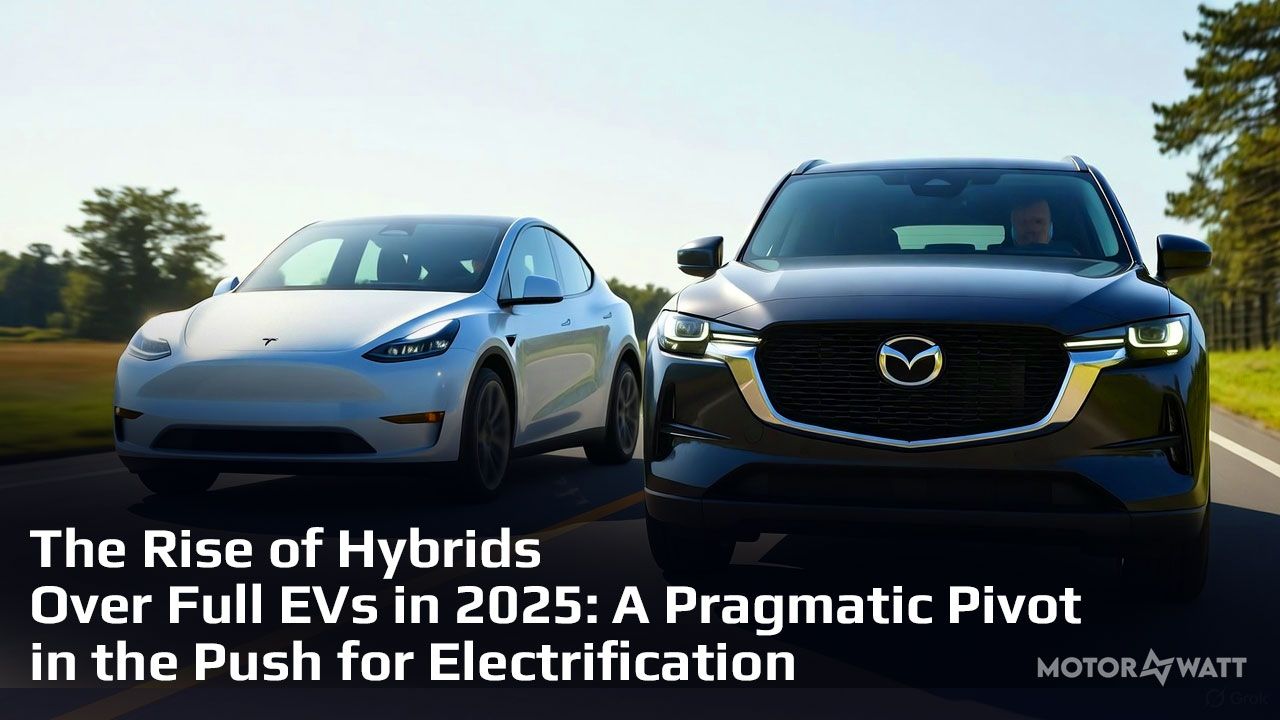
The rise of hybrids over full EVs in 2025 reflects a shift from hype to practicality. With EVs facing high prices and charging limits, hybrids offer affordability, reliability, and no range anxiety. Global hybrid sales jumped over 30%, making them the preferred bridge toward electrified mobility.
In 2025, hybrids are stealing the thunder from full electric vehicles. As battery EV adoption slows, hybrids—both plug-in and traditional—are seeing double-digit growth. They combine electric efficiency with gasoline dependability, sidestepping the cost and charging barriers that plague full EVs. It’s not a retreat from green tech but a reality check, where affordability, infrastructure, and consumer comfort drive the shift. Simply put, hybrids are the practical middle lane in the fast-evolving world of electrified transport.
Hybrid Sales Surge: The Data Behind the Shift
The numbers speak volumes. U.S. hybrid sales spiked 36% in the second quarter of 2025, now commanding roughly 22% of the light-duty market—up from 18% last year. Meanwhile, battery-electric vehicles hover below 9%. Globally, China reports plug-in hybrids (PHEVs) at nearly 30% of electric car sales, doubling since 2020. According to JATO Dynamics, traditional and mild hybrids now hold over 55% market share versus BEVs at 38%. Even Europe, long the EV darling, is seeing hybrids fill the demand gap as incentives fade and infrastructure lags. This momentum suggests consumers aren’t abandoning electrification—they’re redefining it on their own terms.
Why Hybrids Are Winning: Affordability and Familiarity
Sticker shock plays a huge role. The average BEV now costs about $59,200 (€54,700), compared to an industry average of $47,500 (€43,900). Meanwhile, a Toyota Camry Hybrid starts at roughly $37,200 (€34,400), offering 50+ mpg (4.7 L/100 km) without plugging in every night. For buyers weary of charging anxiety, hybrids make perfect sense—PHEVs deliver 30–60 miles (48–96 km) of electric range for city drives, with gas engines kicking in for longer trips. They also boast proven reliability, lower battery degradation risk, and easier resale. For most, it’s the best of both worlds: part-electric, all-practical.
Policy and Market Factors Fueling Hybrid Growth
Policy changes are reshaping the market just as much as consumer demand. The expiration of the $7,500 U.S. federal EV tax credit in early 2025 left full EVs exposed, while many hybrids still qualify for state-level rebates. Globally, the European Union’s tariffs—up to 35.3% on Chinese-built EVs—are tilting exports toward plug-in hybrids. Automakers are reacting fast: Ford predicts EVs could shrink to just 5% of U.S. sales this year, while GM and Toyota are expanding hybrid offerings to meet fleet emission targets without overburdening buyers. In short, politics, policy, and pragmatism are aligning behind hybrids.
Automakers’ Strategic Pivot Toward Hybrids
Major carmakers are changing course. Toyota, long the hybrid trailblazer, is doubling down on its “multi-pathway” electrification strategy. Ford’s CEO Jim Farley has rebalanced production to emphasize models like the Maverick and Escape hybrids, forecasting far higher demand than for EVs. General Motors is extending hybrid production to cushion its $1.6 billion EV losses, while Jeep is electrifying its Wrangler ahead of its 2028 all-electric debut. In China, BYD’s plug-in hybrids are now nearly as popular as its BEVs. Even luxury brands like Mercedes expect hybrids and BEVs to coexist “for a longer period,” reflecting a broader industry recalibration toward consumer reality.
Environmental Impact: Are Hybrids Green Enough?
Critics argue hybrids are a half-step, but 2025’s data paints a different picture. With renewable energy surpassing coal globally this year, hybrids powered by cleaner grids deliver tangible CO₂ reductions. They use smaller batteries—cutting rare metal demand—and still achieve 30–50% lower emissions than internal combustion engines. For fleets, they’re an immediate path to meet CAFE standards without the logistical nightmare of large-scale charging. In effect, hybrids are buying time for infrastructure to catch up while keeping emissions in check. They’re not flawless, but they’re undeniably effective.
|
Powertrain Type |
Market Share (%) |
YoY Growth |
|
Traditional/Mild Hybrids |
55.1 |
+28% |
|
Battery Electric (BEVs) |
38.4 |
+3% |
|
Plug-in Hybrids (PHEVs) |
6.5 |
+15% |
Consumer Behavior and Market Psychology
Americans are famously pragmatic buyers, and the hybrid surge underscores that. Surveys show 45% of consumers favor hybrids for their next vehicle, compared to just 33% for full EVs. The reasons? Convenience and trust. Drivers appreciate not hunting for a charging station at midnight or fretting about cold-weather range loss. Test-drive conversions are faster for hybrids, and satisfaction scores remain consistently high. Simply put, hybrids hit the psychological sweet spot—green enough to feel responsible, practical enough to feel smart.
Looking Ahead: The Bridge to a Fully Electric Future
The rise of hybrids over full EVs isn’t a step backward—it’s a pause for balance. Automakers are refining battery tech, governments are adjusting incentives, and consumers are voting with their wallets. By 2030, experts project electrified vehicles—hybrids, PHEVs, and BEVs combined—will capture 50% of global sales. Hybrids are the bridge that keeps the dream alive without breaking budgets or patience. Whether it’s a Prius refresh or a hybrid Ford Maverick, the road to electrification just got longer—but also smoother.
Conclusion
Pros and Cons of the Rise of Hybrids Over Full EVs
- Pros:
- Lower purchase prices and maintenance costs compared to BEVs.
- No dependence on public charging infrastructure.
- Proven reliability and wide model availability.
- Ongoing eligibility for some state and regional incentives.
- Reduced emissions versus traditional gas vehicles.
- Cons:
- Still reliant on gasoline for extended travel.
- Not as clean as pure electric options over their lifecycle.
- Limited EV-only range on most plug-in hybrids.
- Potential phase-out as future zero-emission mandates tighten.
Final Thoughts
The rise of hybrids over full EVs in 2025 reflects consumers’ desire for balance—cleaner driving without the compromises. With affordability, reliability, and simplicity on their side, hybrids have become the realistic stepping stone toward a fully electric future. Sometimes, the smarter route isn’t the fastest—it’s the one that actually gets you there.