
Can I Own an EV Without a Garage?
The short answer: Yes — you absolutely can own an EV without a garage. Roughly 35% of U.S. EV owners already charge without a private garage, using public stations, workplace outlets, or weatherproof outdoor home chargers. The key is matching your charging strategy to your daily driving distance and living situation.
Key Findings at a Glance
- 35% of U.S. EV owners successfully charge without a private home garage (EPRI / J.D. Power, 2025).
- Level 1 charging (120 V) adds 3–5 miles (5–8 km) of range per hour - enough for the average American's 37-mile (60 km) daily commute overnight.
- 326,000+ public charging ports are live in the U.S. as of early 2026 - up 30% year-over-year (EV Connect, Feb 2026).
- Home charging costs roughly $0.13–$0.18/kWh vs. $0.28–$0.48/kWh at public DCFC - meaning smart home charging saves up to $900/yr (€819/yr) vs. public-only charging.
- Weatherproof Level 2 EVSE units carry IP-65 or higher ratings and operate safely from -40 °F (-40 °C) to 122 °F (50 °C).
What's Inside This Guide
Is Garage-Free EV Ownership Actually Realistic in 2026?
Here's the counterintuitive truth: not having a garage is no longer a real barrier to EV ownership. The fear is understandable - you've probably heard someone say, "EVs are only practical if you can charge at home." That was mostly true five years ago. In 2026, it isn't.
According to a 2025 EPRI (Electric Power Research Institute) survey, approximately 35% of U.S. EV owners charge primarily away from home or via outdoor setups without a dedicated garage. Urban dwellers in cities like New York, Chicago, Los Angeles, and San Francisco are among the fastest-growing EV adopter segments - precisely the people least likely to own a garage.
"Range anxiety is fading fast - but 'charging access anxiety' is the real issue for apartment renters. And that's solvable right now."
What's changed? Three things, mainly: public charging density has tripled since 2020, outdoor-rated Level 2 home chargers are now mainstream and affordable, and most major apartment markets are passing Right-to-Charge legislation. The math now genuinely works for garage-free owners.
What Are the Three Levels of EV Charging - and Which One Do You Need?
Understanding charging speed is the foundation of garage-free EV ownership. There are three tiers, each with distinct costs, speeds, and installation requirements. Here's the full breakdown:
Level 1 - Standard Outlet
120 V AC · No InstallationUses the same 120 V outlet as your phone charger. Zero installation cost. The included EVSE cable plugs into any grounded 3-prong outlet. Best for low-mileage drivers (<40 mi/day) who can charge 8–10 hrs overnight. Power draw: ~1.4 kW. Cost: $0 hardware (cable included with vehicle).
Level 2 - Fast Home / Public
240 V AC · Professional Install RecommendedRequires a 240 V / 40–50 A dedicated circuit - the same as a clothes dryer outlet. Adds roughly 25–30 miles (40–48 km) per hour on a 7.2 kW charger. Equipment costs $200–$700 (€183–€638); installation adds $300–$1,000 (€274–€912). Can be mounted outdoors with IP-65 weatherproof rating.
Level 3 - DC Fast Charging
480 V DC · Public Stations OnlyFound at public charging hubs, highway corridors, and retail locations. Adds 150–200 miles (240–320 km) in 15–20 minutes. Costs $0.28–$0.48/kWh (€0.26–€0.44/kWh) on most networks. Not suitable for overnight home use - designed for en-route top-ups and long-distance travel.
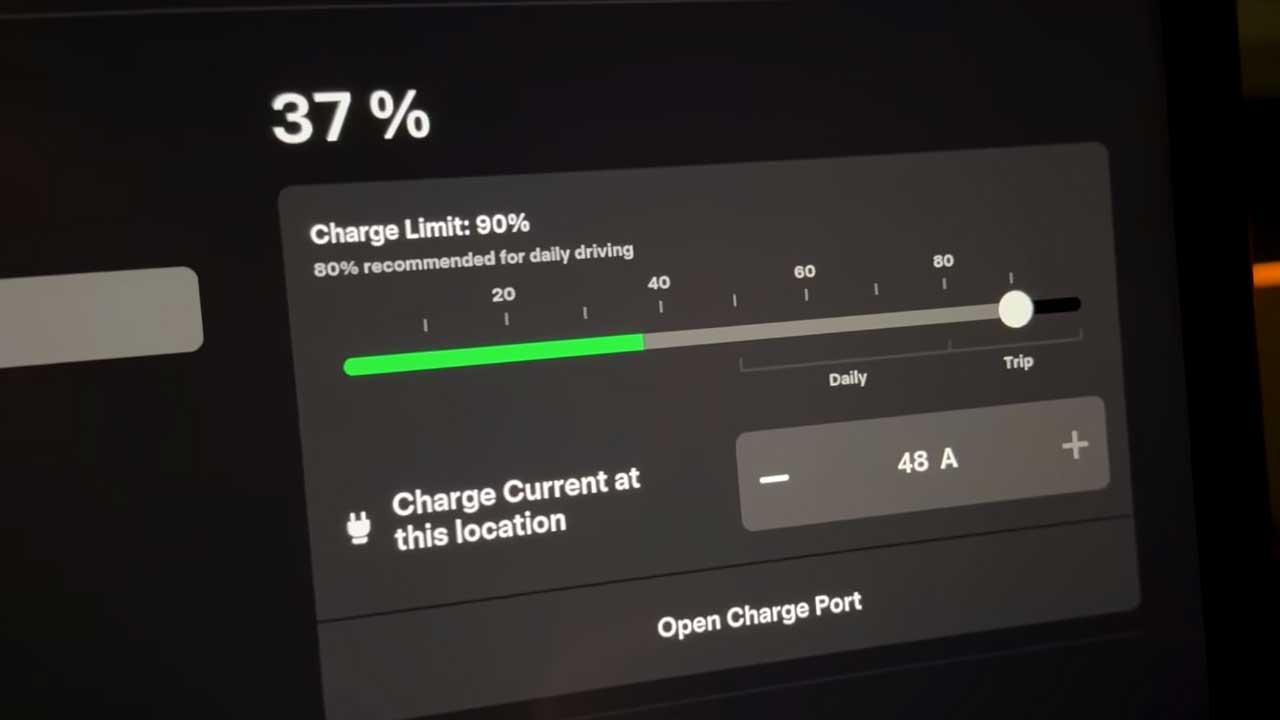
Pro tip: The average American drives 37 miles (60 km) per day. A Level 1 overnight charge of 8–10 hours adds 24–50 miles (39–80 km) - comfortably covering the national average daily commute with no installation required.
Source: U.S. DOE Alternative Fuels Data Center, EPRI 2025. Assumes mid-range EV efficiency.
How Do You Set Up Home Charging Without a Garage?
No garage doesn't mean no home charging. Outdoor Level 2 charging stations are designed specifically for exterior installation and carry weatherproof ratings that handle everything from Pacific Northwest rain to Minnesota winters. Here's exactly how to set one up.
Step-by-Step: Installing an Outdoor Home Charger
1. Assess Your Electrical Panel
Hire a licensed electrician to inspect your main panel. A Level 2 charger needs a dedicated 240 V / 40–50 A breaker. Most homes built after 1980 have capacity; older homes may need a panel upgrade costing $1,500–$4,000 (€1,367–€3,645). Timeline: 1–2 hrs assessment.
2. Choose a Weatherproof EVSE Unit
Look for IP-65 or NEMA 4X ratings, which protect against rain, dust, and jet spray. Top picks include the ChargePoint Home Flex (~$699 / €637), Emporia Level 2 (~$229 / €209), and JuiceBox 40 (~$399 / €364). All operate from -40 °F to 122 °F (-40 °C to 50 °C).
3. Select the Optimal Mounting Location
Mount the EVSE within 20–25 ft (6–7.5 m) of your vehicle's charge port. Ideal locations: exterior wall near parking space, a dedicated post mount, or a covered carport wall. Avoid south-facing walls in desert climates where units may overheat in summer above 115 °F (46 °C).
4. Run Conduit and Pull Wire
Your electrician will run weatherproof conduit from the panel to the mount location. Use Schedule 80 PVC or rigid metal conduit for any outdoor runs. Wire gauge: #8 AWG minimum for 40 A circuits; #6 AWG for 50 A. This step typically costs $300–$800 (€274–€729) in labor depending on run length.
5. Pull Permits and Schedule Inspection
Most municipalities require an electrical permit for Level 2 EVSE installation - cost is typically $50–$150 (€46–€137). The inspection confirms the installation is code-compliant. Skipping this step voids most homeowner's insurance policies regarding the charger. Timeline: 1–3 business days for permit approval.
6. Manage Cord Safety and Length
Most Level 2 units come with a 20–25 ft (6–7.5 m) cable. Use a weatherproof cable holster or a dedicated wall-mounted cord holder to prevent tripping hazards and cord degradation from UV exposure. Avoid extension cords - they violate NEC code and increase fire risk. Longer cable runs beyond 25 ft can drop voltage by 1–2%.
Important: Never use a standard indoor extension cord to extend an EV charge cable outdoors. This violates the National Electrical Code (NEC Article 625) and creates both a fire and electrocution risk. If your parking spot is far from your panel, a licensed electrician can run conduit the full distance safely.
What Does Outdoor Level 2 Installation Cost?
Typical U.S. residential installation. Prices shown in USD and EUR (1 USD = 0.912 EUR, April 2026).
How Good Is the Public Charging Network for Garage-Free Owners?
Here's where the argument against garage-free EV ownership falls apart most completely: the U.S. public charging network is now genuinely usable for daily life. As of early 2026, the DOE's Alternative Fuels Data Center counts over 77,000 public charging locations with more than 326,000 individual ports nationwide.
According to Paren's Q2 2025 network reliability report, non-Tesla charging uptime has climbed to 85.5%, while Tesla Supercharger uptime remains above 99%. That's a massive improvement from the 70% non-Tesla uptime J.D. Power reported in 2022.
Top Public Charging Networks to Know in 2026
| Network | U.S. Stations (2026) | Max Speed | Cost Range | Connectors | Reliability |
|---|---|---|---|---|---|
| Tesla Supercharger | |||||
| Electrify America | |||||
| ChargePoint | |||||
| EVgo | |||||
| Blink Network | |||||
| Walmart EV Charging |
Best apps for finding chargers: Use PlugShare for real-time community check-ins and station condition reports, and ABRP (A Better Route Planner) for route-integrated charging planning. Both are free and work offline.
Source: U.S. DOE Alternative Fuels Data Center, EV Connect February 2026.
Can Your Workplace Solve Your Charging Problem?
Workplace EV charging is one of the most underrated solutions for garage-free owners. According to a 2025 SHRM survey, 29% of U.S. employers now offer or plan to offer EV charging as an employee benefit - up from just 9% in 2021. If you work a standard 8-hour shift, that's enough time for a Level 2 charger to add 200–240 miles (320–386 km) of range while you're on the clock.
The math is compelling for both sides. Employers who install Level 2 workplace chargers qualify for the Alternative Fuel Vehicle Refueling Property Credit (30C), covering 30% of equipment + installation costs, up to $100,000 (€91,200) per location for commercial property. That incentive expires at the end of 2032.
"Workplace charging is the ultimate 'two for one' - the employee gets free or low-cost energy, and the employer gets a tangible sustainability win that actually moves the needle on EV adoption."
- Most workplace Level 2 stations provide 6–8 hours of charging per workday - enough for 120–200 miles (193–322 km) of added range.
- Apps like ChargePoint and Blink include employee authentication so companies can track usage and bill fairly.
- Federal and state EV infrastructure grants (NEVI Formula Program) cover up to 80% of public-access workplace charger costs.
- Many employers offer workplace charging as a free perk - the average monthly energy cost per employee is just $15–$25 (€13.70–€22.80).
- If your employer doesn't have charging, print out the IRS 30C fact sheet and share it - the tax credit argument often closes the deal.
Garage-Free EV Charging: Old Approach vs. Smart 2026 Strategy
| Dimension | Old Approach (Pre-2022) | Smart 2026 Approach | Outcome |
|---|---|---|---|
| Primary Charging | |||
| Overnight Charging | |||
| Charging Cost | |||
| Apartment Access | |||
| Charger Weather Protection | |||
| Network Reliability | |||
| Finding Chargers | |||
| Charging Speed |
How Do You Get EV Charging Approved at an Apartment, Condo, or HOA?
This is the real sticking point for many renters and condo owners. The good news: 24 U.S. states now have Right-to-Charge laws that limit landlord and HOA authority to block EV charging installation requests. California pioneered this approach with Civil Code Section 1947.6 - and dozens of states followed.
Right-to-Charge: Key States and What the Law Says
| State | Law | Landlord Must Allow? | Notes |
|---|---|---|---|
| California | |||
| Florida | |||
| Colorado | |||
| Oregon | |||
| New York | |||
| Hawaii | |||
| Texas |
If your state isn't listed above, you still have options. Present your landlord or HOA with a formal written request citing potential property value increases (homes within 1 mile of a charger sell for 3.3% more on average, according to a 2025 Lawrence Berkeley National Lab study) and the availability of NEVI Program grants that can fund shared chargers at no cost to the building.
Negotiation tip: Propose a shared charging arrangement where your landlord installs 2–4 Level 2 stations in the parking lot (funded by NEVI grants, covering up to 80% of costs) and charges residents per kWh. This turns an expense into a potential revenue source for the property - often the argument that moves the needle fastest.
Which EVs Are Best for Owners Without a Garage?
Not all EVs are equally suited for garage-free life. The best choices combine high EPA-rated range, efficient real-world performance, and fast public charging speeds so you can top up quickly and infrequently. Here are the 2026 model-year standouts:
| Model | EPA Range | Real-World Range | Max Charge Speed | Starting Price | Best For |
|---|---|---|---|---|---|
| Tesla Model 3 LR AWD | |||||
| Hyundai IONIQ 6 SE LR | |||||
| Chevy Equinox EV LT | |||||
| BMW i4 eDrive40 | |||||
| Rivian R1T Standard | |||||
| Kia EV6 Long Range |
Research indicates that high max charge speed matters most for garage-free owners, because you're more likely to rely on fast public charging for occasional top-ups. A car that can accept 233–250 kW will add 150 miles (241 km) in under 20 minutes - while a car capped at 50–100 kW takes 45–60 minutes for the same result.
Estimated real-world highway range at 70–75 mph (113–121 km/h). Source: Consumer Reports, Car and Driver 2025.
What Does Garage-Free EV Ownership Really Cost vs. Having a Garage?
The cost comparison between garage-free and garaged EV ownership is more nuanced than most people think. Let's run the real numbers for a driver covering 12,000 miles (19,312 km) per year - the U.S. average.
| Cost Category | Garage Owner (L2 home) | No Garage / Outdoor L2 | No Garage / Public-Only |
|---|---|---|---|
| Setup Cost (yr 1) | |||
| Annual Charging Cost | |||
| vs. Gasoline (12K mi) | |||
| Federal 30C Credit | |||
| Break-Even Point | |||
| 3-Year Total Cost |
The data reveals a clear takeaway: a garage-free owner who installs an outdoor Level 2 charger pays essentially the same as a garaged owner, while a public-only strategy is still significantly cheaper than gasoline but costs roughly $800–$1,200 (€729–€1,094) more annually than home charging.
Pros of Garage-Free EV Ownership
- Lower EV adoption barrier - no garage required
- Outdoor L2 cost parity with garaged charging
- 326,000+ public backup ports nationwide
- Free workplace charging available at 29% of employers
- Right-to-Charge laws expanding nationwide
- Federal 30C tax credit offsets L2 install costs
- Lower maintenance vs. gasoline regardless of charger location
- DCFC speeds match gas-station refuel time
Cons of Garage-Free EV Ownership
- Upfront L2 install cost ($679–$1,899)
- Panel upgrade may add $1,500–$4,000
- Public-only charging costs ~$800/yr more than home
- HOA or landlord approval may be required
- Cold weather impacts L1 overnight charging efficiency
- Public charger availability still varies by ZIP code
- Cord management safety responsibility outdoors
Full Charging Strategy Comparison: All Options for Garage-Free EV Owners
| Strategy | Speed | Setup Cost | Annual Cost | Ease of Use | Apartment-Friendly | Best For |
|---|---|---|---|---|---|---|
| Level 1 / 120V outdoor | ||||||
| Outdoor L2 / 240V home | ||||||
| Workplace L2 charging | ||||||
| Public L2 stations | ||||||
| Public DCFC / 50–350 kW | ||||||
| Shared building charger | ||||||
| Portable L2 EVSE |
The 5-Phase Garage-Free EV Success Strategy
1. Calculate Your Daily Miles (Days 1–3)
Track your actual daily driving for 3 days using Google Maps or your phone's mileage log. Compare against the U.S. average of 37 miles (60 km). If you drive under 40 miles daily, Level 1 overnight charging covers you tonight with zero setup.
2. Map Your Charging Ecosystem (Days 4–7)
Open PlugShare and ABRP. Identify (a) public Level 2 and DCFC stations within 1 mile of home, (b) workplace charging options, and (c) destination chargers at your most-visited locations. If you find 3+ viable public options near home, you may not need a home charger at all.
3. Decide Home Charger Feasibility (Days 8–14)
If you own the property or have Right-to-Charge legal standing: get 2–3 electrician quotes for an outdoor Level 2 install. If you rent without legal standing: begin the landlord/HOA conversation using the NEVI grant + property value data. Factor in the 30C tax credit (30% back, up to $1,000 / €912).
4. Establish Your Primary Charging Routine (Days 15–30)
Set your car to charge overnight on a schedule (most EVs let you set start/stop times to hit off-peak utility rates, typically 10 PM–7 AM). Sign up for one DCFC membership (ChargePoint or EVgo) for backup fast charging. Download your utility's EV rate plan app - most U.S. utilities offer EV-specific rates of $0.07–$0.12/kWh overnight.
5. Optimize and Track Costs (Days 31–60)
After 30 days, review your charging log. Calculate your actual cost per mile. Most garage-free owners discover their real-world cost is $0.03–$0.06/mi (1.9–3.7 ¢/km) - 60–70% cheaper than gasoline at $3.50/gal (€0.83/L equivalent). Fine-tune your routine based on real data, not assumptions.
Garage-Free EV Ownership: 8 Most-Asked Questions
- Can you charge an EV with a regular 120-volt outlet outside?
Yes - most EVs come with a Level 1 EVSE (mobile charger) that plugs into any standard 120V grounded outlet. For outdoor use, the outlet must be GFCI-protected, weatherproof (with a bubble cover), and on a dedicated 15–20 A circuit. Level 1 adds 3–5 miles (5–8 km) of range per hour, which covers the average 37-mile (60 km) U.S. daily commute in 8–10 hours of overnight charging.
- Is it safe to charge an EV outdoors in the rain or snow?
Absolutely. EV charging connectors and Level 2 EVSE units are rated for outdoor use. The J1772, CCS, and NACS connectors all carry IP-55 or higher ingress protection ratings. Quality outdoor EVSE units (ChargePoint, JuiceBox, Emporia) carry IP-65 or NEMA 4X ratings, meaning they're sealed against rain, sleet, and jets of water from any direction. They operate safely from -40°F to 122°F (-40°C to 50°C).
- Does cold weather make garage-free EV ownership harder?
Cold weather temporarily reduces EV battery range by 20–40% below freezing. This is manageable for garage-free owners using two strategies: First, keep the battery warm by plugging in overnight even on Level 1 - the car draws a small amount of power to maintain battery temperature. Second, use your EV's built-in "pre-conditioning" feature to warm the cabin and battery remotely while still plugged in, so the car is warm before you unplug. Most 2023+ EVs have heat pumps that reduce cold-weather range loss by 15–20% versus older resistive-heating models.
- What if my apartment complex won't let me install a charger?
If you're in one of the 24 states with Right-to-Charge laws (including California, Florida, Colorado, New York, and Oregon), you may have legal standing to request installation even without landlord approval - as long as you agree to bear the cost and meet reasonable conditions. In other states, present the NEVI Program grant option to your landlord: federal grants cover up to 80% of shared charger installation costs, turning a potential expense into a property amenity. Public-only charging is a fully viable backup strategy in any major U.S. metro area.
- How long does it take to charge an EV without a Level 2 home charger?
With Level 1 charging (120V outlet), a completely depleted battery on a typical mid-range EV (60–80 kWh) takes 40–55 hours to fully charge. However, most drivers don't start from empty - a typical overnight top-up of 20–30% (adding 60–90 miles / 97–145 km) takes just 12–20 hours on Level 1. For a full charge, public Level 2 stations at ~7.2 kW charge 60–80 kWh batteries in 8–12 hours; DC fast chargers handle the same job in 25–50 minutes.
- Is it more expensive to own an EV without a garage?
Not significantly, if you install an outdoor Level 2 charger. The charging cost per kWh is identical to indoor home charging ($0.13–$0.18/kWh vs. $0.13–$0.18/kWh). The one-time installation cost of $679–$1,899 (€619–€1,731) is offset by the federal 30C tax credit (30% back, up to $1,000 / €912). If you rely solely on public DCFC charging, annual costs run $600–$1,200 (€547–€1,094) higher than home charging - still cheaper than gasoline, but the gap narrows.
- What is the best EV to own without a garage?
For garage-free owners in 2026, the Hyundai IONIQ 6 SE Long Range and Tesla Model 3 Long Range AWD stand out. Both offer real-world highway ranges above 300 miles (483 km), maximum DC fast charge speeds above 230 kW (adding 150 miles in 18 minutes), and competitive pricing under $45,000 (€41,040). The IONIQ 6 starts at $38,615 (€35,225), making it the best value for combined range and charging speed. For budget buyers, the Chevy Equinox EV LT at $34,995 (€31,916) offers solid 258-mile (415 km) real-world range at the lowest entry price.
- Can you use a portable Level 2 charger if you move frequently?
Yes. Portable Level 2 EVSE units like the Lectron Portable Level 2 Charger ($199 / €181) and the Grizzl-E Genius ($349 / €318) plug into a NEMA 14-50 outlet (standard dryer-type) with no permanent installation. You simply carry the unit with you when you move. Many RV parks, campgrounds, and some residential complexes already have NEMA 14-50 outlets available, making portable Level 2 charging a practical option for renters and frequent movers who can't do permanent installation.
Your Action Plan: Going Garage-Free in 60 Days
Owning an EV without a garage isn't a compromise - it's a completely viable lifestyle choice that 35% of current U.S. EV owners are already living. The technology, infrastructure, and legal landscape have all converged to make it genuinely practical in 2026.
Here's your concrete implementation timeline:
Week 1: Assess and Map
Track your daily mileage. Open PlugShare. Find all charging options within 1 mile of home and work. Determine if Level 1 alone covers your needs.
Week 2: Legal & Landlord Research
Check your state's Right-to-Charge status. If needed, submit a formal written request to your landlord or HOA citing NEVI grant availability and property value data.
Week 3: Get Electrician Quotes
Get 2–3 quotes for outdoor Level 2 installation. Ask about panel capacity and permit requirements. Calculate your net cost after the 30C tax credit (30%, up to $1,000 / €912).
Week 4: Choose and Install
Select your EVSE unit (Emporia Level 2 at $229 / €209 for budget; ChargePoint Home Flex at $699 / €637 for premium features). Schedule installation. Pull the permit.
Month 2: Optimize Your Routine
Set your charge schedule to off-peak hours (10 PM–7 AM). Sign up for your utility's EV rate plan. Join one DCFC network for backup fast charging. Review costs after 30 days and compare to your pre-EV fuel bills.
Ready to Join the EV Revolution - Garage or Not?
Browse the Motorwatt EV Database to find the perfect long-range EV for your garage-free lifestyle. Filter by max charging speed, range, and price to find your match.
Browse All Electric CarsSources & Further Reading
- EPRI (Electric Power Research Institute). EV Charging Without Dedicated Home Charging Report. 2025.
- U.S. DOE Alternative Fuels Data Center. Electric Vehicle Charging Station Counts. February 2026. afdc.energy.gov
- Paren / EV Connect. EV Charging Network Reliability Report Q2 2025. 2025.
- J.D. Power. U.S. Electric Vehicle Experience (EVX) Public Charging Study. 2022 & 2025.
- Lawrence Berkeley National Laboratory. EV Charger Proximity and Home Values. 2025.
- McKinsey Center for Future Mobility. EV Consumer Survey 2025. 2025.
- Plug In America. EV Owner Survey. 2025. pluginamerica.org
- IRS. Form 8911 - Alternative Fuel Vehicle Refueling Property Credit (30C). 2025. irs.gov
- Consumer Reports. EV Real-World Range Test. 2025.
- SHRM. Employee Benefits Survey - EV Charging as Workplace Perk. 2025.
Related Video