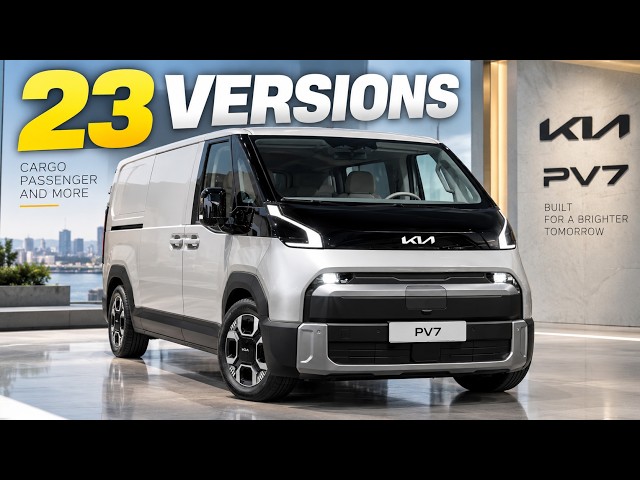
Kia PV7 electric van has been revealed at IAA Transportation,
Kia unveiled the PV7 at IAA Transportation 2026 in Hannover, Germany, on September 14 — the second model in its dedicated all-electric Platform Beyond Vehicle (PBV) lineup, and a significantly bigger van than the PV5 that preceded it. At over 17.5 feet long, with up to 460 km of WLTP range and room for nine passengers or a serious cargo load, the PV7 is Kia's clearest push yet into the heart of the light commercial vehicle market.
460km
WLTP range, Long Range Cargo
200kW
Motor output
8,000L
Max cargo volume, high-roof
9
Passenger seating capacity
Kia's PBV Strategy Scales Up
The PV7 is the second vehicle in Kia's dedicated Platform Beyond Vehicle program, following the PV5 — which was named the 2026 International Van of the Year. Where the PV5 established the PBV concept, the PV7 is built specifically to move Kia further into the light commercial vehicle segment with more space, payload, and configurability. Kia previewed the model with teaser images back on August 31 before the full public debut in Hannover.
At IAA Transportation 2026, running September 15-20, Kia is showing three PV7 variants alongside seven PV5 derivatives, underlining how central the PBV family has become to its commercial vehicle strategy.
Specifications
|
Platform
|
Dedicated E-GMP.S architecture, 800V
|
|
Motor (launch)
|
200 kW / 420 Nm, front-wheel drive; AWD planned
|
|
Battery options
|
71.5 kWh or 96.2 kWh, NCM chemistry
|
|
Range
|
Over 460 km WLTP (Long Range Cargo)
|
|
Body variants
|
PV7 Cargo (Compact, Long, High Roof) and PV7 Passenger (Compact, Long)
|
|
Cargo volume
|
6,100 L (long-body) up to 8,000 L (high-roof), VDA standard
|
|
Cargo door options
|
Rear barn doors or lift-up tailgate; two- or three-seat front row
|
|
Passenger seating
|
Up to 9 occupants, flexible/convertible layouts
|
|
Software
|
Pleos Connect infotainment, Gleo AI generative assistant, OTA updates
|
|
Design
|
One-box profile, flat floor, black hood/pillar trim, signature lighting graphics
|
|
Launch markets
|
South Korea and Europe in 2027; Australia confirmed for Q4 2027
|
Cargo and Passenger, Built for Business
The PV7 Cargo is aimed squarely at fleet and delivery operators, with a low loading height and up to 8,000 liters of cargo volume in its high-roof configuration — enough to sit as a genuine rival to established players like the Ford Transit Custom and Renault Trafic. The PV7 Passenger version leans into flexible seating and long-distance comfort, positioning it for shuttle, MPV, and business-transport use rather than pure cargo hauling.
Kia is also emphasizing conversion flexibility and fleet management tools across the range, continuing the modular, business-first pitch that's defined the PBV lineup since the PV5.
Where It's Headed
Kia confirmed the PV7 will launch in South Korea and Europe in 2027, with Australia following in the fourth quarter of 2027 in local specification. That timeline puts it on a similar horizon to several rival electric LCVs currently expanding across those same markets, setting up a competitive fight in a segment that's rapidly electrifying.
With the PV5 already crowned International Van of the Year and the PV7 now scaling that formula up into a genuinely large, flexible commercial EV, Kia is positioning its PBV family as a serious, dedicated alternative to the traditional van makers — built from the ground up as electric rather than adapted from a combustion platform.
Sources