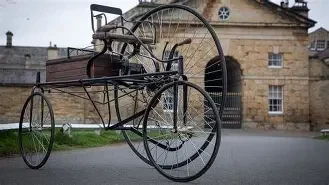
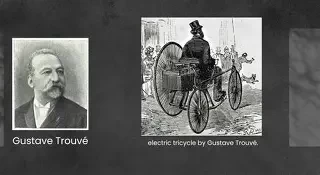
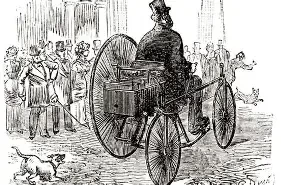
That's a fantastic historical vehicle to discuss. The electric tricycle developed by the French inventor **Gustave Trouvé** is widely considered to be the **world's first electric road vehicle**.
It represents a crucial moment in the history of electric mobility, predating Karl Benz's gasoline-powered Motorwagen by several years.
Here is an overview of Gustave Trouvé and his groundbreaking electric tricycle:
## ⚡ Gustave Trouvé's Electric Tricycle (1881)
Gustave Trouvé was a brilliant French electrical engineer and polymath, often noted for his innovative skill in **miniaturization**. In the early 1880s, he successfully combined three key innovations of the time to create the first self-propelled electric road vehicle.
### 1. The Vehicle and Mechanics
| **Base Vehicle** | A modified British-made **Coventry-Rotary** pedal tricycle (velocipede) manufactured by James Starley. |
| **Power Source** | Newly developed, powerful, and **rechargeable** lead-acid batteries (specifically, a set of Planté or Faure-type cells). |
| **Motor** | A compact, high-efficiency **Siemens electric motor** (which Trouvé had improved upon). |
| **Propulsion** | The electric motor drove the wheels via a simple chain-drive mechanism, adapting the existing tricycle's drivetrain. |
### 2. The Demonstration and Impact
* **Date of Test:** The tricycle's first successful test drive took place on **April 19, 1881**.
* **Location:** The test occurred along the **Rue Valois** in central Paris, making it the first time an electric vehicle operated on a public road.
* **Performance:** The tricycle was capable of reaching a top speed of about $12\text{ km/h}$ ($\approx 7.5\text{ mph}$), though Guinness World Records cites a top speed closer to $4.8\text{ km/h}$ ($\approx 3\text{ mph}$) for the very first run. The performance was remarkable for the time, demonstrating the viability of electric propulsion for personal transport.
### 3. A Forgotten Pioneer
Despite his monumental achievement, Trouvé did not immediately capitalize on his electric vehicle for the following reasons:
* **Lack of Patent:** He was reportedly unable to secure a patent for the complete vehicle assembly.
* **Focus Shift:** Immediately following the successful road test, Trouvé quickly dismantled the motor and batteries. He adapted them to power a small boat, creating the **world's first electric outboard engine** (demonstrated on the River Seine in May 1881).
* **Exhibition:** Trouvé exhibited his electric boat, but not the tricycle, at the **International Exhibition of Electricity in Paris** in 1881, which led to his boat gaining more immediate renown.
Trouvé's tricycle, though disassembled, served as the **proof of concept** that battery-powered electric motors could be practically used for road transport. It established the baseline for the early electric vehicle boom that would follow in the late 19th and early 20th centuries.
Would you like to compare the specifications of Trouvé's tricycle with a later, more famous electric vehicle from the early 1900s?
Post is under moderation
Stream item published successfully. Item will now be visible on your stream.
 Post is under moderationStream item published successfully. Item will now be visible on your stream.