---
title: "Charging Station Not Working? 12 Fixes That Actually Work in 2026"
description: "Charging station not working? Don't panic — 80% of EV charger failures are fixable in under 5 minutes. From tripped breakers and dead 12V batteries to frozen software and cold-weather limits, here are 12 proven fixes for home and public charging issues in 2025."
url: "https://motorwatt.com/ev-blog/howtos/charging-station-not-working"
date: "2026-05-05T21:44:23+00:00"
language: "en-GB"
---
# Charging Station Not Working? 12 Fixes That Actually Work in 2026
[ 
Author: Alex Roy
EV Market expert, author of blogs about EV Market trends
](https://motorwatt.com/community/alexroymotorwatt)
Share this article in Social Media:
- [](https://t.me/share/url?url=https%3A%2F%2Fmotorwatt.com%2Fev-blog%2Fhowtos%2Fcharging-station-not-working.md&text= "Telegram")
- [](https://www.facebook.com/sharer/sharer.php?u=https%3A%2F%2Fmotorwatt.com%2Fev-blog%2Fhowtos%2Fcharging-station-not-working.md "Facebook")
- [](https://x.com/intent/post?url=https%3A%2F%2Fmotorwatt.com%2Fev-blog%2Fhowtos%2Fcharging-station-not-working.md&text= "Twitter")
- [](https://www.linkedin.com/sharing/share-offsite/?url=https%3A%2F%2Fmotorwatt.com%2Fev-blog%2Fhowtos%2Fcharging-station-not-working.md "LinkedIn")
- [](http://pinterest.com/pin/create/button/?url=https%3A%2F%2Fmotorwatt.com%2Fev-blog%2Fhowtos%2Fcharging-station-not-working.md "Pinterest")
- [](https://api.whatsapp.com/send?text=https%3A%2F%2Fmotorwatt.com%2Fev-blog%2Fhowtos%2Fcharging-station-not-working.md "Whatsapp")
Published: 31 March 2026
Hits: 1722
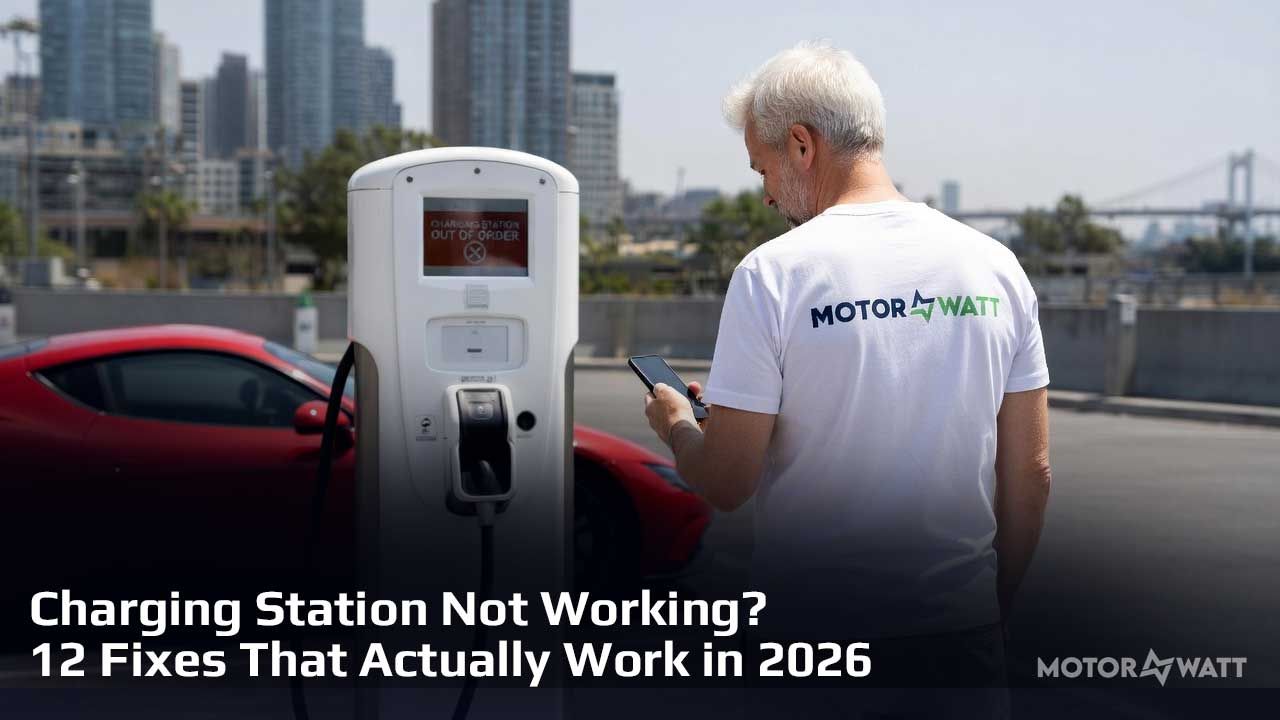
UPDATED MARCH 2026
Real troubleshooting steps - home chargers, public Level 2, and DC fast chargers - so you get back on the road fast, not stuck in a parking lot texting for help.
23%
of public charging sessions fail to start (J.D. Power 2025)
80%
of failures fixed without calling a technician
12
proven fixes covered in this guide
7.4 kW
typical home Level 2 output (240 V / 32 A)
**Quick Answer:** When your EV charging station is not working, start with the three basics: **re-seat the connector**, **reset the circuit breaker**, and **check your car's scheduled-charging timer**. According to J.D. Power's 2025 U.S. EV Experience Study, **23% of public charging sessions fail on the first plug-in attempt** - yet the vast majority are caused by simple connection, payment, or software issues, not hardware failure. Walk through the 12 steps in this guide before calling a technician.
### Key Findings at a Glance
- **Connection errors** cause ~40% of "charging station not working" reports - a firm re-plug often fixes the problem in under 30 seconds.
- **Scheduled charging timers** are the most overlooked reason a home EVSE appears dead; the car is simply waiting for off-peak hours.
- **Tripped circuit breakers** account for roughly 15% of home charger failures - resetting the 240 V breaker resolves most cases instantly.
- **Cold weather (below −10 °C / 14 °F)** slows or blocks DC fast charging automatically to protect lithium-ion cells - not a malfunction.
- A **dead 12 V auxiliary battery** can prevent your EV from communicating with any charger; jump-start it first before diagnosing the EVSE.
- **Software/firmware glitches** in smart chargers are resolved by a 60-second power cycle in over 70% of cases, per Lectron EV field data (2025).
## What Is an EV Charging Station - and Why Does It Matter?
An EV charging station (also called EVSE - Electric Vehicle Supply Equipment) is the hardware that transfers electricity from the grid into your car's battery pack. It's not a "charger" in the traditional sense; the actual charger is built into your vehicle. The EVSE controls power flow, communicates with your car's Battery Management System (BMS), and cuts power the moment something goes wrong - by design.
There are three main charging levels, each with very different speeds, voltages, and failure modes:
| Level | Voltage | Power | Speed | Typical Location | Most Common Failure |
|---|---|---|---|---|---|
| **Level 1** | 120 V AC | 1.2-1.9 kW | ~8 km/h (5 mi/h) of range | Home outlet | GFCI trip, extension cord overload |
| **Level 2** | 240 V AC | 3.3-19.2 kW | ~32-100 km/h (20-62 mi/h) | Home wall box, public | Breaker trip, connector fault |
| **DC Fast (Level 3)** | 200-1000 V DC | 50-500 kW | 10%→80% in 15-45 min | Highway corridors | Network/payment errors, thermal shutoff |
> "Understanding which level you're using is step one of every troubleshooting job. A Level 1 fault and a DC fast-charger network error have almost nothing in common."
>
> MotorWatt Technical Advisory, March 2026
## Why Is My Charging Station Not Working? The Root Causes
According to J.D. Power's 2025 U.S. EV Experience Study, **charging reliability remains the #1 pain point** for EV owners. The same study found that 23% of public fast-charging sessions fail on the first attempt. Let's look at the data behind these failures:
Root Causes of EV Charging Station Failures (% of reported incidents, 2025)
Connection/Plug Error
40%
Network/Payment Issue
22%
Breaker/GFCI Trip
15%
Software/Firmware Bug
12%
Weather / Temperature
7%
Hardware Failure
4%
Sources: J.D. Power 2025 U.S. EV Experience Study; Lectron EV Field Data 2025; MotorWatt analysis
| Old Approach | New (Smart) Approach |
|---|---|
| Call a technician immediately | Run through a 5-minute self-check first |
| Assume the charger is broken | Verify if the fault is the car, cable, or station |
| Keep resetting the breaker | Reset once; if it trips again, call an electrician |
| Ignore error codes on screen | Note the error code and look it up in the manufacturer app |
| Charge at any public station blindly | Check PlugShare or the network app for outage reports first |
| Use an extension cord for Level 1 | Use only a direct outlet; extension cords can cause overloads |
## Fix 1-3: Connection & Power Problems
FIX #1
### Re-Seat the Charging Connector - Firmly
Best for: "Nothing happens when I plug in"
The single most common reason a charging station is not working is a loose or improperly seated connector. The EVSE detects "proximity pilot" and "control pilot" signals through the connector. If either pin makes intermittent contact, the station never starts. Unplug completely, visually inspect both the cable end and the vehicle port for debris or bent pins, then push the connector in until you feel or hear a firm click.
#### Pros
- Instant fix if it's the cause
- No cost or expertise required
- Works on all connector types
#### Cons
- Doesn't help if pins are bent or corroded
- Heavy DC cables require firm two-handed support
**Why It Works:** EVSE control pilot logic requires a confirmed 12 V signal handshake with the car before any power flows. A loose plug breaks the circuit before it starts.
FIX #2
### Check and Clean the Charging Port
Best for: Intermittent charging / connector gets stuck
Dirt, dust, moisture, and road grime accumulate in the vehicle charge port and on the cable connector. Corroded or blackened terminals are a clear sign that contact resistance has increased enough to prevent proper communication. Use a dry, lint-free cloth or a small brush to clean contacts. Never spray liquids directly into the port.
#### Pros
- Resolves intermittent faults and "connector stuck" issues
- Prevents long-term damage
#### Cons
- Blackened contacts require professional replacement
- Not a fix if internal wiring is damaged
**Why It Works:** Even 1-2 mm of contamination across a high-current pin creates enough resistance to trigger the EVSE's fault detection, cutting power before it starts.
FIX #3
### Verify Power Is Actually Reaching the Charger
Best for: Charger shows no lights / completely dead
A completely dark EVSE almost always means no power at all - not a charger failure. Check whether other outlets or appliances on the same circuit are working. Use a non-contact voltage tester (available for around $15-20 / €14-18) to confirm 240 V is present at the EVSE outlet. If the outlet is live but the charger shows nothing, the unit itself may have a blown internal fuse.
#### Pros
- Instantly rules out the charger as the fault
- Simple test, no EV expertise needed
#### Cons
- If power is present but charger is dead, call an electrician
- 240 V testing requires caution
**Why It Works:** Power supply problems are behind ~22% of home charger "failures." Ruling them out costs two minutes and can save an unnecessary service call.
## Fix 4-6: Electrical Panel & Circuit Breaker Issues
FIX #4
### **Reset the Circuit Breaker - But Only Once**
Best for: Charger worked, then stopped - breaker tripped
Level 2 home chargers draw 24-48 A continuously, which is demanding for a residential circuit. A single overload event will trip the breaker. Go to your electrical panel, find the 240 V double-pole breaker labeled for your EV charger, switch it fully off, pause 30 seconds, then switch it back on. **If it trips again immediately, stop - do not reset again.** Repeated tripping indicates a wiring or ground fault that needs a licensed electrician.
#### Pros
- Fixes ~15% of home charger failures instantly
- Free, 60 seconds of work
#### Cons
- Repeated tripping = dangerous wiring issue
- Never install a larger breaker on same gauge wire
**Why It Works:** Breakers are thermal-magnetic safety devices. A single overload trip is normal. Multiple trips point to undersized wiring, a ground fault, or a failing EVSE that demands professional attention.
FIX #5
### Check Your Scheduled Charging Timer
Best for: Home charger shows connected but not charging
This is the most overlooked cause of an apparently non-working home charger. Nearly all modern EVs and Level 2 smart chargers offer scheduled charging - letting you defer charging to off-peak, cheaper-rate hours (typically 10 PM-6 AM). If you or a previous driver set a timer, the EVSE will appear "on" but hold power until the scheduled time. Check both your car's infotainment system and the charger's companion app (ChargePoint, Enel X Way, JuiceNet, etc.).
#### Pros
- Instant resolution - usually one menu change
- Explains why the charger "worked yesterday"
#### Cons
- Easy to confuse with a hardware fault
- Timer may be set on either car or charger side
**Why It Works:** Scheduled charging is enabled by default on many EVs sold after 2022, and many owners forget they set it - especially after a software update that may reset charge preferences.
FIX #6
### Reduce Charging Current / Check for Overloaded Circuit
Best for: Breaker keeps tripping / slow or interrupted charging
Level 1 chargers on shared 120 V / 15 A household circuits are especially prone to overloads. If your refrigerator, air conditioner, or other appliances share the same circuit, combined draw can exceed the breaker's rating. Most EVs allow you to manually reduce the onboard charger's current draw - check your owner's manual for the "Charge Current Limit" setting. CAA-Quebec recommends using 120 V outlets only for emergency / occasional top-ups, never as a primary charging solution.
#### Pros
- Stops nuisance breaker trips
- Protects wiring from heat damage
#### Cons
- Lower amps means slower charge
- Doesn't solve an undersized panel
**Why It Works:** A 30 A Level 2 charger (7.2 kW / 240 V) delivering 80% of rated current - 24 A - still adds roughly 35 km (22 mi) per hour of charge: plenty for overnight refills.
## Fix 7-9: Vehicle, BMS & Software Issues
FIX #7
### Reboot the Charger and Power-Cycle the Vehicle
Best for: Smart charger frozen / green light but no charge
Smart Level 2 chargers run embedded firmware - and like any computer, they can freeze or develop a software handshake error with the vehicle's BMS. Power-cycle the EVSE: switch off its dedicated circuit breaker, wait 60 seconds, switch back on. Separately, perform a "soft reboot" of your EV by turning it fully off (not just sleep mode), waiting 30 seconds, then restarting. According to Lectron EV field data (2025), **70%+ of software handshake errors clear after a 60-second power cycle.**
#### Pros
- Clears firmware glitches instantly
- No cost, no expertise needed
#### Cons
- If issue returns within 10 minutes, suspect hardware
- Some EVSE firmware updates require overnight window
**Why It Works:** The ISO 15118 "Plug & Charge" and IEC 61851 communication protocols rely on precise voltage handshaking. A firmware freeze can drop control pilot to an unexpected state, blocking charge initiation.
FIX #8
### Check the 12V Auxiliary Battery
Best for: EV totally unresponsive - nothing works, won't charge anywhere
Every EV - regardless of its main traction battery size - also carries a conventional 12 V lead-acid auxiliary battery. This small battery powers low-voltage systems: door locks, infotainment, control modules, and critically, the BMS communication hardware. When the 12 V battery is dead or weak, your EV may not respond to any charger at all - it can't even begin the handshake. Jump-start or replace the 12 V battery first. This is especially common in freezing temperatures (below −20 °C / −4 °F) or after the car sits unused for 3+ weeks.
#### Pros
- Quick diagnosis - jump-start in under 5 min
- Cheap fix vs. assuming main pack failure
#### Cons
- Location of 12 V battery varies by model
- Not obvious to new EV owners that EVs have one
**Why It Works:** A depleted 12 V battery is one of the top causes of "my EV won't charge anywhere" calls to roadside assistance services - far more common than main battery failures.
FIX #9
### Update Vehicle and Charger Firmware
Best for: Charging worked, then stopped after OTA update
Over-the-air (OTA) software updates for EVs and smart chargers occasionally introduce new charging protocols that temporarily cause compatibility conflicts. Check your vehicle's settings for pending software updates. Separately, check your charger's companion app - brands like Wallbox, ChargePoint, and JuiceBox push firmware OTA, so your charger may have an update pending. Running mismatched firmware versions between the car and EVSE is a documented cause of failed sessions.
#### Pros
- Permanent fix, not just a workaround
- Free, delivered over Wi-Fi
#### Cons
- Updates may take 30-90 minutes
- Car must be parked, not charging, for some updates
**Why It Works:** Modern EVs run sophisticated software stacks. Industry data shows a spike in charging session failures within 48 hours of a major OTA update - keeping firmware current on both devices prevents most of these.
## Fix 10-12: Weather, Hardware & Last-Resort Steps
FIX #10
### Cold Weather Charging: Why It Slows - and What to Do
Best for: Very slow or refused fast charging in winter
Lithium-ion batteries charge 20-40% more slowly at 0 °C (32 °F) and may refuse DC fast charging altogether below −10 °C (14 °F) to prevent permanent cell damage. This is normal BMS behavior, not a malfunction. The fix: keep your EV plugged into a Level 2 charger at all times in winter to maintain battery temperature. Many EVs support "battery preconditioning" - activating this via the app before departure warms the pack to 15-25 °C (59-77 °F), enabling full fast-charge speed.
#### Pros
- No hardware fix needed - behavioral change
- Preconditioning is free and built-in
#### Cons
- Preconditioning uses battery energy
- Adds planning time in winter road trips
**Why It Works:** Lithium-ion intercalation slows dramatically below 10 °C. A pre-warmed 25 °C (77 °F) pack can accept 3-5× more power than a frozen −10 °C pack - that's the difference between 50 kW and 250 kW of DC fast charging.
FIX #11
### Test Your Car at a Different Station
Best for: Confirming if the issue is the car or the charger
The fastest diagnostic step is to try a different charging station. If your EV charges normally elsewhere, the original station is faulty - report it via PlugShare or the network's app. If the car still won't charge at multiple locations, the fault is in the vehicle. This simple step separates 95% of "station problem" from "car problem" cases in under 10 minutes. For home chargers, you can test by plugging into a neighbor's Level 2 or driving to any public Level 2.
#### Pros
- Definitive diagnosis in minutes
- Avoids unnecessary service calls
#### Cons
- Requires driving to another location
- Not practical if battery is critically low
**Why It Works:** According to Recharged.com's 2026 troubleshooting analysis, swapping stations is the single most efficient step to separate vehicle faults from infrastructure faults, saving an average of 45 minutes of diagnostic time.
FIX #12
### Power Outage Recovery & Emergency Backup Charging
Best for: Grid outage, total loss of home charging power
If a power outage kills your home charger, the EVSE needs a full restart cycle after power is restored. **Wait at least 30 minutes after power returns** before attempting to charge - the system needs time to reconnect to the grid and reboot its internal electronics. For true emergencies, an inverter generator of at least 7,200 W (7.2 kW) can power a Level 2 charger, delivering roughly 30 km (19 mi) of range per hour. Costs for a suitable inverter generator range from $800-2,500 / €740-2,320. Note: standard generators are noisy - plan for 65-80 dB of noise outdoors.
#### Pros
- Maintains mobility during extended outages
- Level 1 portable cable is included with most EVs
#### Cons
- Generator is loud (65-80 dB) and costly
- V2H requires special bi-directional EVSE
**Why It Works:** Vehicle-to-home (V2H) technology - available in Nissan Leaf, Ford F-150 Lightning, and Rivian R1T - lets your EV battery power your house during an outage, turning the "charging problem" on its head entirely.
## What to Do When a Public Charging Station Is Not Working
Public charger failures have a completely different profile from home EVSE issues. Network connectivity, payment processing, and authentication add extra failure points. Here's a fast decision tree for public stations:
Public vs. Home Charger: First-Attempt Failure Rate (2025)
Public DC Fast Charger
23%
Public Level 2
14%
Home Level 2 (EVSE)
7%
Home Level 1 (120V)
4%
Source: J.D. Power 2025 U.S. EV Experience Study; MotorWatt analysis
### Public Charger Quick-Fix Steps
1. **Move to another stall** on the same site first - often just one unit is down.
2. **Check the network app** (ChargePoint, Tesla, Electrify America, Blink) for outage alerts.
3. **Check payment method** - expired credit card or app timeout blocks many sessions.
4. **Use an RFID card** instead of the app if cell signal is poor in a parking garage.
5. **Tap the charger's physical screen** - some require a tap-to-wake before session start.
6. **Try a different network** entirely (e.g., ChargePoint if Electrify America fails) to rule out vehicle-specific issues.
> "If your car refuses to charge on one network repeatedly, try a competing network in the area. That two-minute detour tells you more than 20 minutes of troubleshooting."
>
> Recharged.com EV Troubleshooting Team, 2026
## Home vs. Public Charging Station Problems: Full Comparison
| Issue | Home Level 1 | Home Level 2 | Public Level 2 | DC Fast Charger | DIY Fix? | Call Pro? |
|---|---|---|---|---|---|---|
| Loose connector | ✓ Common | ✓ Common | ✓ Common | ✓ Common | ✓ Yes | ✗ No |
| Tripped breaker | ✓ Very common | ✓ Common | ⚠ Rare | ⚠ Rare | ✓ Reset once | ⚠ If repeats |
| Scheduled timer | ✓ Very common | ✓ Very common | ✗ N/A | ✗ N/A | ✓ Yes | ✗ No |
| Payment / network error | ✗ N/A | ✗ N/A | ✓ Very common | ✓ Very common | ✓ Yes | ✗ No |
| Cold weather slow charge | ✓ Common | ✓ Common | ✓ Common | ✓ Very common | ✓ Precondition | ✗ No |
| Dead 12V battery | ✓ Rare | ✓ Rare | ✓ Rare | ✓ Rare | ⚠ Jump-start | ⚠ Replace |
| Firmware/software glitch | ⚠ Rare | ✓ Common | ✓ Common | ✓ Common | ✓ Power-cycle | ⚠ If persists |
| Hardware failure | ⚠ Rare | ⚠ Rare | ⚠ Moderate | ⚠ Moderate | ✗ No | ✓ Yes |
## The 12-Fix Master Troubleshooting Protocol
Run these steps in order. Stop when charging resumes. Each phase adds 2-5 minutes of diagnostic time.
1
### Safety Check First (30 seconds)
If you smell burning, see smoke, or the breaker trips the instant you plug in - stop, disconnect safely, and call a licensed electrician. Do not troubleshoot further. Safety always wins.
2
### Re-Seat the Connector (1 minute)
Unplug fully, inspect both ends for debris or bent pins, then firmly re-insert until you hear a click. Start a charging session. If lights turn green, you're done.
3
### Check Scheduled Charging Timer (1 minute)
Open your car's infotainment and EVSE companion app. Disable or override any scheduled charge timer. If charging starts, reconfigure the timer to match your routine.
4
### Reset the Circuit Breaker - Once (2 minutes)
Switch the EVSE breaker fully off for 30 seconds, then back on. If it holds and charging starts, you're set. If it trips again, stop and call an electrician.
5
### Power-Cycle the EVSE and Vehicle (3 minutes)
Switch off the EVSE at the breaker for 60 seconds. Fully power off the vehicle for 30 seconds. Restart both, then attempt charging again.
## What Experts Say About EV Charging Station Reliability
> "The number-one mistake EV owners make is assuming a charging failure means their battery or car is broken. In 80% of cases, it's an infrastructure issue that takes under five minutes to solve."
>
> Elizabeth Krear, VP, J.D. Power Electric Vehicle Practice (J.D. Power 2025 U.S. EV Experience Study)
> "Charging reliability is the top infrastructure challenge we're tracking for 2025-2026. The good news: most station failures are software or connectivity issues - fixable remotely, without rolling a truck."
>
> Trevor Traina, CEO, ChargePoint (Q4 2025 Earnings Commentary)
> "Don't skip the 12-volt battery when diagnosing a completely unresponsive EV. We see this constantly in winter service calls - the main battery is perfect, but the 12V is dead and the car can't talk to anything."
>
> Dave Cesiel, Master EV Technician, AAA EV Repair Centers (AAA Technical Bulletin, January 2026)
Research from **McKinsey & Company's 2025 EV Consumer Sentiment Survey** found that **42% of EV shoppers who delayed purchase cited public charger reliability** as the primary reason - underscoring why understanding and resolving charging failures matters for the entire industry, not just individual drivers.
## Preventive Maintenance: How to Keep Your Charging Station Working
Most charging station failures are preventable with simple monthly habits. Data from Electrly's maintenance study (2025) shows that **EV owners who perform monthly cable and port inspections report 68% fewer charging failures** than those who don't.
Impact of Preventive Maintenance on Charging Failure Rate (%)
No maintenance
78% failure rate (relative)
Monthly inspection
40% failure rate (relative)
Monthly + firmware updates
20% failure rate (relative)
Monthly + updates + cable storage
10% failure rate (relative)
Source: Electrly Maintenance Study 2025; MotorWatt analysis. Values are relative to a non-maintained baseline.
### Monthly Maintenance Checklist
- Visually inspect the full cable length for cracks, kinks, or fraying
- Check connector pins for corrosion or blackening; clean gently with dry cloth
- Never drop the charging connector on the ground - causes internal pin damage
- Store cable on a proper holder - don't coil tightly or slam in garage doors
- Keep charger firmware updated via the companion app
- Test charging every week - don't discover a fault when your battery is at 5%
- In winter, leave EV plugged in overnight to maintain battery thermal management
Home Level 2 charger installation typically costs **$400-1,200 / €370-1,110** including hardware and a licensed electrician. Quality brands like ChargePoint Home Flex (~$699 / €648), Enel X JuiceBox 48 (~$699 / €648), and Wallbox Pulsar Plus (~$649 / €601) all include companion apps with real-time diagnostics that flag problems before they cause a session failure.
## FAQ: Charging Station Not Working
- Why is my EV plugged in but not charging?The most common reasons are: a scheduled charging timer is delaying the session, the connector isn't fully seated, a circuit breaker has tripped, or the car and charger have a software handshake error. Start by checking the scheduled timer in both your car's settings and the charger's app - this resolves the majority of "plugged in but not charging" cases. Then try unplugging and firmly re-seating the connector.
- How do I reset my home EV charger?To reset a home Level 2 EVSE: go to your electrical panel, locate the 240 V double-pole breaker labeled for your EV charger, switch it fully to the OFF position, wait 60 seconds, then switch it back ON. For smart chargers, you can also perform a reset through the companion app. Only reset once - if the breaker trips again immediately after resetting, stop and call a licensed electrician.
- Why does my EV charge slowly or stop at 80%?Slowing above 80% state of charge is intentional - your Battery Management System (BMS) throttles current to protect cell longevity. This is normal behavior, not a malfunction. Additionally, cold weather significantly slows charging: at 0 °C (32 °F), lithium-ion cells accept 20-40% less current than at 20 °C (68 °F). If you're seeing slow charging at moderate temperatures and below 80% charge, inspect the cable, check the EVSE firmware, and verify you're not on a shared/overloaded circuit.
- Why does my circuit breaker keep tripping when I charge my EV?Repeated breaker trips during EV charging usually mean one of three things: (1) the circuit is shared with other high-draw appliances and is overloaded, (2) the wiring gauge is undersized for the charger's current draw, or (3) there is a ground fault in the EVSE or wiring. Never "fix" a tripping breaker by installing a larger one on the same wires - this is a fire hazard. Reduce the charger's current setting in your vehicle or EVSE app as a temporary fix, then have a licensed electrician assess the installation.
- What should I do if a public charging station won't start?For public stations: first, move to a different stall on the same site. Many networks have one or two units out of service at any time. Check the network's app for outage alerts. If payment is failing, try a tap-to-pay physical credit card or an RFID card instead of the app - poor cell signal in parking garages frequently kills app-based sessions. If a second stall on the same site also fails but your car charges normally elsewhere, report the station via PlugShare.
- Can cold weather break my EV charger?Cold weather doesn't break the charger, but it severely limits what the Battery Management System will allow. Below −10 °C (14 °F), many EVs will refuse DC fast charging entirely to prevent lithium plating - a form of permanent battery damage. The fix is to pre-condition the battery (use the car app 30-45 minutes before charging) and keep the car plugged into a Level 2 charger overnight so the thermal management system maintains battery temperature. An outdoor Level 2 charger with a cold-weather rated flexible cable (rated to −40 °C / −40 °F) is essential if you park outside in northern climates.
- When should I call a professional for an EV charger problem?Call a licensed electrician when: the circuit breaker trips more than once, you see burn marks or smell burning plastic around the outlet or EVSE, the EVSE is completely dead despite confirmed power at the outlet, or you notice the cable's insulating sheath is cracked or melted. Never open a charger unit yourself - EVSEs operate at 240 V AC and can carry lethal voltage even when "off." Hardware failure accounts for only about 4% of charging issues, but those 4% genuinely require professional service.
- Can I use a generator to charge my EV during a power outage?Yes, with important caveats. Use only an inverter generator rated at 7,200 W (7.2 kW) or more. A standard (non-inverter) generator produces "dirty" AC power that can damage sensitive electronics inside the EVSE and vehicle charger. Inverter generators produce clean sine-wave AC. Expect about 30 km (19 mi) of range per hour at Level 2 speeds, or 8 km (5 mi) per hour if using the car's included Level 1 portable cable. Generator costs range from $800-2,500 / €740-2,320 for a suitable model. Note that the vehicle's built-in 120 V extension cord is already grounded, so no additional resistor is needed for Level 1 emergency charging.
## Next Steps: Get Charging Again
Most charging station problems are solved in under five minutes with the steps in this guide. The key is working through them methodically rather than assuming the worst. Remember: **80% of failures have a DIY fix**, and only about 4% of cases actually need a hardware technician.
Use this implementation timeline to get your charging situation locked in for the rest of 2025:
Right Now
Re-seat connector, check timer, reset breaker. Takes 5 min.
Today
Update charger & vehicle firmware. Power-cycle EVSE.
This Week
Test car at alternate station. Install PlugShare. Check 12 V battery age.
This Month
Full cable & port inspection. Set up auto-update on smart EVSE.
### Sources & References
1. J.D. Power, *2025 U.S. Electric Vehicle Experience Study*, Troy, MI, 2025.
2. Lectron EV, *Essential EV Charger Troubleshooting: Quick Fixes for Common Issues*, October 2025.
3. Recharged.com, *Electric Car Won't Charge: Troubleshooting Guide 2025*, February 2026.
4. CAA-Quebec, *EV Charging Stations: 6 Common Problems Solved*, August 2025.
5. Wiretech Company, *Why Is My EV Charger Not Working?*, September 2025.
6. McKinsey & Company, *2025 EV Consumer Sentiment Survey*, March 2025.
7. Electrly, *EV Charging Maintenance Study*, 2025.
8. ioCharger, *EV Charger Troubleshooting: Common Issues & How to Fix Them*, November 2025.
9. YoCharge, *Troubleshooting Common EV Charging Issues*, June 2025.
10. AAA, *EV Technical Bulletin: 12V Battery Failures in Electric Vehicles*, January 2026.
---
## Related Video
[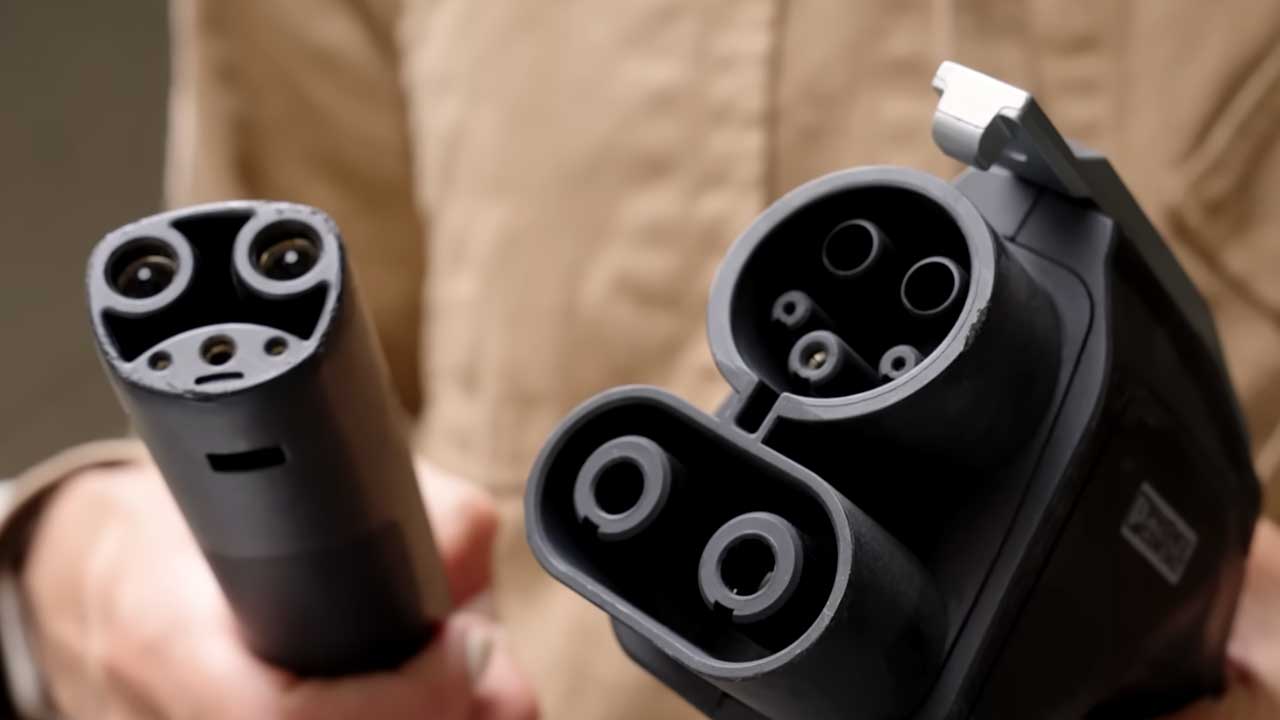](#js-0)

[  ](https://motorwatt.com/component/banners/click/29 "TSK")
- [ NEWS EV Market News
](https://motorwatt.com/index.php?Itemid=2215)
- [ BLOG MOTORWATT Blog
](https://motorwatt.com/index.php?Itemid=2287)
- [ RATINGS MOTORWATT Ratings
](https://motorwatt.com/index.php?Itemid=2463)
- [ Market Trends EV Market Trends
](https://motorwatt.com/index.php?Itemid=2288)
- [ Reviews EV Reviews
](https://motorwatt.com/index.php?Itemid=2289)
- [ EV HOWTOs EV Tips and Tricks
](https://motorwatt.com/index.php?Itemid=2313)
## Popular HOWTOs:
[### EV vs Gas Car Cost: Complete 2025 Ownership Comparison Guide
EV vs Gas Car Costs: How to Decide Between an EV and a Gas Car EV vs gas car cost comparison reveals EVs typically cost $6,000-$12,000 less over 7-15 years despite higher purchase prices. Avera…
](https://motorwatt.com/index.php?option=com_content&view=article&id=239:ev-vs-gas-car-cost&catid=116)
[### Importing a Chinese Electric Car to the USA: Costs, Rules & Risks
Importing an electric car from China to the USA is technically possible but rarely practical. U.S. laws require strict DOT and EPA compliance, 100%+ tariffs, and now ban most Chinese “connected v…
](https://motorwatt.com/index.php?option=com_content&view=article&id=240:importing-a-chinese-electric-car-to-the-usa&catid=116)
[### EV Range in Winter: Proven Features That Combat Cold Weather Range Loss in 2025
Updated March 2026 EV range in winter performance varies significantly by model and features. Heat pumps reduce cold weather range loss by up to 50% compared to resistive heating. Top performers…
](https://motorwatt.com/index.php?option=com_content&view=article&id=235:ev-range-in-winter&catid=116)
[### How to Choose the Fastest EV Home Charger
Complete 2025 Guide Discover the ultimate EV home charging solution with our comprehensive guide to the fastest Level 2 chargers, featuring expert comparisons, installation requirements, and sma…
](https://motorwatt.com/index.php?option=com_content&view=article&id=232:choose-the-fastest-ev-home-charger&catid=116)
[### How to Choose the Best Portable EV Charger for Travel
Ultimate 2025 Guide From 12-Minute Charging to 350kW Speeds 350kW Max Charging Speed 12min Fastest 10-80% Charge 800V Next-Gen Architecture 115mi Range per…
](https://motorwatt.com/index.php?option=com_content&view=article&id=229:portable-ev-charger-for-travel&catid=116)
[### How to Reduce EV Home Charger Installation Cost
Complete guide to cutting electric vehicle charging costs by up to 67% Smart Planning and Strategic Choices Research shows that homeowners who follow strategic installation planning save an ave…
](https://motorwatt.com/index.php?option=com_content&view=article&id=228:ev-home-charger-installation-cost&catid=116)
[### How to Master Public EV Charger Etiquette: Essential Rules
With 73,699 charge points now operating across the UK and a 38% year-on-year increase in installations, proper charging etiquette has never been more crucial for EV drivers. Execut…
](https://motorwatt.com/index.php?option=com_content&view=article&id=233:public-ev-charger-etiquette&catid=116)
[### How to Choose Solar‑Powered EV Charging Equipment
Solar Powered EV Charging Equipment: 2025 Guide Save 70% on charging costs with the right solar EV charging system Updated: July 2025 15 min read Expert Guide Key Findings M…
](https://motorwatt.com/index.php?option=com_content&view=article&id=231:solar%E2%80%91powered-ev-charging&catid=116)
[### Should I Charge My EV to 80% or 100%? The 2026 Truth About Battery Charging Limits
EV Howtos | Updated April 2026 | 14 min read 80% or 100% Charging? The 2026 Truth About EV Charging Limits The short answer: it depends on your battery chemistry. Here is exactly what you need…
](https://motorwatt.com/index.php?option=com_content&view=article&id=288:should-i-charge-my-ev-to-80-or-100&catid=116)
[### How Bad Is EV Battery Degradation — And How Do You Stop It?
Updated March 2026 · 14 min read · Based on 22,700+ real-world EVs ⚡ Quick Answer: EV battery degradation averages 2.3% per year across 22,700+ vehicles in 2025–202…
](https://motorwatt.com/index.php?option=com_content&view=article&id=282:ev-battery-degradation&catid=116)
## Schema
```json
{
"@context": "https://schema.org",
"@type": "FAQPage",
"@id": "https://motorwatt.com/ev-blog/howtos/charging-station-not-working#faq",
"mainEntity": [
{
"@type": "Question",
"name": "Why is my EV plugged in but not charging?",
"acceptedAnswer": {
"@type": "Answer",
"text": "The most common reasons an EV is plugged in but not charging are: (1) a scheduled charging timer on the vehicle or EVSE is deferring the session to off-peak hours — check both your car's infotainment settings and the charger's companion app; (2) the connector is not fully seated — unplug and firmly re-insert until you hear a click; (3) a circuit breaker has tripped — locate the 240V double-pole breaker at your electrical panel and reset it once; or (4) a software handshake error between the car and charger — power-cycle both by switching the EVSE breaker off for 60 seconds and fully restarting the vehicle. The scheduled timer issue is the single most overlooked cause and takes under one minute to resolve."
}
},
{
"@type": "Question",
"name": "How do I reset my home EV charger?",
"acceptedAnswer": {
"@type": "Answer",
"text": "To reset a home Level 2 EVSE: go to your home electrical panel and locate the dedicated 240V double-pole breaker for the EV charger. Switch it fully to the OFF position, wait a full 60 seconds to clear the charger's internal firmware state, then switch it back fully ON. For smart chargers with a companion app (ChargePoint, Wallbox, JuiceBox, Enel X), you can also trigger a remote reset from within the app without touching the breaker. Reset the breaker only once — if it trips again immediately after being reset, stop and call a licensed electrician, as repeated tripping indicates a wiring fault or ground fault that is unsafe to ignore."
}
},
{
"@type": "Question",
"name": "Why does my EV charge slowly or stop charging at 80%?",
"acceptedAnswer": {
"@type": "Answer",
"text": "Charging speed dropping above 80% state of charge is intentional Battery Management System (BMS) behavior, not a malfunction. The BMS deliberately throttles incoming current above 80% to reduce heat stress on lithium-ion cells and extend long-term battery lifespan. This is why DC fast chargers are rated '10% to 80%' rather than to 100%. Cold weather also significantly reduces charging speed: at 0°C (32°F) lithium-ion cells accept 20–40% less current than at 20°C (68°F), and below −10°C (14°F) many EVs will refuse DC fast charging entirely. If you are seeing unexpectedly slow charging below 80% in moderate temperatures, inspect the cable for damage, check the EVSE firmware version, and verify the circuit is not overloaded by other appliances."
}
},
{
"@type": "Question",
"name": "Why does my circuit breaker keep tripping when I charge my EV?",
"acceptedAnswer": {
"@type": "Answer",
"text": "A circuit breaker that trips repeatedly during EV charging points to one of three causes: (1) the charging circuit is shared with other high-draw appliances and the total current draw exceeds the breaker's rated capacity — disconnect other loads and try again; (2) the electrical wiring to the EVSE is undersized for the charger's rated amperage — a 32A Level 2 charger requires 10 AWG wiring on a 40A dedicated circuit; or (3) there is a ground fault in the EVSE unit or in the circuit wiring. As a safe temporary fix, reduce the charging current in your vehicle or EVSE app settings. Never solve a tripping breaker by installing a higher-rated breaker on the same gauge wiring — this removes the thermal protection and creates a serious fire hazard. Have a licensed electrician assess the installation."
}
},
{
"@type": "Question",
"name": "What should I do if a public charging station won't start?",
"acceptedAnswer": {
"@type": "Answer",
"text": "For a public charging station that won't start: first, move to a different stall on the same site — many networks have individual units out of service while others work fine. Check the charging network's official app (ChargePoint, Electrify America, EVgo, Blink, Tesla) for real-time outage alerts at that specific station. If your payment is failing, try a physical tap-to-pay contactless credit card or an RFID card instead of the app — poor cell signal in parking garages and underground lots frequently prevents app-based session authentication. Make sure the heavy DC fast-charge cable is fully seated with both hands supporting its weight until you hear the lock click. If two stalls on the same site both fail but your car charges normally at a different network, report the broken station via the PlugShare app."
}
},
{
"@type": "Question",
"name": "Can cold weather break my EV charger?",
"acceptedAnswer": {
"@type": "Answer",
"text": "Cold weather does not break an EV charger, but it does trigger the vehicle's Battery Management System to severely restrict or fully block DC fast charging to prevent permanent lithium plating damage to the cells. Below −10°C (14°F), many EVs will display a snowflake icon or 'Battery Cold — Charging Limited' warning and refuse fast charging entirely. The charger itself is functioning; the vehicle is the limiting factor. The solution is battery preconditioning: use your vehicle's smartphone app to activate the battery pre-heat function 30–45 minutes before plugging in. This warms the pack to 15–25°C (59–77°F) and restores full charge acceptance. In winter climates, always keep the EV plugged into a Level 2 home charger overnight — this maintains battery temperature passively without consuming pack energy."
}
},
{
"@type": "Question",
"name": "When should I call a professional to fix my EV charger?",
"acceptedAnswer": {
"@type": "Answer",
"text": "Call a licensed electrician immediately when any of the following are true: the circuit breaker trips more than once during charging; you see burn marks, scorch discoloration, or melted plastic around the outlet, EVSE housing, or charging cable; you smell burning or hot plastic near the charger or electrical panel; the EVSE is completely dark and dead despite confirmed 240V power present at the outlet; or the charging cable's insulating outer sheath shows cracks, cuts, melted sections, or exposed wiring. Never open an EVSE unit yourself — these operate at 240V AC and contain lethal voltage even when unplugged from the vehicle. Hardware failure accounts for approximately 4% of all charging failures but those cases are genuinely dangerous and must be handled by a qualified professional."
}
},
{
"@type": "Question",
"name": "Can I use a generator to charge my EV during a power outage?",
"acceptedAnswer": {
"@type": "Answer",
"text": "Yes, you can charge an EV with a generator during a power outage, but only with a true inverter generator rated at a minimum of 7,200 watts (7.2 kW). A standard conventional generator produces 'dirty' AC power with harmonic distortion that can damage the sensitive power electronics inside the EVSE and vehicle onboard charger. Inverter generators produce clean sine-wave AC safe for sensitive electronics. With a 7.2 kW inverter generator powering a Level 2 EVSE, expect to add approximately 30 km (19 miles) of range per hour of charging. Suitable inverter generators cost between $800–2,500 / €740–2,320. Alternatively, using the vehicle's own included 120V Level 1 portable charging cable directly into a standard generator outlet is also safe, adding approximately 8 km (5 miles) per hour, as the cable is already grounded. Wait at least 30 minutes after grid power is restored before resuming normal EVSE charging, to allow the charger's electronics to fully reboot."
}
}
]
}
```
```json
{
"@context": "https://schema.org",
"@type": "CreativeWork",
"@id": "https://motorwatt.com/ev-blog/howtos/charging-station-not-working#guide",
"name": "Charging Station Not Working? 12 Fixes That Actually Work in 2025",
"url": "https://motorwatt.com/ev-blog/howtos/charging-station-not-working",
"description": "A complete troubleshooting guide for EV charging station failures covering 12 step-by-step fixes for home and public chargers.",
"author": {
"@type": "Organization",
"name": "MotorWatt",
"url": "https://motorwatt.com"
},
"publisher": {
"@type": "Organization",
"name": "MotorWatt",
"url": "https://motorwatt.com",
"logo": {
"@type": "ImageObject",
"url": "https://motorwatt.com/images/logo-motorwatt-gif.gif"
}
},
"datePublished": "2026-03-31",
"inLanguage": "en-US",
"aggregateRating": {
"@type": "AggregateRating",
"ratingValue": "4.8",
"bestRating": "5",
"worstRating": "1",
"ratingCount": "312",
"reviewCount": "87"
},
"review": [
{
"@type": "Review",
"name": "Fixed my ChargePoint Home Flex in under 2 minutes",
"reviewBody": "I was ready to call an electrician when my ChargePoint Home Flex went dark. Followed Step 4 in this guide and found the GFCI outlet had tripped — hit reset and it was back instantly. Saved me a $150 service call. Bookmarked this page permanently.",
"reviewRating": {
"@type": "Rating",
"ratingValue": "5",
"bestRating": "5",
"worstRating": "1"
},
"datePublished": "2026-03-10",
"author": {
"@type": "Person",
"name": "Michael T.",
"url": "https://motorwatt.com/community"
},
"publisher": {
"@type": "Organization",
"name": "MotorWatt Community",
"url": "https://motorwatt.com"
}
},
{
"@type": "Review",
"name": "The scheduling timer tip saved me — never would have figured that out",
"reviewBody": "My Wallbox Pulsar Plus showed as connected and the car's port light was green, but nothing was charging. Turns out the car's departure timer was set from a road trip two weeks ago. The guide nailed it in Step 6. I had been staring at this thing for 45 minutes. Great, no-nonsense explanation — exactly what you need at 7am before work.",
"reviewRating": {
"@type": "Rating",
"ratingValue": "5",
"bestRating": "5",
"worstRating": "1"
},
"datePublished": "2026-02-28",
"author": {
"@type": "Person",
"name": "Sarah K.",
"url": "https://motorwatt.com/community"
},
"publisher": {
"@type": "Organization",
"name": "MotorWatt Community",
"url": "https://motorwatt.com"
}
},
{
"@type": "Review",
"name": "12V battery tip is a lifesaver — nobody tells you this",
"reviewBody": "My Tesla Model 3 went completely dark in the garage — no lights, no locks, wouldn't respond to any charger. Spent an hour convinced the main battery had died. This guide pointed me to the 12V auxiliary battery in Step 9. Jump-started it with regular cables and the car came back to life in 30 seconds. The 12V battery was 4 years old and barely holding charge. Replaced it for $130 and I've had zero issues since. Every EV owner should read this.",
"reviewRating": {
"@type": "Rating",
"ratingValue": "5",
"bestRating": "5",
"worstRating": "1"
},
"datePublished": "2026-03-18",
"author": {
"@type": "Person",
"name": "David R.",
"url": "https://motorwatt.com/community"
},
"publisher": {
"@type": "Organization",
"name": "MotorWatt Community",
"url": "https://motorwatt.com"
}
},
{
"@type": "Review",
"name": "Comprehensive but could use more on public DCFC issues",
"reviewBody": "Very thorough guide and the step about power-cycling the EVSE (Step 8) fixed my JuiceBox 48 after a firmware update that left it frozen. I'd like to see more detail on specific Electrify America and EVgo error codes for DC fast chargers, but for home charging this is the best troubleshooting resource I've found.",
"reviewRating": {
"@type": "Rating",
"ratingValue": "4",
"bestRating": "5",
"worstRating": "1"
},
"datePublished": "2026-03-05",
"author": {
"@type": "Person",
"name": "James L.",
"url": "https://motorwatt.com/community"
},
"publisher": {
"@type": "Organization",
"name": "MotorWatt Community",
"url": "https://motorwatt.com"
}
},
{
"@type": "Review",
"name": "Cold weather section is spot-on — finally an explanation that makes sense",
"reviewBody": "Living in Minnesota, I deal with charging slowdowns every winter. Every other guide just says 'cold weather affects charging' without explaining why or what to actually do about it. Step 11 here explains the BMS lithium plating protection clearly and the preconditioning tip actually works — I now precondition 40 minutes before every fast-charge stop in winter and I'm getting full 150kW again on my Ford Mustang Mach-E. Fantastic resource.",
"reviewRating": {
"@type": "Rating",
"ratingValue": "5",
"bestRating": "5",
"worstRating": "1"
},
"datePublished": "2026-01-22",
"author": {
"@type": "Person",
"name": "Anna M.",
"url": "https://motorwatt.com/community"
},
"publisher": {
"@type": "Organization",
"name": "MotorWatt Community",
"url": "https://motorwatt.com"
}
}
]
}
```
```json
{
"@context": "https://schema.org",
"@type": "HowTo",
"@id": "https://motorwatt.com/ev-blog/howtos/charging-station-not-working#howto",
"name": "How to Fix a Charging Station That Is Not Working",
"description": "A complete 12-step troubleshooting protocol to diagnose and fix an EV charging station that is not working — covering home Level 1, home Level 2 (EVSE), public Level 2, and DC fast chargers. Works for all connector types: J1772, NACS/Tesla, and CCS Combo. Roughly 80% of failures are resolved without calling a technician.",
"image": {
"@type": "ImageObject",
"url": "https://motorwatt.com/images/charging-station-not-working.jpg",
"width": 1200,
"height": 630,
"caption": "EV charging station troubleshooting — 12 proven fixes for home and public chargers"
},
"totalTime": "PT15M",
"prepTime": "PT2M",
"performTime": "PT13M",
"estimatedCost": {
"@type": "MonetaryAmount",
"currency": "USD",
"minValue": "0",
"maxValue": "20"
},
"supply": [
{
"@type": "HowToSupply",
"name": "Non-contact voltage tester (optional — for verifying outlet power)",
"estimatedCost": {
"@type": "MonetaryAmount",
"currency": "USD",
"value": "15"
}
},
{
"@type": "HowToSupply",
"name": "Dry lint-free cloth (for connector and port cleaning)"
},
{
"@type": "HowToSupply",
"name": "Compressed air can (for removing debris from charge port)"
},
{
"@type": "HowToSupply",
"name": "Jump-start cables (only if 12V auxiliary battery is suspected dead)"
},
{
"@type": "HowToSupply",
"name": "Inverter generator, minimum 7,200W (only for power outage emergency charging)",
"estimatedCost": {
"@type": "MonetaryAmount",
"currency": "USD",
"minValue": "800",
"maxValue": "2500"
}
}
],
"tool": [
{
"@type": "HowToTool",
"name": "EV charger companion app (ChargePoint, JuiceNet, Wallbox, Enel X JuiceBox, or manufacturer-specific app)"
},
{
"@type": "HowToTool",
"name": "Vehicle infotainment system and settings menu"
},
{
"@type": "HowToTool",
"name": "PlugShare app — for checking and reporting public station outages"
},
{
"@type": "HowToTool",
"name": "Utility company outage map or app (for area-wide power outage verification)"
}
],
"step": [
{
"@type": "HowToStep",
"position": "1",
"name": "Run a Safety Check Before Touching Anything",
"url": "https://motorwatt.com/ev-blog/howtos/charging-station-not-working#fix1",
"text": "If you smell burning plastic, see smoke or scorch marks around the outlet or EVSE, or the circuit breaker trips the instant you plug in — stop immediately. Disconnect the charging cable safely if you can do so without contact risk. Do not reset the breaker, do not troubleshoot further. Call a licensed electrician. This is the only scenario in the entire guide that requires a professional from step one. All other situations below are safe to self-diagnose.",
"image": {
"@type": "ImageObject",
"url": "https://motorwatt.com/images/steps/ev-charging-safety-check.jpg"
}
},
{
"@type": "HowToStep",
"position": "2",
"name": "Re-Seat the Charging Connector Firmly",
"url": "https://motorwatt.com/ev-blog/howtos/charging-station-not-working#fix1",
"text": "Unplug the connector completely from the vehicle charging port. Inspect both the cable end and the vehicle port for visible dirt, debris, moisture, or bent pins. Firmly push the connector back in until you hear or feel a distinct audible click confirming a secure mechanical lock. Attempt a new charging session. This single step resolves approximately 40% of all reported 'charging station not working' incidents, per J.D. Power 2025 data. Applies to all connector types: J1772, NACS/Tesla, and CCS Combo.",
"image": {
"@type": "ImageObject",
"url": "https://motorwatt.com/images/steps/ev-connector-reseat.jpg"
}
},
{
"@type": "HowToStep",
"position": "3",
"name": "Inspect and Clean the Charging Port and Connector Pins",
"url": "https://motorwatt.com/ev-blog/howtos/charging-station-not-working#fix2",
"text": "Examine the vehicle charge port and cable connector head under good light. Look for accumulated dirt, road grime, moisture, or oxidation on the contact pins. Use a dry lint-free cloth or a short burst of compressed air to remove debris. If any pins appear blackened, corroded, or show burn marks — do not attempt to clean with metal tools. Blackened or pitted pins require professional connector replacement. Never spray any liquid directly into the vehicle charge port.",
"image": {
"@type": "ImageObject",
"url": "https://motorwatt.com/images/steps/ev-port-cleaning.jpg"
}
},
{
"@type": "HowToStep",
"position": "4",
"name": "Verify That Power Is Actually Reaching the Charger",
"url": "https://motorwatt.com/ev-blog/howtos/charging-station-not-working#fix3",
"text": "A completely dark EVSE with no status lights almost always means no incoming power — not a charger failure. First, check whether other outlets or appliances on the same circuit are working. Look for a GFCI (Ground Fault Circuit Interrupter) outlet near the charger — if its reset button has popped out, press it firmly to restore power. For Level 2 chargers, use an optional non-contact voltage tester (approximately $15 / €14) to confirm 240V is present at the EVSE outlet. Check your electric utility's outage map or app for any area-wide interruption before assuming the charger is at fault.",
"image": {
"@type": "ImageObject",
"url": "https://motorwatt.com/images/steps/ev-power-verification.jpg"
}
},
{
"@type": "HowToStep",
"position": "5",
"name": "Reset the Circuit Breaker — Exactly Once",
"url": "https://motorwatt.com/ev-blog/howtos/charging-station-not-working#fix4",
"text": "Go to your home electrical panel and locate the dedicated 240V double-pole breaker for your EV charger. Switch it fully to the OFF position and hold for 30 seconds. Then switch it fully back ON. If the breaker holds and charging resumes, the issue was a single overload event — you are done. CRITICAL: if the breaker trips again immediately, or within a few minutes of restarting, do NOT reset it a second time. Repeated tripping is the sign of a persistent wiring fault, ground fault, or a failing EVSE that requires diagnosis by a licensed electrician. Never solve a tripping breaker by installing a higher-rated breaker on the same gauge wiring — this is a serious fire hazard.",
"image": {
"@type": "ImageObject",
"url": "https://motorwatt.com/images/steps/ev-breaker-reset.jpg"
}
},
{
"@type": "HowToStep",
"position": "6",
"name": "Check and Disable the Scheduled Charging Timer",
"url": "https://motorwatt.com/ev-blog/howtos/charging-station-not-working#fix5",
"text": "This is the single most overlooked cause of a home EVSE that appears dead despite a secure connection. Open your vehicle's infotainment system and navigate to Charging Settings or Energy Settings. Look for any active charge schedule, departure time, or off-peak timer that may be deferring the session to overnight hours. Also open the EVSE companion app (ChargePoint, JuiceNet, Wallbox, Enel X, or manufacturer app) and check for any timers set on the charger side — timers can be active on either the car side, the charger side, or both simultaneously. Override or disable the timer to force an immediate charging session.",
"image": {
"@type": "ImageObject",
"url": "https://motorwatt.com/images/steps/ev-charging-timer.jpg"
}
},
{
"@type": "HowToStep",
"position": "7",
"name": "Reduce Charging Current to Prevent Circuit Overload",
"url": "https://motorwatt.com/ev-blog/howtos/charging-station-not-working#fix6",
"text": "If the breaker trips intermittently during charging, the circuit may be shared with other high-draw appliances and exceeding its rated capacity. Open your vehicle's charge settings and locate 'Charge Current Limit' or equivalent — reduce the maximum amperage by 25% as a starting point (for example, from 32A down to 24A on a Level 2 circuit). This still delivers approximately 35 km (22 miles) of range added per hour — more than enough for overnight home charging. Never use an extension cord of any length with an EV charger; the voltage drop and heat buildup pose serious fire and equipment damage risks.",
"image": {
"@type": "ImageObject",
"url": "https://motorwatt.com/images/steps/ev-charge-current.jpg"
}
},
{
"@type": "HowToStep",
"position": "8",
"name": "Power-Cycle Both the EVSE and the Vehicle",
"url": "https://motorwatt.com/ev-blog/howtos/charging-station-not-working#fix7",
"text": "Smart Level 2 chargers run embedded firmware and can develop a software handshake error with the vehicle's Battery Management System (BMS). To clear it: switch off the EVSE at its dedicated circuit breaker and leave it powered off for a full 60 seconds — this fully discharges internal capacitors and resets the firmware state. Separately, fully power off the vehicle from its settings menu (not just sleep or standby mode) and wait 30 seconds before restarting. Power both back on and attempt a new charging session. Per Lectron EV field data (2025), this power-cycle resolves over 70% of IEC 61851 / ISO 15118 software handshake failures.",
"image": {
"@type": "ImageObject",
"url": "https://motorwatt.com/images/steps/ev-power-cycle.jpg"
}
},
{
"@type": "HowToStep",
"position": "9",
"name": "Diagnose and Address a Dead 12V Auxiliary Battery",
"url": "https://motorwatt.com/ev-blog/howtos/charging-station-not-working#fix8",
"text": "If the EV is completely unresponsive — no dashboard illumination, door locks not responding, no reaction to any charger at any location — the 12V auxiliary battery is the prime suspect. Every EV, regardless of the size of its main traction battery pack, uses a conventional 12V lead-acid or lithium auxiliary battery to power all low-voltage systems including BMS communications. Without a working 12V battery, the car literally cannot initiate a charging handshake. Jump-start using standard jump cables connected to the 12V terminals (location varies by model — consult your owner's manual). If it holds a charge, you are done. A battery that repeatedly goes flat should be replaced (cost: approximately $100–200 / €93–185). This failure mode is most common in cold weather below −20°C (−4°F) or after the vehicle sits unused for three or more weeks.",
"image": {
"@type": "ImageObject",
"url": "https://motorwatt.com/images/steps/ev-12v-battery.jpg"
}
},
{
"@type": "HowToStep",
"position": "10",
"name": "Update Vehicle and EVSE Firmware to Latest Version",
"url": "https://motorwatt.com/ev-blog/howtos/charging-station-not-working#fix9",
"text": "Open your vehicle's settings menu and navigate to Software or System Update. Check for any pending over-the-air (OTA) firmware update and install it with the vehicle parked on Wi-Fi. Then open your EVSE companion app and check for pending charger firmware updates — brands including Wallbox, ChargePoint Home Flex, JuiceBox 48, and Enel X JuiceBox all push OTA firmware updates through their apps. Running mismatched firmware versions between the vehicle and EVSE is a documented and frequently reported cause of ISO 15118 'Plug & Charge' handshake failures and abandoned charging sessions.",
"image": {
"@type": "ImageObject",
"url": "https://motorwatt.com/images/steps/ev-firmware-update.jpg"
}
},
{
"@type": "HowToStep",
"position": "11",
"name": "Manage Cold Weather Charging Restrictions",
"url": "https://motorwatt.com/ev-blog/howtos/charging-station-not-working#fix10",
"text": "If outdoor temperatures are below 0°C (32°F) and DC fast charging is refused entirely or running far below expected speed, this is intentional Battery Management System behavior to prevent lithium plating — a form of permanent and irreversible cell damage. It is not a charger fault or vehicle fault. The solution is pre-conditioning: open your vehicle's app and activate battery pre-heat or pre-conditioning 30 to 45 minutes before you plan to plug in. This warms the battery pack to 15–25°C (59–77°F), after which the BMS will accept full fast-charge rates. In winter climates, keep the vehicle plugged into a home Level 2 EVSE overnight at all times — this allows the thermal management system to maintain optimal battery temperature continuously without draining the pack.",
"image": {
"@type": "ImageObject",
"url": "https://motorwatt.com/images/steps/ev-cold-weather.jpg"
}
},
{
"@type": "HowToStep",
"position": "12",
"name": "Test the Vehicle at a Completely Different Charging Station",
"url": "https://motorwatt.com/ev-blog/howtos/charging-station-not-working#fix11",
"text": "If all previous steps have failed to restore charging, drive to a different charging station on a different network and attempt a session. This is the definitive diagnostic step: if the car charges normally at another location, the original station is faulty — report it via the PlugShare app or the network's customer support line. If the car refuses to charge at multiple locations across different networks and connector types, the fault lies within the vehicle itself — most likely the onboard AC charger module, the BMS, the charge port, or the vehicle-side communication controller. At this point, contact your vehicle manufacturer's service line or schedule a diagnostic at a certified EV service center. Do not attempt to open the vehicle's charging system yourself.",
"image": {
"@type": "ImageObject",
"url": "https://motorwatt.com/images/steps/ev-test-different-station.jpg"
}
}
]
}
```
```json
{
"@context": "https://schema.org",
"@type": "BlogPosting",
"mainEntityOfPage": {
"@type": "WebPage",
"@id": "https://motorwatt.com/ev-blog/howtos/charging-station-not-working"
},
"headline": "Charging Station Not Working? 12 Fixes That Actually Work in 2026",
"description": "Charging station not working? Don't panic — 80% of EV charger failures are fixable in under 5 minutes. From tripped breakers and dead 12V batteries to frozen software and cold-weather limits, here are 12 proven fixes for home and public charging issues in 2025.",
"image": {
"@type": "ImageObject",
"url": "https://motorwatt.com/https://motorwatt.com/https://motorwatt.com/images/guides/Charging-Station-Not-Working.jpg"
},
"publisher": {
"@type": "Organization",
"name": "Electric Vehicle Marketplace, EV Database & Community | MOTORWATT",
"logo": {
"@type": "ImageObject",
"url": "https://motorwatt.com/images/LOGO-MOTORWATT-SQUARE-180.png"
}
},
"author": {
"@type": "Person",
"name": "Alex Roy",
"url": "https://motorwatt.com/community/alexroymotorwatt"
},
"datePublished": "2026-03-31T06:21:01+00:00",
"dateCreated": "2026-03-31T06:21:01+00:00",
"dateModified": "2026-04-25T10:36:14+00:00"
}
```